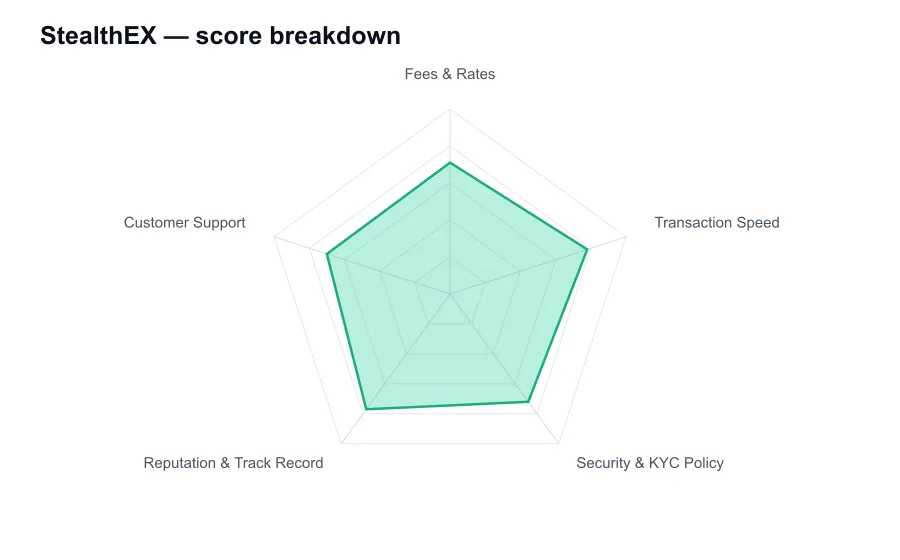
StealthEX is one of the better-known no-account crypto exchange aggregators. It does not try to replace Coinbase or Kraken as a full trading platform. Its job is narrower: find a route through liquidity partners, accept one asset, and send another to a wallet address. The service has built its identity around privacy, wide asset coverage, and a simple exchange widget, placing it squarely among the stronger brands in the instant-swap market.
The first thing StealthEX gets right is range. It supports hundreds of assets and a large number of exchange pairs, including mainstream coins, stablecoins, tokens, and network-specific assets that are awkward to source on a single centralized exchange. That breadth is useful for wallet users and for people consolidating small positions. It does not mean every route is equally good. The most obscure token pairs may involve several hops and a rate that makes a supposedly convenient swap expensive.
StealthEX acts as an aggregator rather than presenting itself as a single deep order book. It sources pricing from external partners and liquidity providers, then offers the customer a quote. This design helps it cover more pairs than many direct competitors. It also means the exact quality of an exchange can vary from one route to the next. A BTC to ETH quote may be sharp at noon and less attractive than ChangeNOW or a centralized exchange an hour later.
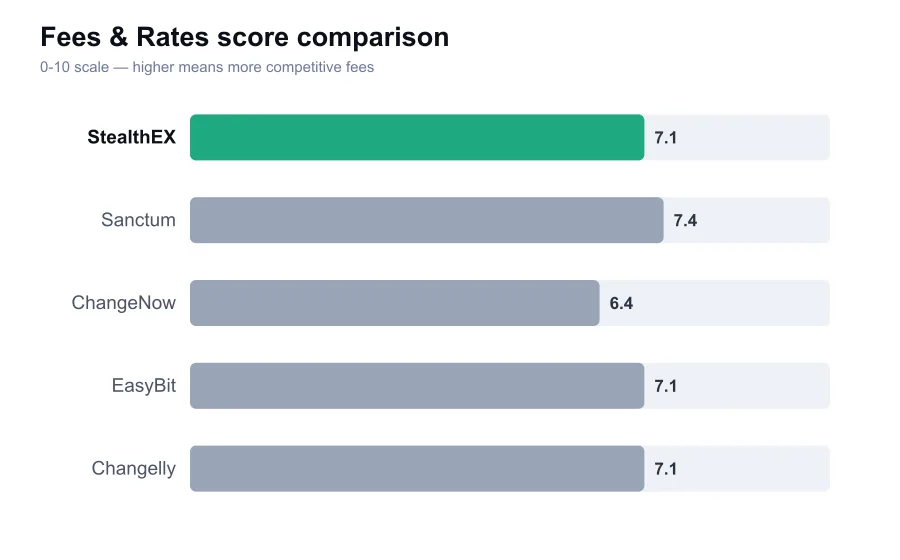
Fees are incorporated into the quoted rate instead of published as one universal visible commission. StealthEX has historically described service fees around 0.4 percent for floating exchanges and around 0.8 percent for fixed-rate exchanges, although actual economics also depend on provider spread and network fees. Those figures should be treated as a guide, not a guaranteed all-in tariff. The only number that matters is the final amount of coin expected in your receiving wallet, compared with competing live quotes.
The 0.4 percent floating-rate headline is reasonable for an instant, no-account service. It is not cheap compared with a spot market fee at a major exchange, where active users can pay a fraction of that. Yet it can be fair value if it saves a user a bank transfer, account approval, withdrawal wait, or a complicated chain of trades. Fixed-rate pricing is naturally dearer because somebody is absorbing market movement. I like that StealthEX gives users the choice rather than pretending volatility does not exist.
Small orders require special attention. A platform fee may be only part of the cost, while the outgoing miner fee on Bitcoin or Ethereum becomes disproportionately large. ERC-20 swaps are particularly easy to misjudge. StealthEX shows the expected payout and should be judged on that figure, not on the fee label alone. For a $50 test transaction, an order-book exchange can be meaningfully better if you already have an account. For a cross-chain conversion that would otherwise take several steps, StealthEX may still be the easier choice.
Speed is usually good on popular routes. After the deposit confirms, a liquid swap can arrive in a matter of minutes, and fifteen to thirty minutes is a realistic expectation for many common exchanges. A fast network does not guarantee an instant result because the provider still has to execute and broadcast the outgoing transaction. Bitcoin, Ethereum during congestion, and routes involving manual checks can take much longer. Anyone needing a payment by a hard deadline should not rely on optimistic marketing timers.
StealthEX offers both fixed and floating rates, and this is more than a cosmetic distinction. A floating transaction is exposed to the market between order creation and execution. If the incoming coin falls quickly, the delivered amount can shrink. Fixed rate gives a clearer expected payout for a limited period, but you need to send the correct amount promptly. Sending too little, sending too late, or using the wrong chain can turn a smooth swap into a support case.
The company emphasizes that it does not hold customer deposits as a conventional custodial exchange would. That is a real security benefit. There is no long-lived StealthEX balance that can be drained after a password compromise because the service is not designed as a wallet. Still, every exchange order passes through addresses controlled by the service or its partners. Users must verify the domain, protect their own receiving wallet, and understand that an instant exchange cannot reverse an on-chain mistake.
KYC is not generally required for ordinary use, and that is a major reason people choose StealthEX. The more accurate description is no mandatory upfront KYC, not absolute anonymity. StealthEX has an anti-money-laundering policy and can pause an exchange that its risk controls identify as suspicious. If it asks for documents, the fast and private experience that attracted the customer disappears immediately. This is an industry-wide weakness, but privacy-focused services should be unusually clear about it.
StealthEX has a stronger public track record than many small instant exchangers. It has been operating since 2018, has developed integrations and public-facing partnerships, and is regularly included in comparisons of non-custodial swap services. That longevity counts. It is still not a regulated bank-like institution, and it does not provide the public financial disclosures, audited reserves, or legal recourse associated with major licensed exchanges. Its reputation is good for its category, not equivalent to the biggest names in crypto.
User feedback follows a recognizable pattern. Successful orders are often praised for being quick and simple. Negative reports tend to involve a failed partner route, a payout below the user's expectation on a floating exchange, or an AML review. I do not dismiss those complaints just because blockchain transfers are irreversible. A service that sits between a customer and multiple liquidity providers must own the communication burden when something breaks. StealthEX is generally more visible and responsive than unknown aggregators, but it is not immune to frustrating edge cases.
Support is available around the clock through the website's chat and email channels, and the service provides transaction IDs for tracking. This is better than the silent support desks found at some tiny exchangers. Still, live chat availability does not guarantee that a compliance or provider issue will be resolved instantly. If an order is delayed, concise evidence helps: the deposit transaction hash, sent amount, network, destination address, and exchange ID. Do not send repeated deposits in an attempt to force an order through.
StealthEX is a credible option for users who need breadth, a no-login workflow, and a reasonable chance of fast settlement on a normal pair. It earns a higher place than many anonymous-looking swap sites because it has a longer operating record and a more mature product. I would use it for a normal wallet-to-wallet conversion after checking the quote, especially where a fixed amount matters. I would not treat its privacy language as a guarantee, and I would still move a large amount through a tested route or a major exchange with known liquidity.