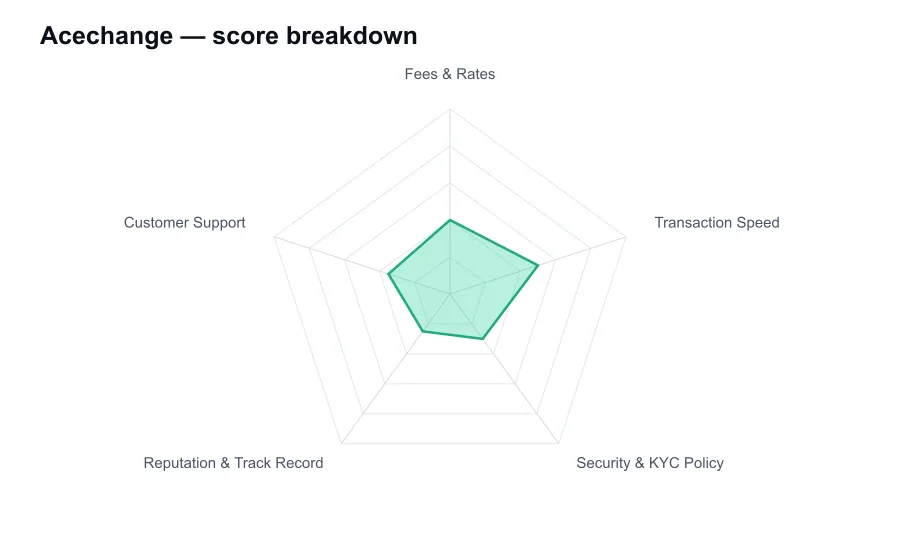
Acechange is the hardest provider in this group to assess confidently because its public footprint and independently verifiable operating history are far thinner than those of established exchanges or major DeFi protocols. That alone should shape the review. In crypto, a sleek interface, broad token list, and promises of fast swaps are not evidence of durable operations, strong custody, or reliable customer recourse. A provider has to earn trust with transparent ownership, clear legal disclosures, and a history that can be checked.
The name also creates confusion. It can be mistaken for similarly named services, including ACE-related exchanges and brands that are not necessarily connected. Prospective users should verify the exact domain, legal entity, support contact, and wallet destination before sending funds. Brand ambiguity is not a cosmetic issue in this industry. It is one of the easiest ways for scammers to benefit from search traffic and users who assume similar names represent the same company.
Acechange appears to position itself around quick crypto conversion rather than sophisticated order-book trading. If that is the service being offered, the practical question is not only the advertised exchange rate. Users need to know whether a quote is fixed or floating, whether the displayed rate includes a spread, which liquidity provider executes the trade, and whether there are minimums or maximums. Those details determine the real cost more honestly than a marketing claim about low fees.
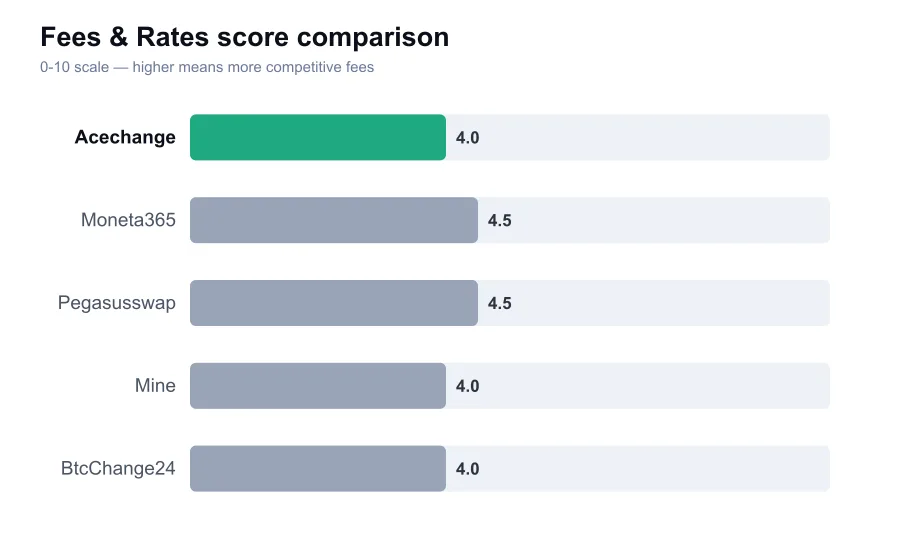
A service that does not publish a clear, durable fee schedule deserves caution. Instant-swap providers often charge through the rate spread rather than a plainly separated commission. That can be acceptable if the quote is competitive and transparent. It becomes a problem when a user cannot compare the expected output with the market rate, or discovers after initiating a transfer that the final amount may change. With limited independent evidence, I would assume nothing and test only with a tiny amount.
Speed claims should receive the same treatment. An instant exchange can generate a quote immediately, but the actual swap is constrained by deposit confirmations, liquidity availability, blockchain congestion, risk checks, and the receiving network. Bitcoin deposits can take considerably longer than a token transfer on a fast chain. Cross-chain trades add another layer of potential delay. A reputable provider explains these dependencies before it takes the deposit, rather than calling every transaction instant.
The most serious concern is security transparency. I could not treat Acechange as comparable with Kraken, Coinbase, Bitstamp, or even a well-documented decentralized protocol without public evidence about custody practices, company leadership, security controls, incident handling, and regulatory status. A user does not need every exchange to be a giant regulated institution. They do need enough information to understand who is receiving their funds and what protection exists if something fails.
KYC policy should also be read carefully, especially at services that advertise easy or registration-light swaps. No-KYC or low-friction access may sound attractive, but many instant exchanges reserve the right to stop a transaction for compliance review. If that happens after funds have been sent, the customer can be asked for identity documents, source-of-funds information, or transaction explanations. A platform should make those conditions clear before a user commits assets.
There is a meaningful difference between a platform that does not require account creation and a platform that never performs verification. The first can still apply screening at the transaction level. The second claim would be difficult to reconcile with sanctions compliance and fraud prevention in many jurisdictions. Users should not send funds on the assumption that anonymity is guaranteed, particularly when the service's published policies are unclear or hard to verify.
Reputation is where Acechange scores poorly, not because every lesser-known operator is automatically unsafe, but because reputation has to be built from evidence. Independent reviews can be manipulated, domain age proves little by itself, and social media activity is not a substitute for transparent business information. I would look for long-running public discussion, named executives, legal registration details, clearly maintained terms, and credible reporting of how the service handled disputes. Without that record, the user bears too much uncertainty.
Customer support is inseparable from that reputation problem. A simple swap service may handle routine transactions without human involvement, which is fine until a deposit is delayed, a memo is missing, a token arrives on the wrong network, or a compliance hold occurs. Then responsive support becomes the product. If a service does not offer a documented escalation process and multiple verifiable contact channels, customers have little leverage when a transaction goes wrong.
There are practical ways to reduce exposure if someone insists on using Acechange. Start with the smallest possible test transaction. Compare the quoted output against multiple alternatives such as 1inch, ChangeNOW, SideShift, or a liquid centralized exchange. Confirm the exact chain and asset contract, save the quote and transaction ID, and never send an amount you cannot afford to have delayed. Avoid using the service for urgent payments, large conversions, or funds needed for trading margins.
For larger sums, the case for a better-known provider is overwhelming. Centralized exchanges such as Kraken or Coinbase may require account verification, but they provide more established operational history, trading records, and support infrastructure. Decentralized aggregators such as 1inch let users retain wallet control, though they require more technical competence. Acechange's potential convenience does not adequately compensate for weak public transparency when the amount at risk is meaningful.
I am also wary of treating promotional claims as a substitute for execution quality. The best exchange rate means little if a provider later reprices a floating order, pauses the transaction, or provides no useful answer after a failed deposit. In crypto, the difference between a good service and a dangerous one often becomes visible only during an exception. Small, obscure services are least equipped to prove they handle exceptions well.
My take is blunt: Acechange has not established enough verifiable public credibility for me to recommend as a primary exchange or a home for significant funds. It may be usable for a tiny, carefully monitored test swap if its exact identity and policies are confirmed first. That is not an endorsement. It is a risk-control approach. Users who value certainty, support, or meaningful legal accountability should choose a provider with a clearer record.