Mine is a difficult provider to assess because the name is so generic that it does not point cleanly to one established, independently documented crypto exchange brand. Search results for "Mine" are crowded with mining services, wallets, tokens, apps, and unrelated businesses. That is not a cosmetic problem. Before anybody sends funds, they need to be certain which legal entity, domain, and operating team they are dealing with. A crypto service that cannot be identified unambiguously starts at a disadvantage.
I would not treat a logo, a Telegram handle, or a listing on an exchange monitor as proof that a particular Mine service is legitimate. Those channels can be useful discovery tools, but they are not a substitute for a clear corporate identity. There should be a consistent website, terms of service, privacy policy, support contact, and a record of the service's rate and reserve history. Without that trail, a reviewer cannot fairly call the operation established.
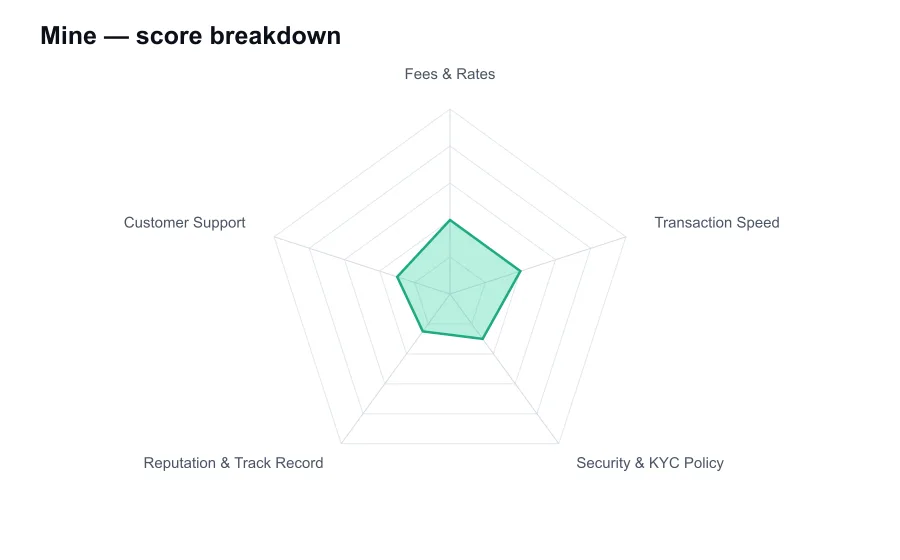
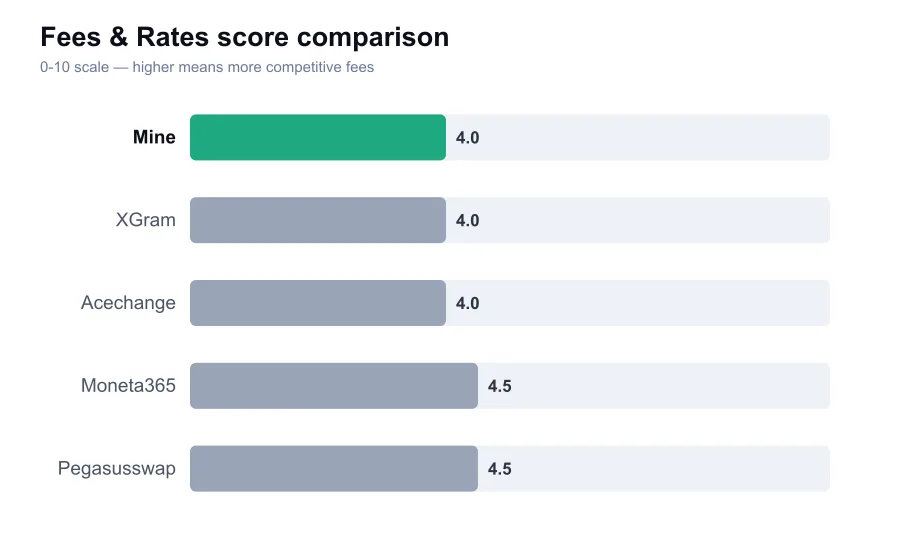
The fee picture is the first practical issue. I could not independently confirm a published, stable fee schedule tied to one identifiable Mine platform. Some small instant exchangers advertise a low percentage fee but recover most of their margin through the quoted conversion rate. That is not automatically deceptive, provided the customer sees the exact send amount and receive amount before paying. It becomes a problem if the rate shifts after funds arrive or if network charges appear only at the final step.
For a small crypto conversion, the only meaningful number is the all-in quote. Compare Mine's displayed payout against two or three large alternatives at the same moment, such as ChangeNOW, SimpleSwap, or a liquid spot market after withdrawal costs. If the gap is more than a modest convenience premium, the attractive headline fee is irrelevant. A provider with no independently verifiable fee page does not deserve the benefit of the doubt on pricing.
Speed claims require the same discipline. Non-custodial swap services can look fast because they begin processing as soon as the inbound transaction gets enough confirmations. Yet the real elapsed time depends on the chain, the token, the destination network, liquidity, and whether the trade is fixed rate or floating rate. Bitcoin transfers can take far longer than a quick stablecoin swap on a low-fee network. Promising universal instant settlement would be a red flag.
A responsible Mine service would show transaction status, deposit address, required confirmations, and a unique order ID that support can trace. It should also explain what happens if a customer sends an unsupported token, uses the wrong network, or pays less than the required amount. I could not verify those operational details from a sufficiently reliable public record. That means speed is not merely unproven, it is difficult for a prospective user to hold the provider accountable if a swap stalls.
Security is where the absence of verifiable information matters most. Crypto users should distinguish between a service that does not custody balances and one that is actually low risk. A non-custodial exchange may reduce the risk of a platform-wide account freeze, but it still temporarily controls the conversion path and can apply compliance screening. Users need a visible explanation of address screening, sanctions controls, suspicious transaction reviews, and the circumstances in which a payout may be delayed.
No-KYC marketing is often misunderstood. It rarely means a provider will never request information. Many exchange operators reserve the right to ask for identification, proof of source of funds, or wallet history if automated screening flags a transaction. That policy can be reasonable, but it must be written plainly before payment. If Mine presents itself as anonymous while retaining broad discretion to freeze an order, that would be an unacceptable mismatch between marketing and reality.
I would also look for basic site security signals, although they are only a starting point. HTTPS, a working status page, signed support messages, domain history, and documented phishing warnings all help. None replaces proof of controls. There is no widely visible public security audit, formal proof of reserves, or independently documented incident response record that I can confidently attribute to this particular Mine provider. For a business handling irreversible transfers, that is a major weakness.
Reputation cannot be built from a handful of anonymous review snippets. Small exchange brands sometimes collect positive comments quickly, while users with unresolved cases have little leverage and may never post a detailed report. The useful evidence is a long pattern of dated feedback, complaints answered in public, domain continuity, named operators, and credible references from communities that do not profit from referrals. Mine does not presently offer enough clear evidence on those points for me to rate it as a trusted veteran.
That does not prove misconduct. It does mean the burden should remain on the provider, not on the customer, to demonstrate consistency. Crypto is full of services that work perfectly for several small transactions and fail at the exact moment a user tries to exchange a larger amount. An obscure operation should be tested, if at all, with an amount one can afford to lose. It should not be used as the first destination for a large portfolio rebalance or a time-sensitive payment.
Support is another area where transparency matters more than a cheerful chat widget. A real support operation publishes response channels, working hours, expected response times, and a process for disputes. The customer should receive an order receipt and be able to provide a transaction hash without exposing unnecessary personal data. I could not independently establish Mine's support coverage, escalation route, or history of resolving stuck orders, so a high support score would be fiction.
If you decide to test the service, verify the exact domain through more than one trusted source, bookmark it, and never follow a sponsored search link blindly. Start with a tiny transaction. Save the quote, order ID, wallet addresses, and transaction hashes. Confirm that the destination wallet supports the asset and network before you pay. Those habits are sensible everywhere, but they are essential with a provider whose public identity is hard to pin down.
The strongest argument for Mine would be convenience, if the particular service behind the name offers a competitive live quote and completes a small test without friction. Convenience alone is not enough to offset opaque ownership, uncertain policies, and limited independent history. There are many bigger exchanges with their own shortcomings, but at least their fee rules, support routes, and compliance practices can be examined. Mine needs more public evidence before it can be recommended beyond cautious experimentation.
My view is blunt. The name's ambiguity makes this a research problem before it becomes a crypto exchange decision. I would not call Mine a scam on the information available, but I would not entrust it with meaningful funds either. Until a clearly identifiable Mine operator publishes transparent fees, legal details, security policies, and a sustained public track record, the sensible rating is cautious and below average.