Pegasusswap sits in the crowded instant crypto exchange market, where the pitch is simple: pick two assets, send a deposit, and receive the output without opening a conventional trading account. That model can be useful, especially for someone who wants to swap a coin quickly without handing an exchange a full profile. The problem is that this is a market where presentation can look more mature than the business behind it. Pegasusswap has not built the public footprint, independent review history, or long operating record that would make me comfortable treating it like an established name.
The site experience follows the familiar noncustodial exchange script. You select the asset you are sending, select the asset you want back, enter a receiving address, and get a deposit address. Pegasusswap is not functioning like Coinbase, Kraken, or Binance, where you keep a balance on the platform and place orders in an order book. It is an intermediary for a single conversion. That distinction matters because your transaction depends on its liquidity providers, its routing, and its operational controls at the exact moment you send funds.
The advertised appeal is a low-friction swap process. There is no obvious reason for a casual user to create an account for a small conversion, and that is a real convenience. But a no-registration flow should not be confused with a guarantee of anonymity. Blockchain transfers are public, and an exchange service can still pause a transaction under its compliance rules. Anyone using it because they believe no questions can ever be asked is taking a poor reading of how crypto compliance works in 2026.
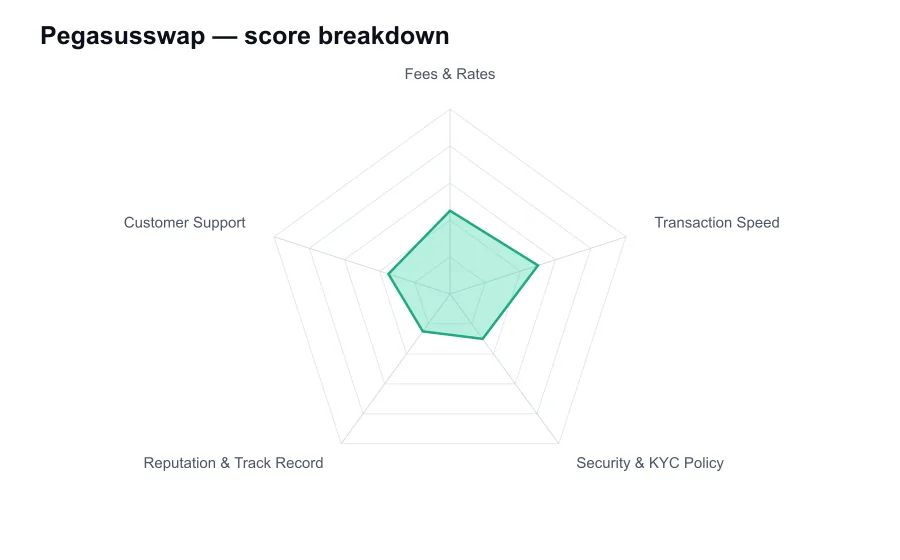
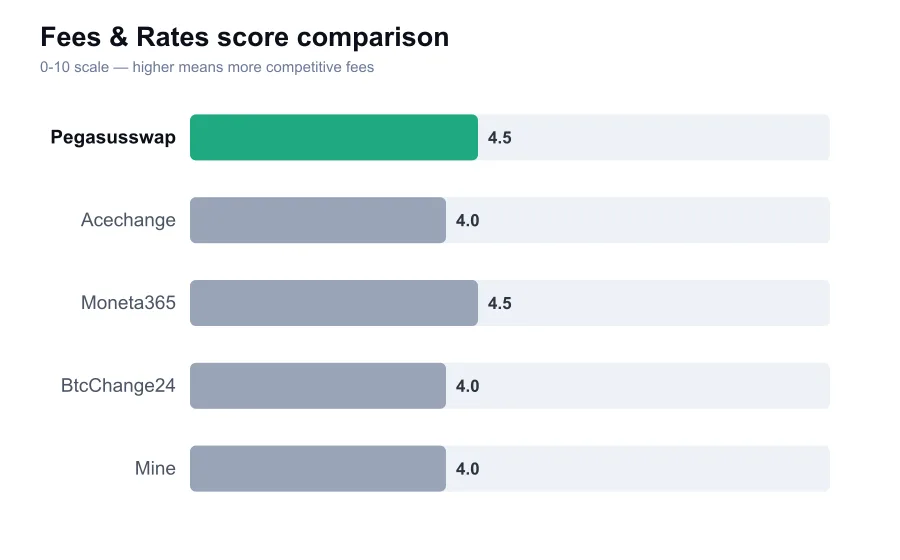
Fees are difficult to judge cleanly here because the exchange rate is the important number, not any headline promise of low fees. Instant swap providers often build their service charge and liquidity spread into the quote. You may also pay the network mining fee, and the final received amount can be affected by a moving market if you choose a floating-rate route. Pegasusswap does not have the kind of transparent, long-standing public fee documentation that lets a reviewer confidently state a flat percentage for every trade.
That does not automatically mean the quotes are bad. For a simple BTC to USDT or ETH to BTC swap, the visible amount can be perfectly competitive at a given minute. Still, I would compare the quoted output against Godex, ChangeHero, and Trocador before funding a transaction. Trocador is particularly useful as a benchmark because it can surface offers from multiple providers. If Pegasusswap is materially worse after network costs, there is little reason to reward uncertainty with extra spread.
Speed depends less on the checkout screen than on the asset and the route used. A swap involving Litecoin, Tron, or a well-confirmed stablecoin can finish fairly quickly once the deposit is credited. Bitcoin deposits may require multiple confirmations, and a conversion through a thinly traded asset can take much longer. A realistic expectation is minutes for straightforward routes, not an instant guarantee. Any provider that markets a crypto conversion as immediate is simplifying a process that includes blockchain confirmation and external liquidity execution.
There is a more serious concern than speed: what happens when a transaction does not proceed normally. Small swap services are easy to praise when the route is liquid and everything lands in ten minutes. The real test is an underpaid deposit, an incorrect memo, a rate change, a compliance flag, or a delayed payout. Pegasusswap does not have enough widely documented cases, both positive and negative, to give prospective users a clear picture of how consistently those exceptions are resolved.
Its security model also requires sensible user behavior. You should send only from a wallet you control, paste addresses carefully, and save the exchange ID, deposit transaction hash, quoted amount, and every support message. Do a small test first if the destination chain or token standard is unfamiliar. Never send a large first-time transaction simply because an interface looks polished. A clean design is not evidence of reserves, licensing, insurance, or operational resilience.
KYC is another area where users should read the terms rather than rely on marketing language. A service may allow ordinary swaps without account verification while retaining the right to request identity information if a transaction triggers anti-money-laundering checks. That can be frustrating, but it is common across this sector. The practical risk is that funds may be held while documents are reviewed. If your priority is predictable compliance handling, a regulated exchange with clear onboarding is a safer choice than an opaque instant-swap service.
Reputation is Pegasusswap's weakest area. It lacks the long public record of older services such as ChangeHero and Godex, and it is nowhere near as independently visible as an aggregator such as Trocador. Newer companies can do good work, but users should not have to infer reliability from branding alone. I want to see consistent third-party feedback over several market cycles, named company information, clear legal disclosures, and a meaningful history of resolved complaints before giving a provider a stronger reputation score.
Support appears to be centered on the normal ticket or contact-channel model rather than the extensive service infrastructure found at large custodial exchanges. That can be enough for a basic swap, provided the team answers quickly and has access to the transaction details. It is not enough to inspire confidence for a large amount. Before sending anything significant, test the support channel with a specific question about a network, minimum deposit, or stuck transaction procedure. The quality and speed of that reply tells you more than a generic help page.
There are also practical limitations hidden in the word "available." A coin listed in a selector may have a high minimum, limited route availability, or only a floating quote. Token tickers can be confusing, especially across Ethereum, BNB Smart Chain, Tron, and other networks. Pegasusswap users need to verify both the asset and chain at both ends. A wrong network can turn a cheap convenience swap into an expensive recovery effort, assuming recovery is possible at all.
I would not use Pegasusswap as a regular venue for meaningful portfolio moves. There is no clear advantage strong enough to offset its thin independent track record. For a technically capable user making a small, non-urgent test conversion, it may be workable if the live quote beats better-known alternatives. That is a very different recommendation from trusting it with a five-figure transfer.
My view is blunt: Pegasusswap has the shape of a convenient instant exchanger, but it has not yet earned the trust premium that its established competitors have earned. Low-friction access is attractive, and a good quote can make it tempting. Yet fees are not transparent enough, reputation evidence is limited, and support quality is hard to verify from the outside. Keep transactions small, document everything, and use an established provider or regulated exchange if certainty matters more than shaving a few minutes off a swap.