XChangic belongs to the small online exchanger category, a part of crypto where the service often looks simpler than the underlying trade. A customer selects two currencies, receives a payment address, and expects a payout. The mechanics are familiar, but the trust burden is substantial because the operator sits between two wallet transactions. XChangic is not a household-name exchange with a public order book or a widely documented corporate history. That does not disqualify it, but it should shape how a careful buyer uses it.
The first thing I look for with a lesser-known exchanger is whether the site answers basic questions before it takes a deposit. What rate is guaranteed? What happens if a transfer arrives late? Are network fees included? Can an order be paused for compliance review? What happens after a wrong memo, tag, or network is used? Mature services put these answers in plain language because support cannot rescue every preventable mistake. XChangic does not have the kind of easily verifiable documentation footprint that lets me give it the benefit of the doubt.
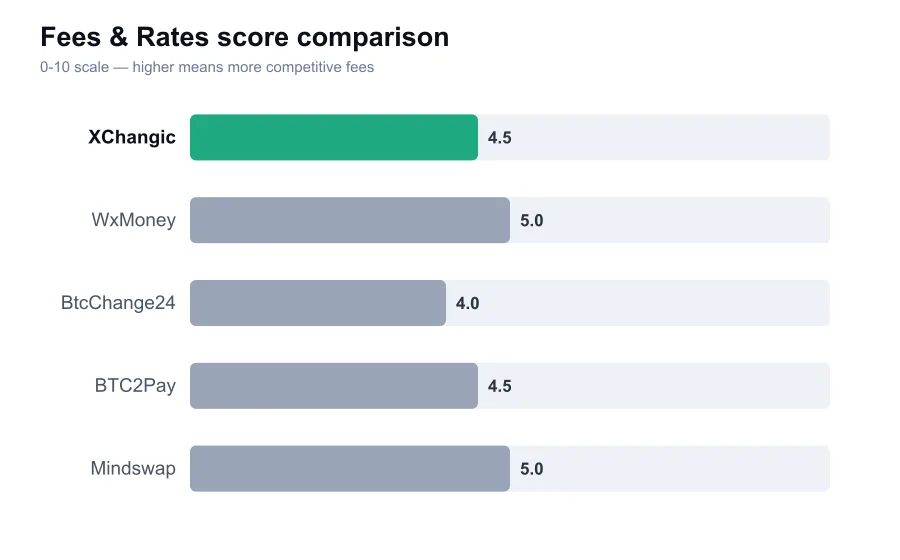
Fees are likely to be the decisive issue for people shopping among exchange aggregators and direct swap sites. The trouble is that a visible fee percentage, if one is shown, rarely captures the whole cost. The provider can price a spread into the conversion rate, pass through a network withdrawal charge, or change a quote once market conditions move. That is not inherently dishonest. It is simply why advertised zero-fee language means very little without a strong final quote. With XChangic, the quoted output should be compared against at least two alternatives at the same moment.
Use the exact input amount and the same network in every comparison. A USDT transfer on Tron, Ethereum, and Solana is not economically equivalent, even though the token ticker is the same. A cheaper-looking quote can vanish once a costly Ethereum payout fee is accounted for. For Bitcoin, compare the actual satoshis received and check whether the service gives a payout transaction ID after completion. XChangic has not established enough pricing transparency for me to call it a bargain by default. It may occasionally produce a good rate, but that must be verified per order.
Speed claims need the same discipline. Blockchain settlement is a chain of events, not a timer on a website. Your deposit must be broadcast, confirmed, recognized by the exchanger, traded or matched against liquidity, and then paid out. On Bitcoin, confirmation timing can vary widely with the network fee chosen by the sender. On Ethereum, gas conditions matter. A provider can control its own processing but not the first part of that sequence. Any promise of instant delivery should be read as an aspiration, not a guarantee.
XChangic may work smoothly for standard assets on a normal day, but I could not verify enough independent, dated operational evidence to credit it with consistently exceptional execution. That matters more for volatile coins. If the trade is floating-rate, a delay exposes the customer to price movement. If it is fixed-rate, the provider needs clear rules about the deposit window and allowed amount variance. Do not send a transfer from an exchange until you know whether the source platform may batch withdrawals or delay them beyond the quote window.
Security here is mostly about counterparty discipline. The safest wallet is the one whose private keys you hold, but a swap requires relinquishing control during the transaction. That is why phishing prevention is essential. Type the site address yourself, bookmark a verified page after checking it, and never trust a search advertisement or a direct message offering help. Crypto users lose funds this way every day, and a small exchanger's brand can be imitated far more easily than a major bank's.
There is also a compliance issue that marketing copy often blurs. A service can avoid upfront registration yet still apply automated transaction screening. If a deposit is associated with a high-risk address, a sanctioned entity, or a pattern the provider cannot clear, it may seek identification or hold the order while reviewing it. This is not a theoretical concern for customers who receive coins from peer-to-peer trades, gambling sites, mixers, or unfamiliar counterparties. XChangic should be approached with the assumption that a no-account flow does not remove compliance risk.
I would be particularly reluctant to use it for assets with tricky recovery procedures. XRP requires a destination tag in many cases. XLM uses memos. Tokens can exist on multiple networks. A mistaken transfer may be recoverable, but recovery usually involves manual work and can carry a fee. With a provider that lacks a highly visible support reputation, that is too much avoidable exposure. Stick to a straightforward chain and a well-known asset if you decide to test the service at all.
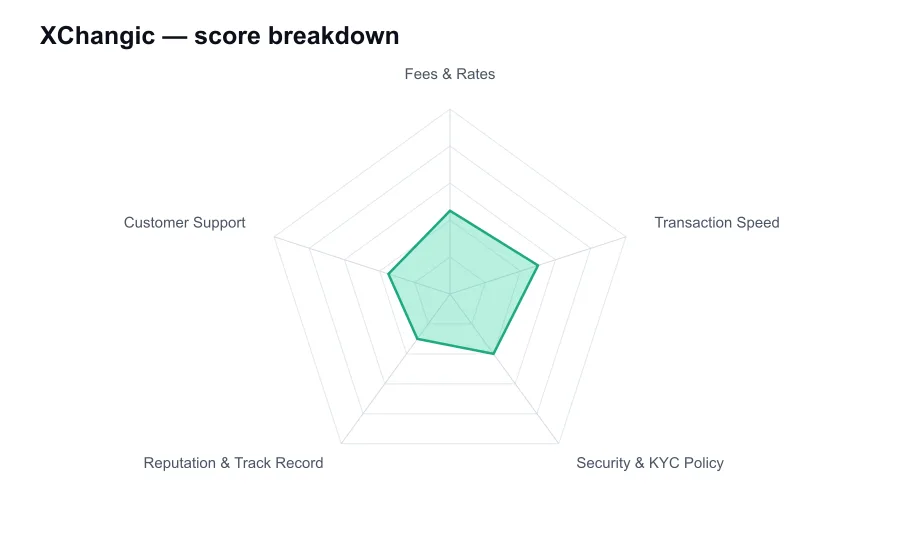
Reputation is XChangic's weakest category. I have not found a broad, independently auditable record comparable to the better known instant-swap brands, nor the institutional disclosures expected from a regulated centralised exchange. A brand can be new and honest, of course. Yet newness is not a feature for someone selecting where to send cryptocurrency. Time in the market, publicly addressed complaints, transparent leadership, and durable third-party review histories are the details that convert a simple interface into a credible financial service.
Customer support is tied to that reputation. In a successful swap, nobody needs support. In an unsuccessful one, a generic contact form becomes a test of whether the company has real operating capacity. Before funding an order, see whether there is a support address, an order-status mechanism, and a published response process. Ask a simple pre-sale question if time permits. A useful answer should be specific and coherent, not a copied assurance that every transaction is automatic. If support cannot explain confirmation requirements before a deposit, do not expect it to explain a problem afterward.
There is a sensible way to use XChangic if you decide its quote is attractive. Begin with a test amount that is large enough to prove the process but small enough that a delay would not hurt. Do not combine it with a deadline, a leveraged position, or a tax-sensitive event. Record the source transaction hash, destination address, amount, timestamp, and screenshots of the offer. Wait for the payout to arrive and verify it on the destination chain before repeating the process.
For merchants, freelancers, and people converting a meaningful payment, I would look elsewhere. Those users need predictable receipts, auditable transaction history, reliable support, and clear rules around compliance holds. XChangic is closer to a convenience tool than a dependable financial counterparty. That may be enough for an experienced user making a low-stakes swap, but it is not enough to justify routine reliance.
My view is blunt: XChangic has not supplied the public proof needed to overcome the normal risks of a small crypto exchanger. A good individual quote does not answer questions about held funds, recovery mistakes, or dispute handling. It can be trialed with caution, provided the customer understands that a completed test is not the same as a long-term reliability record. For most people, paying a little more for a recognizable provider with clearer policies is the more rational trade.