CryptoVortex sits in a difficult part of the exchange market because the name itself has far less public recognition than established instant-swap services such as ChangeNOW, SimpleSwap, StealthEX, or Changelly. For a customer, that means the burden of due diligence is higher from the first click. A lesser-known service can still provide a legitimate exchange route, but it has not earned the automatic trust that comes with years of independently visible operation.
The basic proposition appears to be a straightforward crypto conversion service. That model is attractive because it avoids the clutter of a conventional exchange account. You select a pair, provide a receiving address, send the deposit, and wait for delivery. It is a sensible structure for users who already hold crypto in self-custody. It is not a replacement for a trading venue with deep liquidity, advanced order controls, custody reporting, and a clear regulatory footprint.
My chief concern with CryptoVortex is not that a small exchange service must be bad. It is that publicly verifiable information is thinner than it should be for a business receiving irreversible crypto payments. Before using any such provider, a customer should be able to identify the operator, locate clear terms, understand the complaint process, and find independent discussion extending beyond promotional reviews. If those basics are difficult to verify, caution is not paranoia, it is competence.
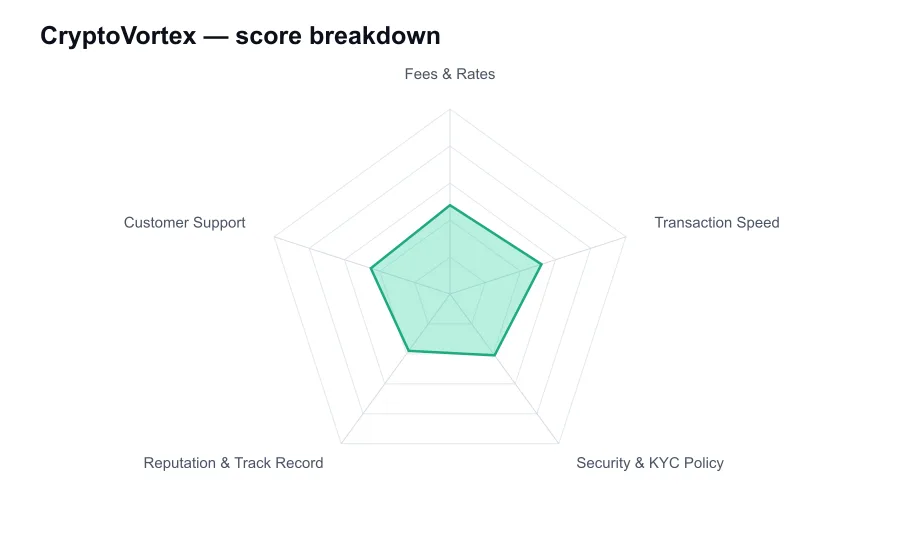
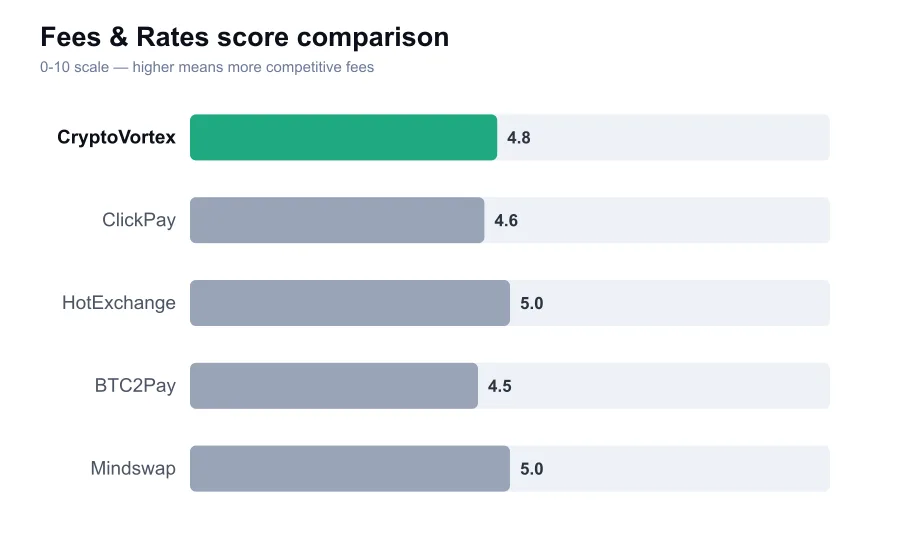
Fee transparency is especially important here. Smaller instant exchangers often advertise a low or zero service fee while earning through the rate spread and through upstream liquidity partners. That can produce a fair result for one pair and a poor one for another. Unless CryptoVortex publishes a precise all-in fee model for the selected route, assume the quote is the only meaningful price. Compare the expected delivery against at least two reputable alternatives before depositing.
This approach matters most with popular pairs such as BTC to USDT, ETH to USDC, or SOL to USDT. These markets are liquid, so an unusually weak quote has little excuse. Less common tokens, obscure networks, and small-value orders can have wider spreads because fixed network costs and liquidity sourcing matter more. A service that does not make this distinction clear invites customers to confuse a technically successful exchange with a competitively priced one.
Speed claims also need a reality check. No instant exchange can send the output safely before it recognizes the incoming deposit and, where appropriate, receives the required network confirmations. Bitcoin transactions can take a while. Ethereum fees and mempool conditions can alter timings. If the service uses a third-party liquidity provider, another layer exists between your deposit and final payout. The phrase instant should describe a simple workflow, not an unconditional settlement guarantee.
A sensible expectation for a normal crypto-only order is anything from several minutes to well over an hour, depending on chain conditions, pair liquidity, and internal review. If an order remains incomplete after the inbound transaction has enough confirmations, the useful questions are specific: has it been credited, is a liquidity partner processing it, has an output transaction been created, and what is the transaction hash? Support that cannot answer those questions is not giving meaningful support.
Security is where CryptoVortex scores poorly by comparison with mature providers, mainly because a customer has fewer public signals to evaluate. A polished site, a padlock icon, and a non-custodial label are not enough. Non-custodial usually means the service does not hold a standing balance for you. It does not mean there is no counterparty risk during the period after you send your deposit and before the outbound transfer reaches your wallet.
KYC policy deserves the same skepticism. Some instant services permit routine crypto swaps without account registration, but nearly all reserve the right to request documents if anti-money-laundering systems flag a transaction. If CryptoVortex describes itself as no-KYC, read that as low-friction for ordinary activity, not as an absolute contractual right. Never send funds that you cannot afford to have temporarily delayed if a review is triggered.
The lack of a strong, well-documented public track record is the central reputational issue. Long-lived competitors have thousands of externally visible reviews, known complaint patterns, public social channels, and years of searchable user discussion. That evidence is imperfect, but it allows a reviewer to assess how a company handles bad days. CryptoVortex has less of that evidence available, so its trust score must be conservative even if an individual order appears to go well.
For that reason, I would avoid making CryptoVortex the first stop for a large transaction. Start with a small amount, use an address from a wallet you control, and verify the output network with care. Do not use borrowed money, a deadline-sensitive transfer, or a first-time swap involving an unfamiliar token. This is not unique advice for CryptoVortex, but it is much more important where the operator's track record is hard to independently establish.
Support should be treated as a test rather than an afterthought. Contact the official support route before sending a meaningful amount and ask a concrete question about the selected network, minimum deposit, or rate type. A useful reply should be prompt, coherent, and consistent with the site terms. Do not rely on a direct message from an unofficial social-media account. Impersonators target lesser-known exchange brands precisely because users have fewer reference points.
CryptoVortex may appeal to someone hunting for a particular token route, but that is not sufficient reason to trust it with meaningful capital. An unfamiliar service must offer something concrete, such as a distinctly better supported network or a genuinely better all-in quote, to offset its lower transparency. If it does not, the safer decision is simple: use a better-known competitor with a more visible operating history and clearer help channels.
My view is blunt. CryptoVortex has not accumulated enough readily verifiable public evidence to earn a strong recommendation. It may complete ordinary swaps, but a reviewer should not confuse possibility with confidence. Use it only after independent checks, only for a small test, and only if its quote or route is materially better than recognized alternatives. For most users, the marginal convenience is not worth the additional trust risk.