Changee occupies the instant-crypto-conversion niche rather than the full-service exchange category. That distinction matters. A conventional exchange offers accounts, order books, balances, advanced trading tools, and often fiat rails. A swap provider tries to remove most of that friction: choose the coins, send the deposit, and receive the output in a wallet. For users who already hold crypto, that can be a useful format, but it also requires careful attention to the quote.
Changee is more usable than the obscure providers in this comparison because its product proposition is at least familiar and easy to understand. It aims at direct wallet-to-wallet exchanges rather than active trading. Still, it does not have the same public recognition, regulatory presence, or deeply documented record as major centralized exchanges such as Kraken, Coinbase, or Binance. That should shape expectations from the start.
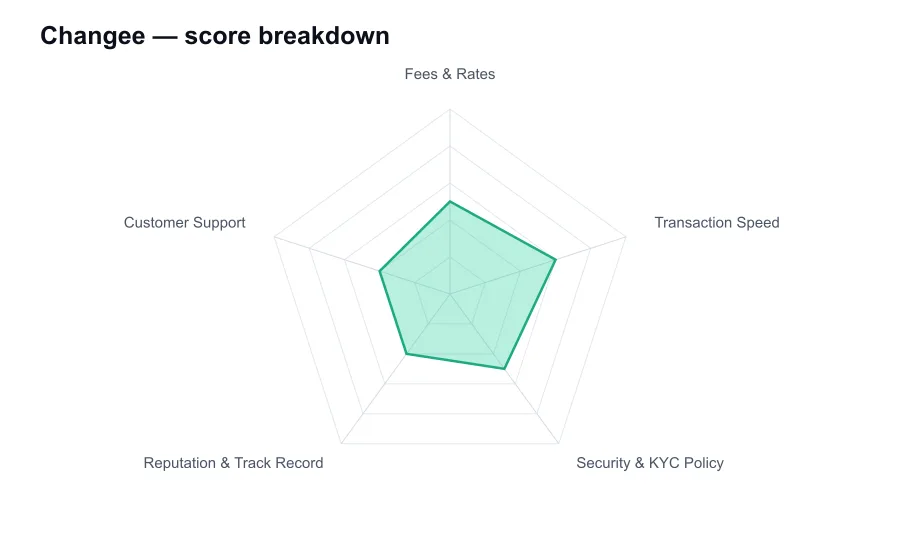
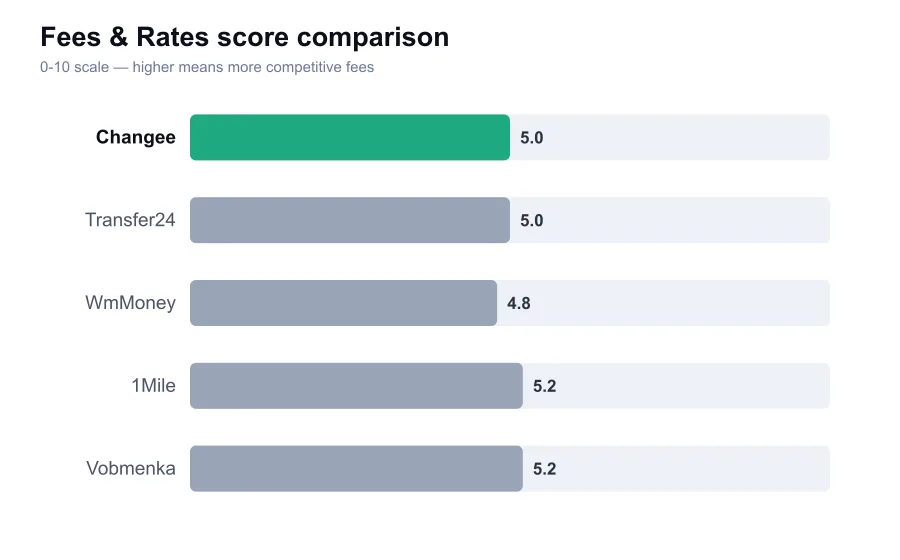
The fee question is not answered by looking for one advertised percentage. Instant exchange providers commonly embed a portion of their charge in the rate. Changee users should focus on the exact receive amount shown before payment, plus the sending-network cost from their own wallet. A quoted rate that looks close to market may still include a meaningful spread, particularly on small trades or lower-liquidity assets.
For common pairs, compare Changee's final quote against at least two alternatives. A practical benchmark is an established swap service such as ChangeNOW or SimpleSwap, then a liquid spot-market route if the user has an exchange account. The spot route can be cheaper for larger amounts, but it takes more steps and may involve withdrawal fees. Changee's value lies in convenience, not in any assumption that it will always produce the best rate.
The distinction between floating and fixed rates is crucial. A floating exchange can provide a better opening quote, but the amount received may change as the deposit confirms. A fixed rate can reduce that uncertainty for a defined period, though it may include a premium. Before sending, users should verify which rate type is selected, the deposit deadline, the minimum amount, and what happens if the deposit arrives late or short.
Speed should be judged realistically. Changee cannot make Bitcoin confirmations instantaneous, nor can it remove congestion from Ethereum. A normal swap's duration depends on the incoming chain, the asset pair, liquidity source, internal checks, and outgoing-chain conditions. Fast networks can produce a quick experience, while BTC and some ERC-20 routes can take considerably longer. Any service promising identical speed for every asset is overselling.
Changee is best suited to standard, liquid swaps that do not carry a hard deadline. If an exchange is needed to meet a payment window, move a business treasury, or react to a sharp market move, a provider with a fuller support infrastructure and clear execution controls is preferable. The convenience of an instant converter disappears quickly if the customer is waiting through a delayed payout with little ability to intervene.
On security, Changee has the general advantage of a swap-style model: customers need not leave a long-term trading balance on the platform if they send from one self-custodied wallet and receive into another. That reduces one kind of custodial exposure. It does not erase operational risk during the transaction itself. The provider still receives the deposit, routes the conversion, and controls the payout process until the swap is complete.
Customers should verify the official site independently, avoid links from unsolicited messages, and double-check token contracts and network selection. USDT and USDC exist on multiple chains, while assets with similar names can be counterfeit. An error in network choice can be costly even with a legitimate provider. Use a hardware wallet for meaningful holdings where possible, and save the swap ID, quote, deposit hash, and payout hash.
KYC policy deserves direct attention. A service that allows a swap without creating a regular account may still apply transaction-monitoring rules and request identification in certain circumstances. That is standard across much of the industry. It should not be mistaken for a promise of anonymity. Users who require certainty about verification should read Changee's current terms before depositing and avoid sending assets that cannot remain unavailable during a review.
Changee's reputation is middling rather than disastrous. It is more recognizable as a swap brand than the least documented names in this review, but it has not earned the same institutional confidence as the major exchanges. That leaves it in a workable but cautious category. A customer can reasonably consider it for ordinary personal swaps after comparing quotes, but not treat it as a default venue for all crypto activity.
Support is where this middle-ground status shows. Swap services need to handle wrong memos, delayed deposits, wallet maintenance, and compliance queries, not merely answer pre-sale questions. Before using Changee for a meaningful amount, check the currently published support channels and transaction-tracking tools. Use official channels only. A genuine agent will never need a wallet seed phrase, private key, or remote control of a device.
I would use Changee only for a clearly priced, non-urgent conversion where the final receive amount compares well with alternatives. It can make sense for an experienced self-custody user who wants to avoid transferring funds through a centralized exchange account. It is a weaker fit for beginners who need phone-level handholding, for traders chasing the tightest spreads, and for people who require strong regulatory protections.
Changee is neither a service I would dismiss outright nor one I would put ahead of established leaders without checking the numbers. Its wallet-to-wallet convenience is real, and the format can reduce unnecessary account friction. The trade-off is a thinner public trust cushion, rate-spread uncertainty, and less certainty around exception handling than a major exchange offers. Use it selectively, verify every detail, and keep large or deadline-sensitive transfers elsewhere.