Vobmenka is the sort of compact exchange service that appeals to users who want a direct conversion rather than an account-heavy trading experience. Its likely audience is practical: someone moving between digital assets and local payment methods, often for a single purpose rather than speculation. That can be a perfectly legitimate need, but it demands a different kind of caution. The user is choosing a counterparty and a rate at the same moment, without the protections and disclosures expected from a large global exchange.
The name and format place Vobmenka in a crowded market of regional exchangers. In that market, a clean order page and a list of available directions are only the beginning of the review. The meaningful questions are whether reserves are real, whether the payout calculation is stable, whether the team responds when a transfer goes wrong, and whether there is enough independent history to assess the answers. Those questions matter more than a colorful rate widget.
Its pricing should be read as a final-output proposition. The provider may earn through the spread between market price and its quoted rate, through a visible fee, or through both. For a customer, the distinction matters less than the exact payout. If you are selling crypto, compare how much fiat reaches your receiving account. If you are buying crypto, compare how much arrives at your wallet after every network and service charge. This is the only fair comparison between Vobmenka and alternatives.
I would be wary of assuming that a listed reserve means a large order will receive the same rate. Reserves can be operational rather than instantly spendable, and a service may need manual confirmation for an amount that is large relative to the route's normal traffic. Ask about limits before funding a major order. A quote that looks excellent for a small test may become less attractive once the transaction crosses a payment-provider threshold or requires a different settlement channel.
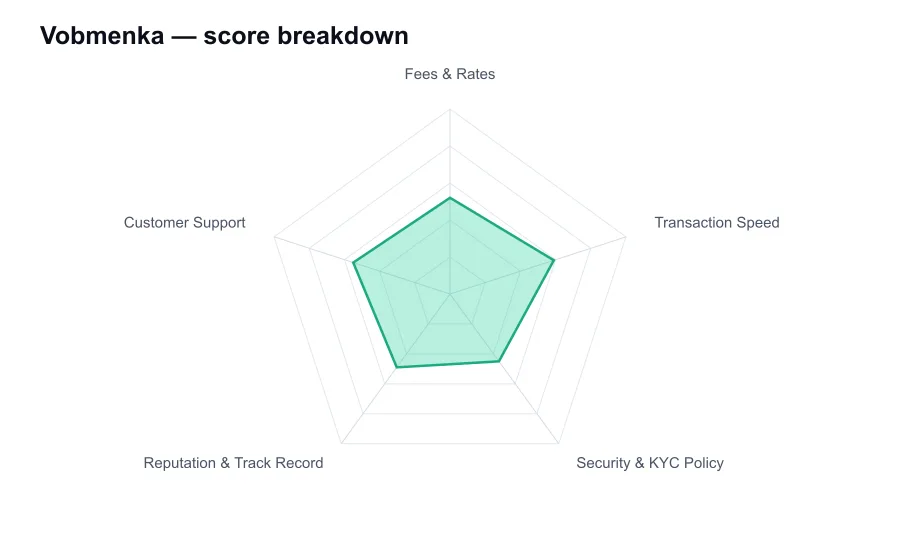
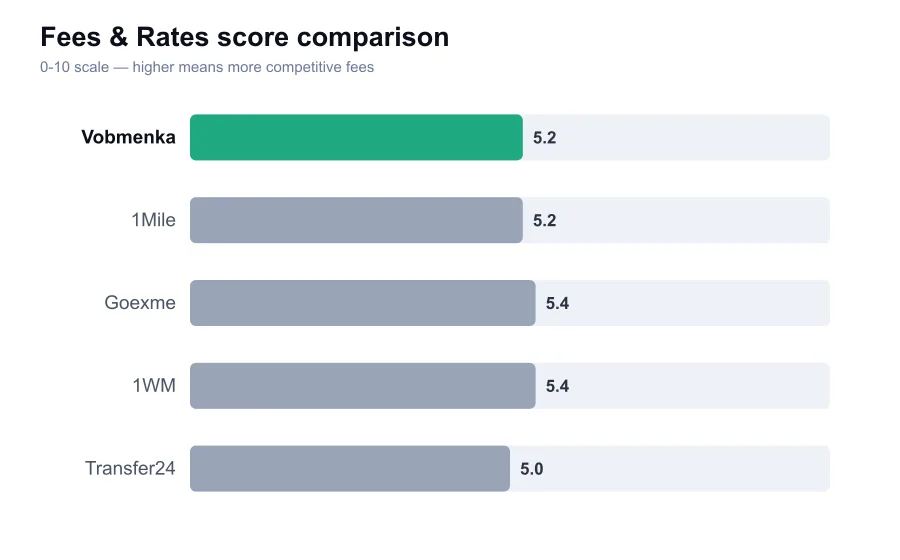
Vobmenka's fee score is middling because the small-exchanger model rarely provides the auditability of a published maker-taker schedule. That is not unusual, but it is a real disadvantage. A transparent venue lets a trader calculate costs before entering an order. Here, the customer must perform that work manually. If the service is not clearly cheaper in final payout, there is little reason to accept the additional counterparty risk instead of using an established exchange and a bank withdrawal.
Processing speed is likely route-specific. Crypto-to-crypto exchanges can be fast after the inbound deposit confirms, assuming the service has enough inventory and its risk filters do not intervene. Fiat directions have more moving parts. Bank hours, receiving-bank checks, card processing, and payment reference errors can all add delay. A claim that an order takes a few minutes should be interpreted as an ordinary-case target, not a service-level agreement.
The most common user error is treating an exchange request as irreversible before the provider has actually received the funds. Send the exact amount requested, on the correct network, and include the required payment reference where applicable. An incorrect network can be difficult or impossible to recover from. A slightly wrong amount can turn an automatic order into a manual one. That is not unique to Vobmenka, but smaller services have fewer automated recovery processes and less capacity for lengthy exceptions.
Security is a concern because public assurance appears limited. For a high security score, I would want credible details about the operating entity, wallet management, access controls, incident history, and preferably independent verification. I cannot treat generic promises of safety as a substitute for those things. Users should assume that assets are exposed to counterparty risk between payment and settlement, then reduce that exposure by keeping order sizes sensible and withdrawing received crypto promptly.
No-registration or light-registration workflows can be convenient, but they should not be marketed to oneself as guaranteed no-KYC use. Vobmenka, like other services handling financial transfers, may request documents where an order triggers AML, sanctions, fraud, or source-of-funds checks. The practical consequence is simple: do not send money if you cannot satisfy a reasonable verification request. The worst time to discover this policy is after the provider has control of your funds.
Before using Vobmenka, I would read its terms specifically for rate changes, refund conditions, identity checks, and order cancellation. Refunds in this market are rarely frictionless. A provider may return crypto less network costs, ask for verification before a fiat refund, or require the customer to prove ownership of the sending account. None of that is inherently improper, but unclear language is a warning sign. A trustworthy exchange makes the unhappy path as understandable as the happy one.
Its reputation should be treated as developing rather than established. Vobmenka does not have the broad, internationally visible record of a long-standing regulated platform, and that limits how much confidence a reviewer can derive from public information alone. Independent monitoring-site entries can be useful, but only after checking that they match the exact website, have recent activity, and contain substantive customer reports. Copycat names and stale directory pages are common in this sector.
A credible reputation is visible in how a provider handles a bad day. Look for detailed replies to complaints, with order references obscured for privacy but the resolution explained. See whether users describe repeated successful transactions over time, not just one small exchange. Be skeptical of review bursts, especially if every comment uses the same tone. Good service produces imperfect feedback. A spotless page with no nuance is less persuasive than a mixed record of specific issues handled competently.
Support is the category where Vobmenka could make or lose a customer's trust quickly. A small team can provide unusually personal help if it is attentive, but it can also be unavailable outside a narrow schedule. Test the contact channel before you need it. Ask a concrete question about a route, a limit, or the fixed-rate window. If the answer is generic or evasive before payment, there is little reason to expect better communication after an exception.
Vobmenka is not an automatic rejection, but it is a service to use with an operator's mindset. Verify the live payout, send a small first order, maintain records, and do not confuse limited onboarding with zero compliance risk. It may serve a niche route efficiently, particularly for an experienced user who knows the payment system involved. I would still favor a larger, more transparent platform for substantial amounts, recurring business flows, or any transfer where a delay would be financially damaging.