Goexme is a smaller instant crypto exchange service that aims to make wallet-to-wallet swaps simple, without the registration-heavy experience of a centralized trading platform. It occupies a much less proven corner of the market than established names such as StealthEX, ChangeNOW, or SimpleSwap. The basic proposition is familiar: select an asset pair, send funds to a generated address, and receive the converted asset. The real question is whether its lower public profile is compensated for by better pricing or service. Usually, that needs to be demonstrated order by order.
A compact brand is not automatically a bad brand. Smaller services can be useful where they provide a particular pair, network route, or quote that larger competitors do not. The problem is that crypto users often mistake a polished exchange form for evidence of deep liquidity and mature operations. Goexme should be approached as an intermediary, not as a household-name exchange. Before sending funds, verify the exact domain, the receiving network, the stated minimum, and the payout estimate.
The site is designed around a direct exchange flow rather than charts, custody accounts, or advanced trading tools. That makes it accessible for a newcomer who only wants to convert one asset into another. It also leaves little room for price discovery. You are accepting a package quote rather than setting a limit order or seeing competing orders. For users who already hold assets in self-custody, that can be convenient. For anyone who trades regularly, it is a restrictive and potentially costly format.
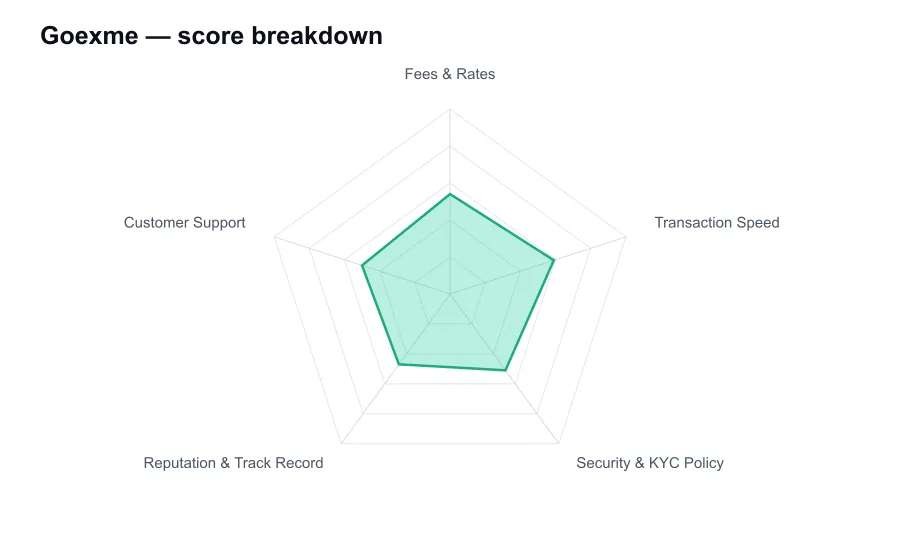
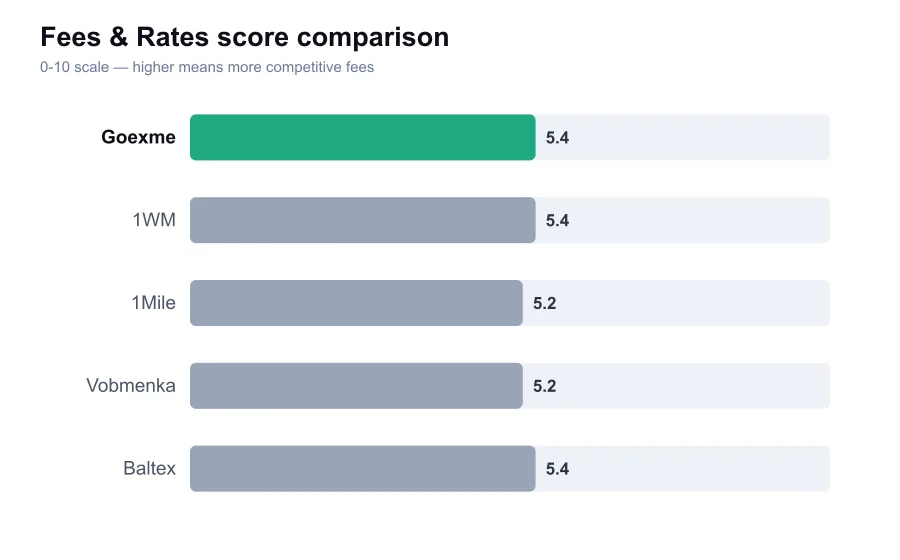
Goexme does not offer the sort of transparent, universally published trading-fee schedule that a traditional exchange provides. The cost is principally embedded in the exchange rate and can include network fees, liquidity-provider margins, and the service's own spread. This is not unique to Goexme, but it matters more at a lesser-known provider because there is less independent history showing how consistently competitive its routes are. Do not infer a low cost from a low visible fee. Compare the exact expected output.
On heavily traded assets, a live Goexme quote may be adequate, especially if it solves a practical network problem. But there is no reason to give a little-known exchange automatic loyalty. Open quotes from StealthEX, Quickex, ChangeNOW, and a liquid centralized exchange where possible. If Goexme pays materially less, its convenience is not a compelling defense. If it pays more, check that the rate type, network, confirmation requirements, and final delivery conditions are actually comparable.
Small orders are where opaque quote systems most often disappoint. A Bitcoin network fee, an Ethereum gas cost, or a provider minimum can consume a significant share of the transaction. A user may see an exchange that appears to carry no visible commission and still lose far more than expected through the all-in rate. Goexme should be used with a calculator, not just optimism. Divide the difference between the market value sent and the expected payout by the amount sent, then decide whether the shortcut is worth it.
Speed depends on far more than the exchange's interface. A swap cannot be completed until the deposit reaches the required blockchain confirmations, and the outgoing transaction then needs to be broadcast and confirmed. On liquid routes using fast networks, completion may take minutes. Bitcoin deposits, overloaded Ethereum blocks, low-liquidity assets, and a routing issue can push the process much further out. Goexme does not have the public scale or visible infrastructure record that would make me especially confident about handling unusual execution problems quickly.
It is sensible to treat the quoted completion time as an estimate, not a commitment. This is especially important if you are buying an asset to meet a deadline, move collateral, or make a payment. Do not send money to an instant exchanger at the final minute and assume that a five-minute estimate is a guarantee. Use a tested route for urgent transfers. If you do use Goexme for the first time, a small test exchange is cheap insurance and reveals whether the address flow and support process work as advertised.
The service is presented as a non-custodial or account-light exchange experience. That is preferable to depositing coins into a long-term balance at an unfamiliar platform. Yet users should understand the limited meaning of that label. During execution, funds still move through addresses and counterparties outside the user's control. The safest practice is to provide a self-controlled destination wallet, never reuse a deposit address unless instructed, and avoid leaving any funds waiting on the service beyond the active order.
Goexme's privacy appeal is the lack of routine signup for normal exchanges. As with practically every legitimate service that touches crypto liquidity today, this is not a promise that every transaction will avoid verification. Risk screening can lead to an order hold and a request for identity or source-of-funds information. A small provider's policy wording and public compliance detail do not give customers much visibility into how these cases are handled. That uncertainty lowers my security score even if the standard flow is simple.
There is also less public information to assess than with a mature exchange. I do not see the level of public security reporting, external auditing, reserve evidence, licensing footprint, executive visibility, or long-running independent coverage that would justify a high trust rating. Absence of that material does not prove misconduct. It does mean the burden shifts to the user. Crypto has taught this lesson repeatedly: a service should not be trusted with more value than its transparency and history can reasonably support.
Goexme's reputation is therefore its weak point. It may have successful users and functional routes, but it lacks the long, broadly documented track record that makes a reviewer comfortable recommending it for substantial transfers. Search results, isolated rating snippets, and affiliate comparison pages are not enough. Look for recent, detailed reports involving the exact type of swap you intend to make. Pay close attention to how the service responds to delays, refund requests, mistaken network deposits, and compliance reviews, rather than only to five-star comments.
Support appears to be centered on online contact methods and transaction-specific assistance rather than a full service desk with robust escalation. That can be sufficient for a straightforward order, because the key facts are on-chain and easy to identify with an exchange ID. It is less reassuring if an order is stuck between providers or documents are requested. Keep all records before contacting support. A clear ticket with the transaction hash, order identifier, amount, network, and destination is much more likely to get traction than a vague complaint.
My view is blunt: Goexme can be considered for a small, non-urgent exchange if its live quote is genuinely better and you have verified the route carefully. It has not earned the trust premium required for a large transfer, a hard deadline, or funds you cannot afford to have tied up. More established instant exchangers already offer similar convenience with deeper public operating histories. Until Goexme provides stronger evidence of pricing consistency, security practice, and support performance, caution is the rational default rather than an insult to the product.