Baltex is a relatively small instant crypto exchange service aimed at people who want to swap coins without opening a trading account or learning a full exchange interface. It sits in the same broad category as ChangeNOW, Changelly, and FixedFloat, but it doesn't have their market visibility or long public history. The site is simple, the exchange flow is familiar, and the pitch is convenience. That can be enough for a small one-off conversion. It is not enough, by itself, to earn the same confidence I would give an established exchange brand.
The basic process is straightforward. Choose the asset you are sending, select the asset you want back, enter a receiving wallet address, and send the quoted amount to the deposit address. Baltex acts as an intermediary, sourcing liquidity and routing the conversion rather than operating like an order-book exchange. You don't need to park a balance on the platform, which is a meaningful advantage over leaving funds sitting on a lesser-known centralized exchange.
That noncustodial framing needs to be understood correctly. Baltex may not ask you to create an account before an ordinary swap, but it still receives the asset you send and controls the process until it pays out the destination asset. If an order is delayed, flagged, or sent with an incorrect memo or network, the user is dealing with Baltex support rather than simply cancelling an open order. Calling a service noncustodial doesn't remove counterparty risk during the swap.
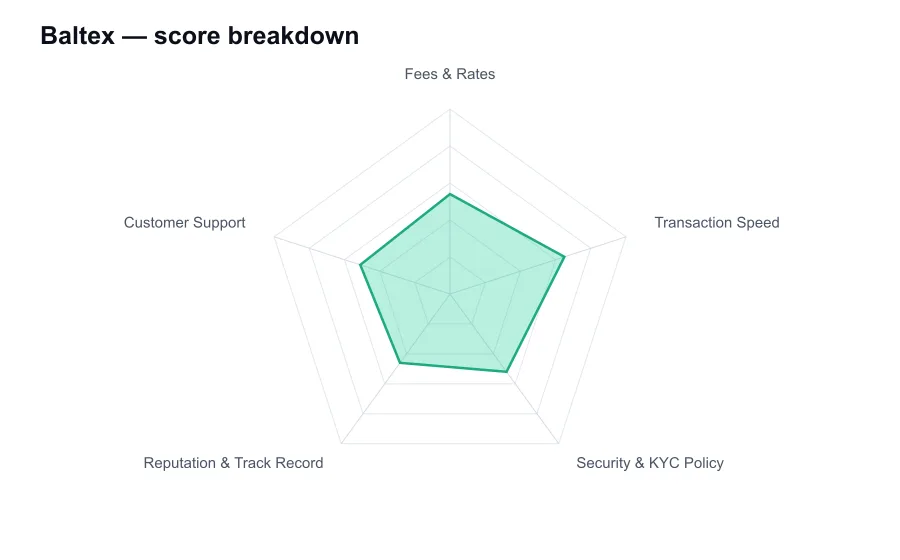
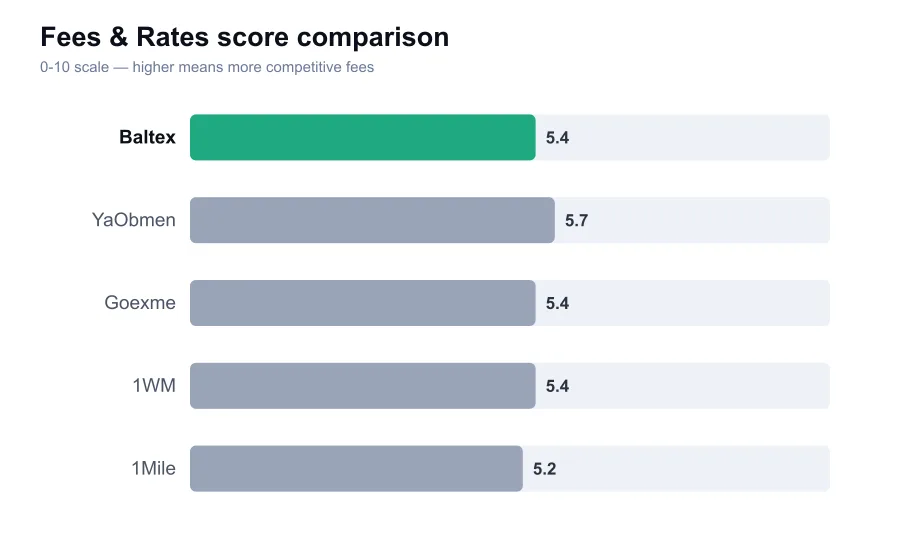
Fees are the part of Baltex's offering that requires the most skepticism. I could not find a simple, permanent public trading-fee schedule comparable to Changelly's stated floating-rate fee or FixedFloat's headline rates. The practical cost is embedded in the quoted exchange rate, together with network fees and the spread charged by liquidity providers. That isn't unusual in this sector, but it makes price comparison essential. A clean-looking quote can still be a costly one.
Before sending anything substantial, I would quote the same pair at Baltex, ChangeNOW, Changelly, and a liquid spot market. Compare the final amount received, not a percentage shown near the top of a page. For large-cap pairs such as BTC to ETH or USDT to USDC, the difference can be material even if every provider describes its rate as competitive. For thin tokens and cross-chain swaps, spreads widen quickly. Baltex doesn't give me enough public fee detail to assume it will win those comparisons.
The service offers both floating and fixed-rate style exchange choices on supported routes. A floating quote can improve if the market moves your way between deposit and execution, but it can also leave you with less than the figure first displayed. A fixed quote gives more certainty for a limited payment window, though that protection is usually reflected in a less favorable rate. For anyone paying an invoice, topping up a wallet, or moving a precise amount, fixed pricing is the sensible choice if it is available.
Speed is usually acceptable for ordinary, liquid swaps, but it is not uniquely fast. The time has three components: blockchain confirmations, liquidity-provider execution, and the payout transaction. A fast chain can make the experience feel nearly immediate. Bitcoin deposits, congested Ethereum transactions, wallet screening, or an illiquid destination asset can turn the same process into a wait measured in hours. Any instant exchange that promises a precise completion time without qualifying it deserves suspicion.
Baltex does a reasonable job of showing order status during a normal transaction. That matters because users panic when their coins leave the sending wallet before the destination payment appears. Still, status pages are only useful if exceptions are dealt with quickly. There is not enough independent evidence of Baltex resolving a large volume of difficult cases for me to rate its operational reliability alongside the bigger names. Newer services are often judged by the edge cases, not by their smooth five-minute swaps.
On identity checks, Baltex presents itself as a low-friction exchange and ordinary users can generally begin without registration. That should not be mistaken for a guarantee of no KYC. Like virtually every serious exchange intermediary, it can apply AML and sanctions screening, then request identification or source-of-funds information when an order triggers risk controls. If you cannot or will not complete that process, don't send funds that you cannot afford to have held while a review is underway.
The security question has two layers. Technically, a short-lived swap service reduces the temptation to keep a standing exchange balance, and using your own destination wallet is good practice. At the business level, however, Baltex has a limited track record and a much smaller public footprint than major competitors. I found fewer detailed independent reviews, fewer long-running public discussions, and less evidence of institutional depth. That doesn't prove misconduct. It does mean the burden of caution belongs with the customer.
A polished website can create a false impression of maturity in crypto. What matters more is whether a company discloses its operating entity, legal terms, risk policy, transaction handling rules, and realistic contact channels. Baltex provides the essentials needed to use the service, but its public profile remains thin. I would want clearer corporate transparency and a more substantial history of independently documented customer outcomes before using it as a regular conversion venue.
Support appears to be centered on online contact channels rather than a large, visible support operation. That is normal for an instant exchange, but it has consequences. If your order is routine, self-service status tracking may be enough. If a deposit needs manual recovery, a tag was omitted, or compliance asks for documents, the quality and speed of human response become the entire product. Smaller providers have less room for error here, and Baltex has not yet built the public support reputation that would calm me.
There are sensible ways to use Baltex if you decide to try it. Start with a small test exchange. Copy wallet addresses rather than typing them. Check the network carefully, especially for USDT, USDC, and wrapped assets. Save the transaction ID, order ID, and screenshots of the quoted return before you send. Those basic precautions won't solve every dispute, but they prevent the most common and expensive user mistakes.
I would also avoid using it for a time-sensitive large payment, a first conversion into an unfamiliar token, or anything that requires a guaranteed completion deadline. The service may work perfectly in those cases, but there is little upside in taking the extra reputation risk when larger competitors offer similar convenience. Baltex's strongest appeal is simplicity, not a clear advantage in price, liquidity, or support infrastructure.
My view is that Baltex is a usable but unproven option for experienced users making modest swaps and checking quotes carefully. It has the appeal of a no-account exchange, but that is a starting point rather than a seal of quality. Until it has a longer record, clearer fee disclosure, and more independently visible support performance, I would keep transaction sizes conservative. For a routine small conversion, it may be perfectly adequate. For meaningful money, established alternatives are easier to defend.