YaObmen belongs to the regional online-exchanger category, a market built around direct swaps rather than continuous trading. A user selects a direction, sees a proposed amount, sends funds, and waits for the matching payout. The model has obvious appeal for people who do not want a formal exchange account or an order book. It is also a model where trust is concentrated in the operator, because the customer usually pays before the service completes its side of the deal.
That distinction matters. YaObmen should not be compared with a self-custody wallet, and it should not be evaluated as if it were a regulated brokerage. It is a conversion counterparty. The right question is whether it is a competent one for a particular transaction: does it give a clear rate, process ordinary orders reliably, explain compliance checks, and provide usable support if the payment does not match? Those basics matter more than a long list of currencies.
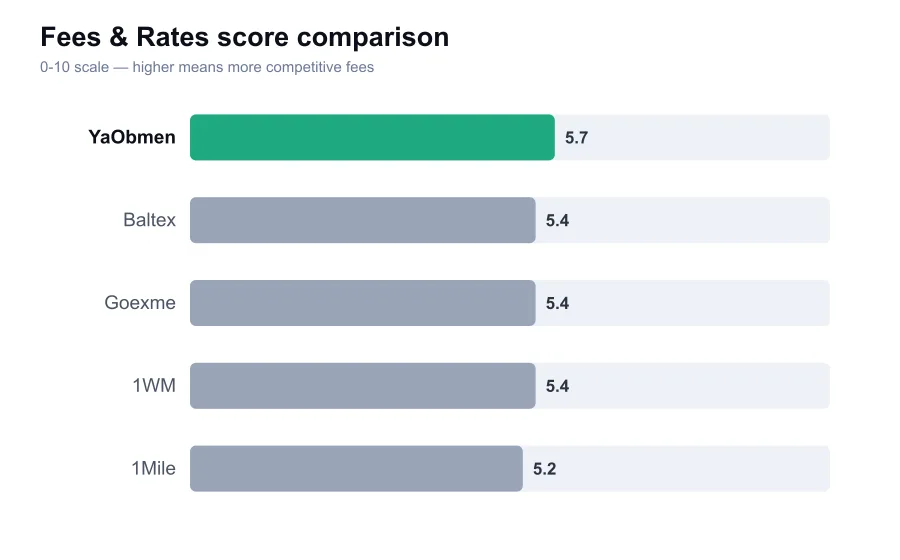
The quoted exchange rate is the center of the fee discussion. Direct exchangers often earn through a spread rather than a simple posted commission, so the service can appear low-fee while still delivering less than another provider. YaObmen may be competitive on particular directions, especially where liquidity is fragmented, but that has to be demonstrated order by order. A user should compare the final amount receivable with at least two live alternatives and include network costs in the calculation.
I would not rely on an old rate comparison, a search snippet, or a claimed percentage commission. Rates can move quickly, and payment methods change the economics. A crypto-to-crypto swap might have a fairly narrow spread but a network fee that makes small transactions unattractive. A card, electronic-money, or bank payout can carry more embedded cost. The only number that matters is what reaches your wallet or account after the order closes.
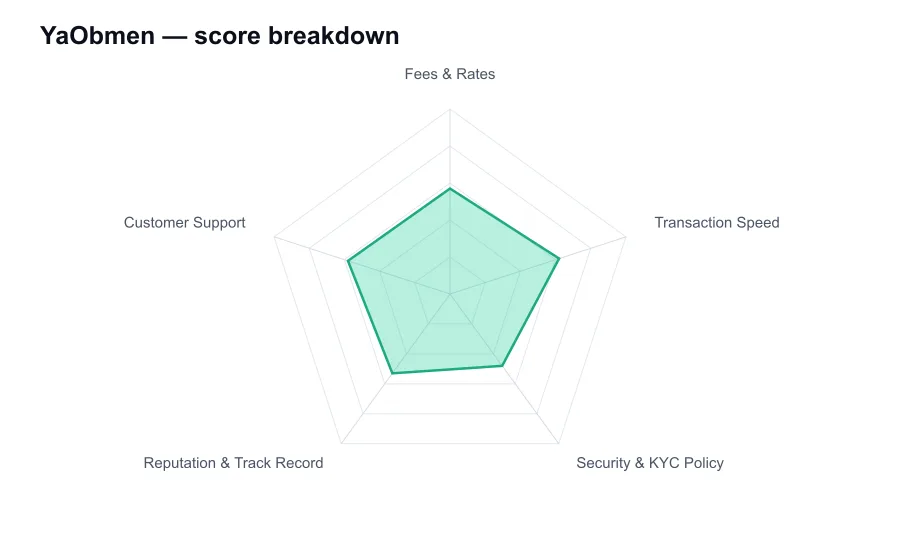
YaObmen earns a somewhat better fee score than the weakest small exchangers only if a customer sees a competitive final output on their selected route. It does not earn a high score because the pricing model is not as transparent or easy to audit as the published fee tiers of a large exchange. For repeated purchases, a customer may find that a mainstream platform plus a normal withdrawal is cheaper even if it takes an extra step. Convenience is valuable, but it has a price.
On speed, YaObmen has the usual strengths and weaknesses of an order-based service. A normal crypto deposit can be recognized quickly after sufficient confirmations, and an outbound transfer on a fast network may arrive soon after release. That is the ideal path. Fiat rails, unusual payment amounts, busy blockchain conditions, and risk screening all create situations where the order is no longer automatic and the customer has to wait.
I would never use a small exchanger for an urgent settlement unless I had already tested that precise route. The term fast is relative. For a straightforward swap, it may mean minutes after confirmations. For a bank-related direction, it may mean later the same day or after a manual check. A provider's processing clock is not the same as a bank's receiving clock, and neither one can guarantee blockchain confirmation times.
Security and identity policy deserve more scrutiny than most users give them. YaObmen may offer a low-friction path to creating an order, but a low-friction interface is not the same thing as proof of strong custody practices. I could not substantiate a broad public record of independently audited systems, proof of reserves, or detailed security controls that would support a top-tier score. Users should minimize the amount exposed to the service and avoid leaving completed-order funds anywhere they do not control.
KYC is another area where expectations should be realistic. Even if YaObmen does not require a lengthy registration procedure before every order, anti-money-laundering and anti-fraud rules may permit it to request identification, payment proof, or source-of-funds information. This can happen because of amount, behavior, a flagged address, or a payment mismatch. Anyone who needs a guaranteed document-free transaction should not fund an order under the assumption that such a guarantee exists.
The safest procedure is unglamorous. Read the current rules before paying. Use a wallet and payment account under your control. Check the coin ticker, network, address, amount, and payment reference. Save the offer page, receipt, and transaction hash. Those habits do not eliminate counterparty risk, but they make a legitimate support investigation much easier. They also protect you from a surprisingly common issue, sending funds on the wrong network or from an unverified third-party payer.
YaObmen's reputation appears more limited than that of the major exchange brands and should be judged accordingly. There may be feedback on exchanger-monitoring platforms or community channels, but the reader should inspect the exact domain and the recency of reports. Reputation is not merely a star average. It is evidence that real users have completed orders over time, that negative cases receive coherent responses, and that terms do not change unpredictably as soon as a customer needs help.
I would give more weight to detailed reports of ordinary transactions than to dramatic unsupported claims, whether positive or negative. The useful reports mention the payment direction, approximate timing, and whether the final payout matched the order. Also look for how YaObmen responds to trouble. A provider that requests an order ID and gives a specific status explanation is more credible than one that deletes criticism or sends generic reassurance. Public review pages are clues, not insurance.
Support is a decisive category for this kind of provider. YaObmen does not need a giant call center to serve customers well, but it does need an accessible channel and agents who can resolve payment exceptions. Before making a large order, contact support with a real question about a fixed quote, reserve, or verification process. The quality of that answer is useful information. If the team cannot explain a simple policy before it has your money, confidence should be low afterward.
My view is that YaObmen can be a workable niche option for a cautious user who has found a favorable confirmed quote and does not need institutional-grade assurances. It is not the kind of provider I would use blindly because a monitor lists it or because its interface is convenient. Keep the first transaction small, plan for possible verification, and move funds out once received. For large transfers, business payments, or situations where timing and recourse are critical, a more established platform remains the sensible choice.