Swapter is a smaller instant crypto exchange service built around a familiar promise, quick conversions without the burden of a full trading account. It is aimed at users who already hold cryptocurrency and want to move between assets with minimal setup. That puts it in a crowded field. The problem for Swapter is not that the model is bad. The problem is that users have many better known alternatives and should demand a strong reason before trusting a lesser known intermediary.
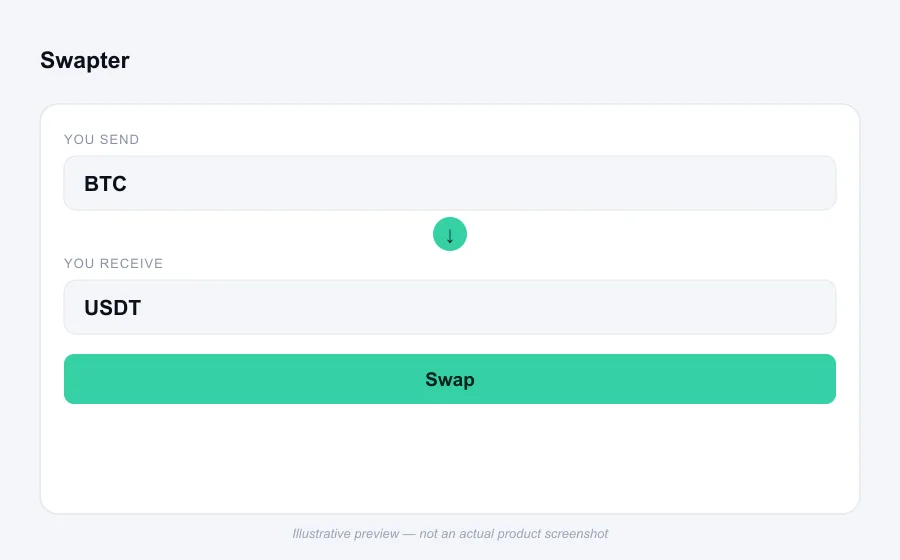
The site presents a clean swap flow rather than a traditional exchange terminal. You select the coin you are sending, choose the asset you want to receive, supply a destination address, and transfer funds to the provided deposit address. For someone who only needs a one off conversion, this is much less intimidating than an order book. The simplicity is welcome, but it also hides the mechanics that determine price and execution quality.
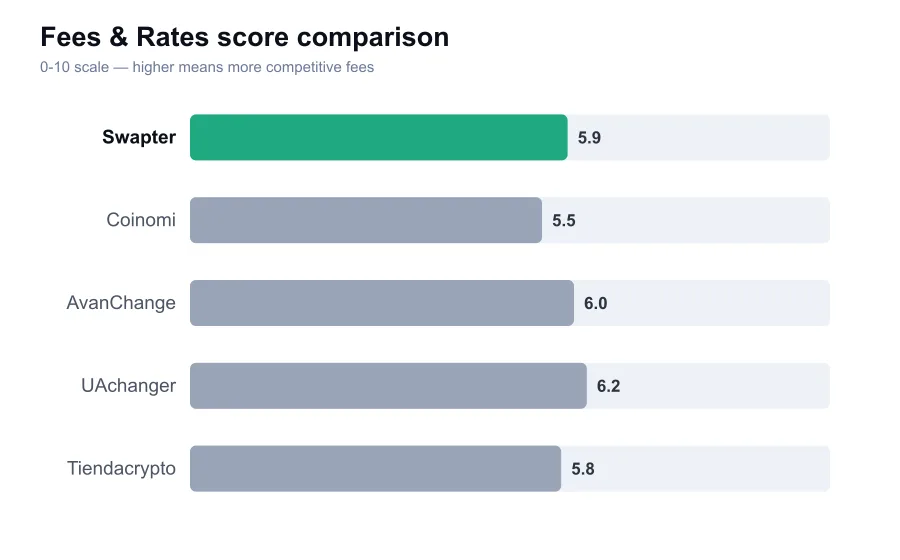
Swapter's fees are largely embedded in its quoted rates. There is no obvious trading style fee schedule that lets a user calculate costs in advance with the precision available on a spot exchange. The quote is therefore the product. Look at the exact amount you will receive and compare it against at least two services, ideally Exolix, ChangeNOW, and a liquid spot market if the pair is listed there.
This is particularly important on small tokens and cross chain conversions. A provider can advertise a low service fee yet offer a weak effective rate because of liquidity sourcing, network costs, or a wide partner spread. Users often focus on a percentage fee because it feels concrete. That is the wrong habit for instant exchanges. The received amount is the only number that tells you what the transaction really costs.
For common pairs, Swapter can be convenient and reasonably quick. The process starts after your deposit reaches the required blockchain confirmation threshold, then the service executes the conversion and sends the output. That can take only a few minutes on efficient networks. Bitcoin, Ethereum, and overloaded chains are a different story. No swap site can make an underpriced Bitcoin transaction confirm faster or make a congested blockchain disappear.
The service is not designed for users who need exact settlement at a precise second. A transaction can be slowed by network conditions, liquidity availability, wallet maintenance, or a risk review. That is true across the sector, but smaller providers have less margin for operational disruption than the largest exchanges. If timing matters to a business, a trading desk, or a payment recipient, use a route with clearer service commitments and deeper liquidity.
Swapter promotes an account light experience, which can be useful for people who do not want another password and another stored identity profile. As with other centralized instant exchangers, that should not be interpreted as immunity from verification. Anti money laundering screening may result in a request for documents or an explanation of transaction origin. Any user whose funds could attract scrutiny needs to accept that possibility before initiating a swap.
That creates a security tradeoff. Swapter does not encourage you to keep a long term balance on its platform, so your exposure is generally limited to the transaction window. That is better than leaving coins idle at a small custodial exchange. Yet the service still takes control of your deposit while it processes the swap. A non account interface is not the same thing as a trustless protocol.
There is less independent public material available about Swapter than there is for the better established brands in this sector. That does not prove bad faith, and new or smaller providers deserve fair treatment. It does mean a careful reviewer cannot give the same reputation credit given to a company with a decade of visible operations, broad regulatory disclosures, or extensive third party coverage. The burden of caution sits with the user.
For that reason, I would not make Swapter my first stop for a large transfer. Start with a small amount, confirm that the network and destination address are correct, and judge the actual result against the quote. Save the order page, transaction hash, and receiving transaction. These steps sound basic, but they are the difference between a manageable support request and an argument with no usable evidence.
Customer support appears to be focused on direct online channels rather than the extensive phone, branch, or regional support infrastructure offered by major financial firms. That is normal for a crypto swap service. What matters is whether support can identify an order, explain its status, and resolve a genuine technical problem. Swapter should be expected to do that. Users should not expect the same response capacity as a large exchange with thousands of staff.
The interface itself is easy to understand and that is a legitimate strength. A small provider can often offer a cleaner experience than a huge exchange whose app pushes staking, derivatives, earn products, and promotions at every turn. Swapter stays close to the basic task. The danger is that a neat design can create more confidence than the provider's public record warrants.
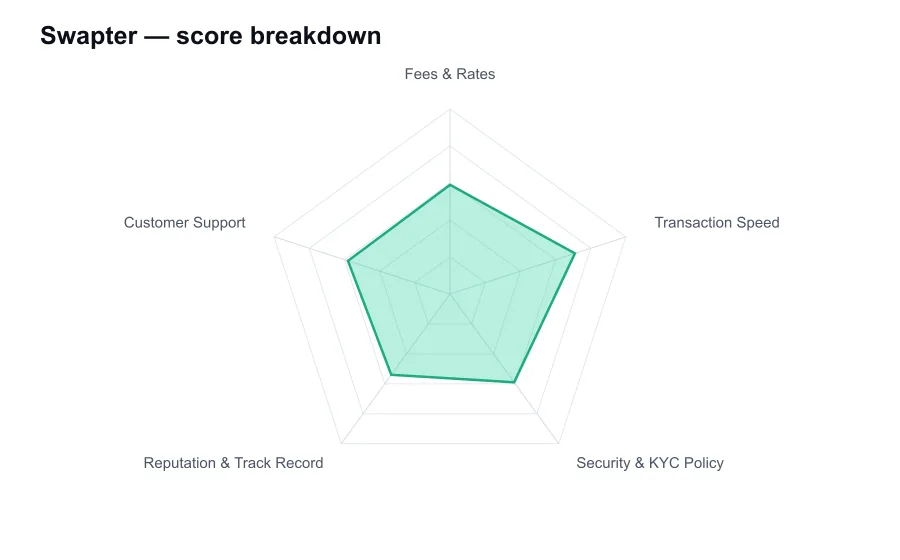
I would place Swapter in the useful but unproven category. It may suit a small, uncomplicated swap if its quote is clearly better than competitors and you are already comfortable managing self custody. It is not the platform I would choose for first time crypto buyers, significant capital, or transactions that need a mature compliance and support framework. A cleaner page is not enough to overcome a thinner reputation record.
Swapter's appeal is convenience, and convenience has value. Still, this is an area where reputation deserves a heavier weight than a slick interface. The service can be a practical option for careful users making modest exchanges, but it has not earned the default trust I would grant to more established providers. Treat it as a transaction tool, not a vault, and make every swap compete on final price and reliability.