Maple is another provider that gets misplaced in exchange lists because it handles crypto capital, yet it is not a retail trading exchange. Maple Finance is an institutional-focused credit protocol. Its original proposition was to connect professional borrowers with onchain lenders through delegated credit pools, rather than require every loan to be overcollateralized like Aave or Compound. That is a far more ambitious model, and it comes with a far sharper risk profile.
The important distinction is that Maple is about credit. Lenders deposit capital into pools or products and seek yield generated by borrowing activity. Borrowers are typically businesses, market makers, trading firms, or other institutions that pass underwriting and pool requirements. A retail user cannot arrive with a debit card, buy SOL, and start trading. Maple belongs in a discussion about onchain fixed income and institutional lending, not casual exchange shopping.
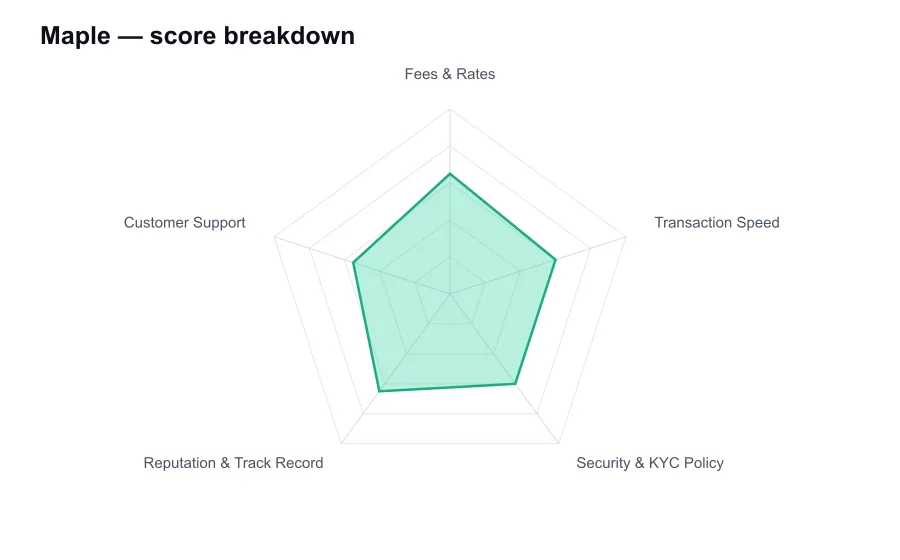
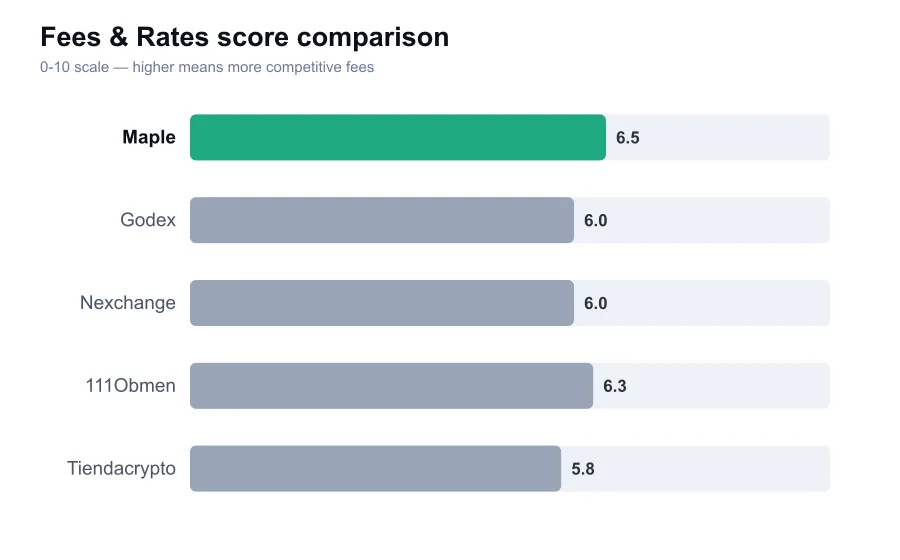
Maple's fee structure is not as simple as a spot exchange maker and taker table. Yield products can have management and performance-related economics, while lenders' returns are displayed net of relevant product costs depending on the pool. Borrowers negotiate or receive loan terms based on credit assessment and product design. The investor should focus less on a nominal fee and more on net yield, lockup terms, redemption mechanics, borrower concentration, and whether the return adequately compensates for credit risk.
This is where Maple can look very attractive. Traditional DeFi lending often offers relatively low returns because loans are heavily collateralized and liquidity is abundant. Maple's credit-oriented products have at times offered yields that are meaningfully higher, particularly on stablecoin capital. Higher yield is not a free upgrade, though. It is compensation for taking a risk that many retail DeFi users have never had to analyze: the risk that a borrower cannot repay.
Maple's history makes that risk impossible to dismiss. During the 2022 crypto credit crisis, loans associated with major borrowers such as Orthogonal Trading suffered defaults, and lenders took losses. That period damaged the idea that onchain transparency somehow makes unsecured or undercollateralized lending safe. Maple survived, adapted its approach, and continued building, which deserves credit. But survival is not the same as a clean record, and prospective lenders should treat that history as required reading.
The protocol has since emphasized more structured lending products, institutional processes, and arrangements designed to improve risk controls. There are products focused on secured lending and treasury-oriented stablecoin users, including offerings marketed under the Syrup brand for eligible users. These changes show a serious attempt to learn from prior failures. They do not convert corporate credit into a risk-free savings account, regardless of how polished the yield page looks.
Speed is good at the blockchain level, but that is not the meaningful measure. Deposits and withdrawals may settle through Ethereum or supported networks according to normal onchain conditions, usually in minutes. Access to liquidity can be slower if a product has withdrawal windows, queue mechanics, notice requirements, or limited immediately available liquidity. Investors who equate a tokenized loan position with cash in a checking account are likely to be disappointed at exactly the wrong moment.
Maple is better suited to capital that can tolerate being allocated for a defined purpose. A lender should read the pool or product documentation, identify the assets held, understand redemption terms, and ask what happens in a credit event. That sounds obvious, but the crypto industry has trained many users to focus solely on annual percentage yield. With Maple, the terms behind that number matter more than the number itself.
Security has two layers here. The first is smart contract security: contracts can have bugs, exploit paths, oracle dependencies, and operational risks. Maple has used audits and public protocol infrastructure, which is necessary but never sufficient. The second, and arguably larger, layer is underwriting security. A perfectly functioning contract cannot recover money from an insolvent borrower. The protocol's technology can enforce terms, but it cannot make a bad loan good.
KYC depends on the product and user route. Maple's institutional credit model naturally involves borrower diligence, and some access paths, especially those aimed at regulated or eligible participants, can impose eligibility checks or geographic restrictions. That is very different from permissionless swapping on a decentralized exchange. A user should not assume that connecting a wallet grants unrestricted access to every Maple product, particularly where securities, lending, or local compliance rules may apply.
Maple's reputation is complicated but real. It is not an anonymous yield farm that appeared last month, and it has a recognizable team, substantial industry visibility, and a track record through a brutal market cycle. Yet the default episode remains central to any honest appraisal. The protocol demonstrated both the promise and weakness of delegated credit. It delivered yields from real borrowers, then showed exactly why lending to those borrowers demands serious judgment.
Customer support is appropriate for a protocol and institutional platform, not exceptional for a mainstream consumer service. Documentation, Discord or community avenues, and team communications can help users understand product mechanics. They cannot undo a market loss, reverse a signed wallet transaction, or guarantee an instant resolution. Sophisticated users may find the available materials sufficient. A first-time investor may find the terminology and legal distinctions dense.
Compared with Aave, Maple offers a fundamentally different bet. Aave's typical model emphasizes onchain collateral and automated liquidation. Maple seeks to bring credit assessment and institutional borrowing onchain, which may produce better yields but introduces counterparty judgment. Compared with centralized lending firms, Maple is more transparent in some ways because the protocol and pool data are observable. It remains exposed to the same broad economic truth, lending is only as sound as the borrower and the underwriting.
I respect Maple more than I would a simplistic high-yield platform because it does not pretend credit risk has disappeared. Still, I would only recommend it to users who can independently assess product documents and accept that a yield position can suffer losses or delayed access to funds. It is not a replacement for cash reserves, and it is not a beginner exchange. Maple is an interesting piece of financial infrastructure, but its best users are the ones least likely to mistake it for easy yield.