Nexchange is an instant cryptocurrency exchange service built around direct conversions rather than a traditional customer trading account. It is aimed at users who want to exchange one coin for another with a receiving address and without navigating charts, order types, or a custodial balance. In a crowded market, Nexchange is closer in spirit to ChangeNOW and SimpleSwap than to Binance or Coinbase. Its appeal is speed and simplicity, but it should be judged with the same skepticism applied to every quote-based crypto intermediary.
The product has a fairly clean purpose. You choose an input asset, select an output asset, enter a destination address, and transfer the required amount to the provided deposit address. Nexchange then executes the conversion through its liquidity arrangements and sends the output. That workflow is attractive for a one-off wallet swap or for moving between chains. It is not an ideal environment for discovering fair market value, because the customer sees a final offer rather than a visible order book.
Nexchange supports a range of prominent cryptocurrencies and tokens, with availability dependent on current network and provider conditions. The range is useful, though users should not assume that every displayed pairing has equal capacity. BTC, ETH, major stablecoins, LTC, and other widely traded assets are naturally less problematic than a thin token with limited external markets. Before committing, check the minimum and maximum, the selected blockchain, and whether the asset ticker refers to the token version you actually hold.
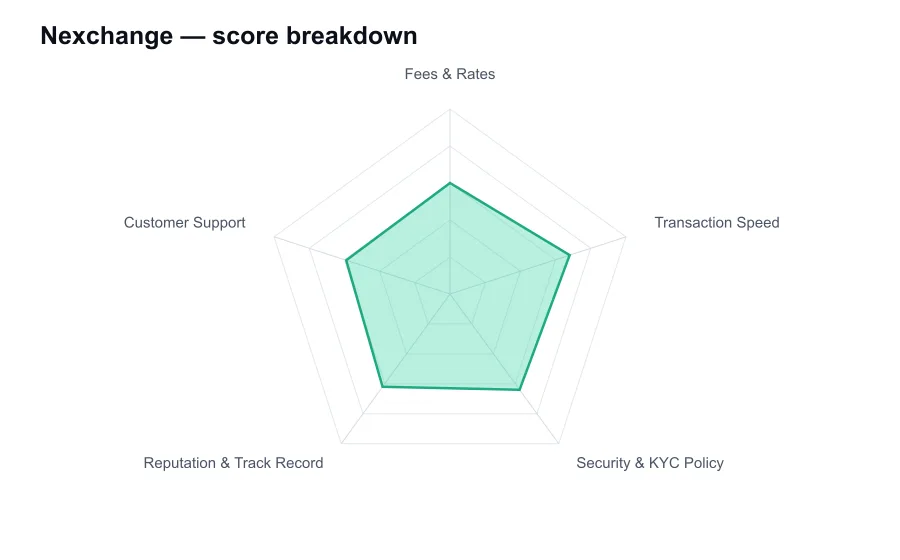
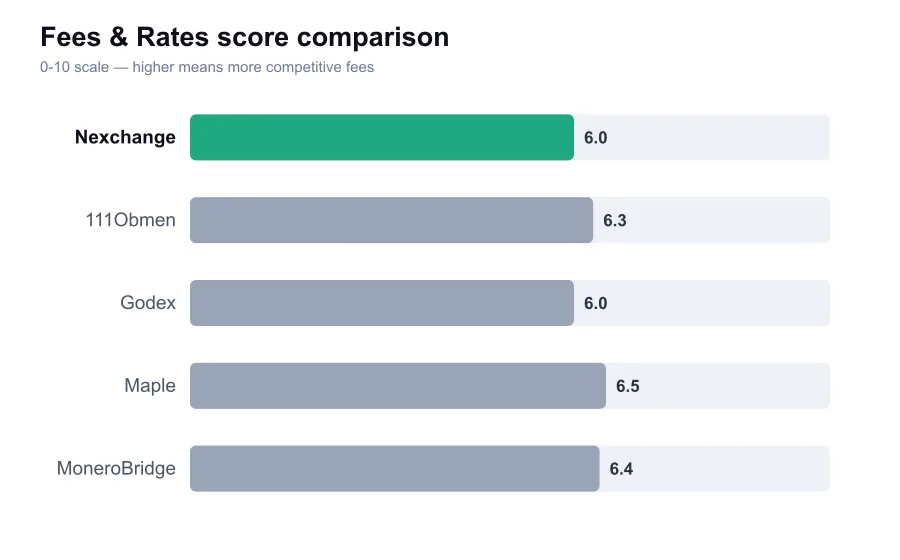
Pricing is built into the quote. Nexchange does not work like a spot exchange where a trader can point to a base fee, a maker fee, and a taker fee before placing an order. Its rate can include service margin, liquidity-provider pricing, and blockchain transaction costs. This is standard for instant swaps, but it is not especially transparent. The practical fee is the gap between the fair market value of what you send and the amount you receive. That figure can vary materially by pair and by network conditions.
For ordinary liquid swaps, Nexchange's pricing can be acceptable, but it is rarely sensible to accept the first quote without checking. A direct trade on a large exchange will usually be less expensive for a user who already has access and can withdraw efficiently. Against other instant services, outcomes can vary from competitive to unremarkable. Compare at least two live quotes for the identical amount. If one provider is offering a dramatically better rate, make sure it is not using a floating quote while another is showing a fixed payout.
Network costs deserve special attention. A BTC transaction fee, Ethereum gas, or an outgoing token transfer can make a supposedly low-cost exchange expensive at small sizes. Stablecoin swaps can be particularly misleading because users mentally treat one dollar as one dollar. USDT on Tron, USDT on Ethereum, USDC on Polygon, and USDC on Ethereum are not interchangeable from a transaction-cost perspective. Nexchange can simplify the conversion, but it cannot remove the underlying cost of settling across chains.
Nexchange offers rate options that can depend on the specific asset route. A floating exchange can give a more appealing initial amount, but the final result may move with the market before execution. Where a fixed-rate option is available, it is usually the better choice for users who need a predictable receipt, even if it costs more. Read the order details before sending. The amount window, time limit, and confirmation assumptions are not fine print if a volatile asset is involved. They determine whether the displayed number remains meaningful.
Transaction speed is generally governed by confirmations and liquidity execution rather than a magic internal engine. A straightforward conversion involving fast networks can complete within minutes after the incoming transfer is recognized. Fifteen to forty-five minutes is a more realistic planning range for many ordinary swaps. Bitcoin can take longer, Ethereum congestion can delay both sides, and a problematic route can become a support case. Nexchange is convenient, but it should never be used as the final link in an urgent payment chain without a time buffer.
The account-light model is a positive security feature. Nexchange is not asking customers to maintain a standing balance, so it avoids some risks associated with obscure custodial exchanges. Your funds are still exposed during the exchange process, however. The service and its execution partners take temporary control of the assets needed to settle the swap. Use a wallet you control for the destination, verify every character of the address, and be especially careful with token networks. A correct address on the wrong network may be unrecoverable.
Nexchange is commonly used without routine upfront identity verification, which will appeal to users who dislike handing documents to a service for a simple swap. That should not be read as an unconditional no-KYC promise. Compliance and anti-money-laundering procedures can trigger a review, with an identity or source-of-funds request possible for a flagged order. This is a difficult reality of modern crypto conversion services. The best defense is not trying to game screening, but avoiding time-sensitive use and understanding the policy before sending funds.
The company has been around long enough to be more than a brand-new anonymous exchange form, and it has a recognizable place in the instant-exchange ecosystem. Still, its public reputation does not carry the same weight as the industry's most established names. The service has a more limited mainstream profile than StealthEX, ChangeNOW, or the large centralized exchanges. That is not disqualifying for a modest swap, but reputation matters most when something goes wrong, because that is when public accountability and a long service history have real value.
Feedback about Nexchange, like feedback about many instant exchangers, should be read carefully. A successful transaction is often uneventful and fast. Complaints can arise from market movement, delays in blockchain confirmations, incorrect deposits, partner liquidity failures, or compliance holds. A reviewer should not automatically blame the service for every blockchain delay, but neither should the service escape responsibility for poor communication. Nexchange's main test is how clearly it explains an exception and how reliably it traces the transaction to a conclusion.
Support is primarily online and transaction-led. For a standard issue, an order ID and on-chain hash provide the essential evidence, and that makes remote support workable. It is less robust than support at a major regulated exchange with phone lines, formal complaints procedures, and dedicated escalation paths. Users should save the order page and transaction hash immediately. If an exchange does not complete as expected, do not send a second payment to the same address unless support explicitly tells you to do so.
Nexchange is best treated as a practical tool, not a financial home. I would consider it for a modest conversion where its live quote is competitive and the destination wallet is under my control. I would choose a large exchange for active trading, a well-established instant provider for a high-value no-account swap, and a direct bridge or wallet feature for certain same-ecosystem moves. Nexchange can do what it promises, but the limited transparency of its pricing and the unavoidable possibility of a compliance interruption keep it from being a top recommendation.