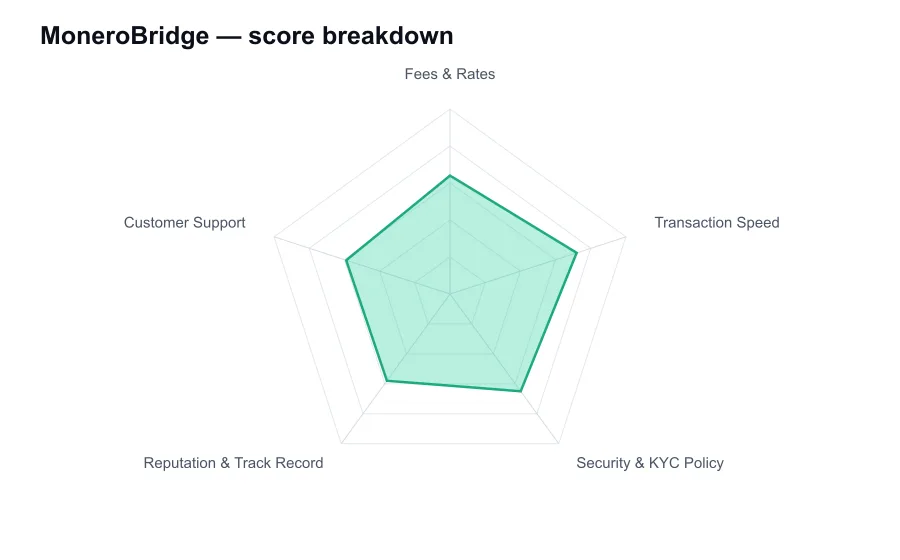
MoneroBridge is a specialist instant exchange built around one very specific need: getting into or out of Monero without opening a conventional trading account. That focus gives it a clearer identity than broad swap aggregators. It is aimed at people who already understand wallet addresses, confirmation times, and Monero's privacy model, not at beginners shopping for their first crypto purchase.
The service's narrow positioning is both its appeal and its limitation. Monero has been delisted or restricted by a number of regulated exchanges, particularly in markets where privacy coins create compliance discomfort. A bridge that can convert BTC, ETH, LTC, stablecoins, and other supported assets to XMR fills a genuine gap. But it does not have the product depth, brand scale, or market visibility of SimpleSwap or LetsExchange.
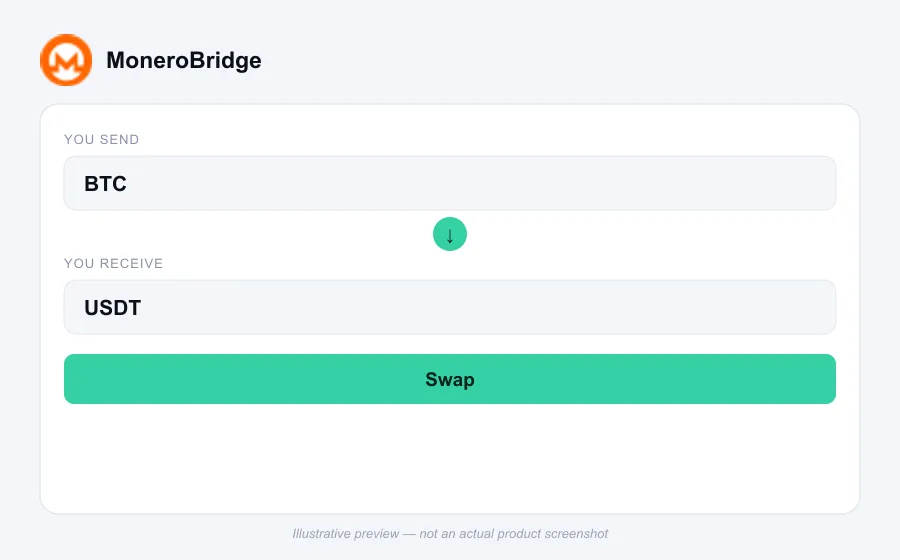
MoneroBridge is designed as a no-account swap service. Users select a pair, provide a receiving address, send the deposit, and wait for the destination asset. There is no standard custodial dashboard with balances, advanced order types, or fiat rails. That makes the interface refreshingly direct. It also means users bear the normal self-custody responsibility for addresses, payment IDs where relevant, and transaction records.
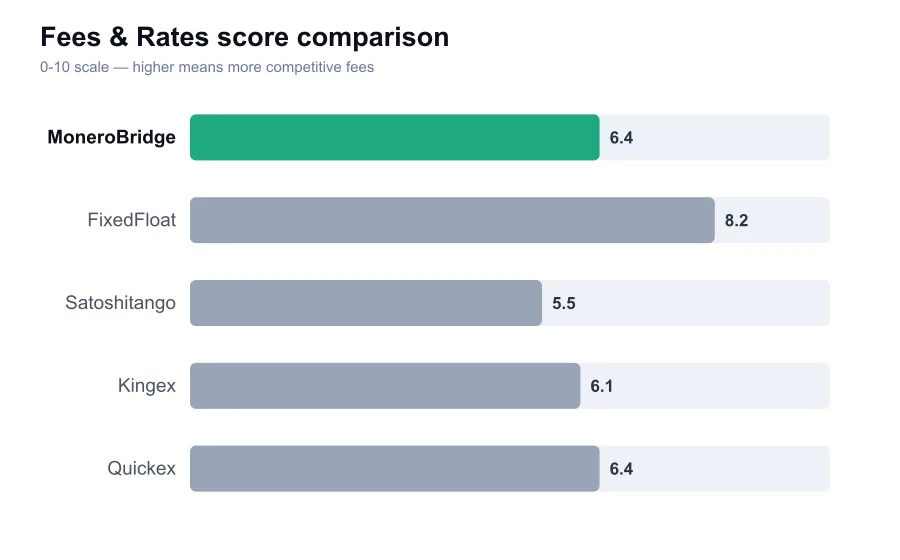
Fees are not presented as a simple exchange commission in the way an order-book venue might publish maker and taker tiers. The actual cost is embedded in the quote and varies with pair liquidity, blockchain conditions, and the service's execution route. This is normal for instant swaps, but it makes marketing claims about low fees less useful than a side-by-side received-amount comparison.
For popular routes such as BTC to XMR or LTC to XMR, MoneroBridge can be reasonably priced, especially for users who value the route's convenience. It is less convincing if you assume every quote is competitive. Monero liquidity is fragmented, and the cost of converting through privacy-coin markets can be noticeably higher than trading a liquid BTC or ETH pair at a major centralized exchange. Check the net output, not a headline promise.
The platform should also be judged with network fees in mind. A small Bitcoin deposit can become inefficient if Bitcoin fees are elevated. Litecoin and other cheaper networks may make more sense for smaller conversions, provided the pair is supported and the quote holds up. Monero itself has low transaction fees, but that doesn't erase the cost of getting value onto the bridge in the first place.
Speed is normally governed by two things: deposit confirmation requirements and Monero's own block production. Monero blocks arrive roughly every two minutes, while Bitcoin's cadence is roughly ten minutes and can be much less predictable under congestion. A routine swap may be completed in 10 to 30 minutes, but users should not interpret the word instant as a contractual delivery promise. Larger deposits and busy chains take longer.
The transaction tracker is useful, but patience is still required. Monero's privacy design makes outside transaction tracing different from transparent-chain transfers, so users should keep the order reference and their sending transaction hash. If a swap stalls, those details are what support will need. Sending from an exchange can add another delay because the exchange may batch withdrawals or hold them for internal review.
Privacy is the obvious reason people look at MoneroBridge, yet it is important not to overstate what it offers. Monero protects transaction details on its own network. An instant exchange is still a centralized service processing a conversion, and its web access, deposit trail, and operational controls are separate issues. Using XMR does not erase the need to use a legitimate service or protect one's own wallet and device.
The service is generally marketed as no-KYC for ordinary transactions. That should be read as low-friction access, not an unconditional legal shield. Like most providers that rely on external liquidity and compliance tooling, it can freeze or review activity that triggers AML, sanctions, or fraud controls. Anyone choosing a swap venue purely because they believe verification can never happen is taking an unnecessary and avoidable risk.
The lack of a long, highly visible corporate record is MoneroBridge's biggest weakness. It may serve its niche well, but it has less independently documented history than older all-purpose providers. There are fewer extensive third-party reviews, fewer public product integrations, and less evidence of how the operation handles rare, high-value disputes. That doesn't make it unsafe by definition. It does justify lower trust limits.
Security begins with the user's side of the transaction. Enter the site directly rather than following sponsored links, verify the HTTPS domain, and copy addresses carefully. XMR addresses are long and errors are unforgiving. Malware that replaces copied crypto addresses remains more common than sophisticated exchange hacks. A hardware wallet and a small test conversion are more meaningful protections than any reassuring slogan on a swap site's homepage.
Support appears to be oriented around email or web contact rather than the expansive support operation offered by major exchanges. That can be enough for a simple order issue, particularly if the user has the correct hash and order number. It is not the kind of service I would choose for an urgent institutional problem or a complicated compliance dispute. The absence of a large public support footprint is noticeable.
MoneroBridge is useful precisely because it does not try to be everything. It gives Monero users a comparatively simple bridge from mainstream coins into XMR, and that is a legitimate service in a market where choices have narrowed. Still, niche convenience should not be confused with proven large-scale reliability. I would use it for carefully sized conversions, not for money I could not tolerate having delayed.
My view is straightforward: MoneroBridge can be a practical tool for experienced XMR users who understand the tradeoffs. Its no-account workflow and privacy-coin focus are real advantages. Its lower public profile, quote-based costs, and modest support visibility demand caution. Start small, save every transaction detail, and compare the rate against at least one alternative before sending.