Kingex is a non-custodial instant crypto exchange, which places it much closer to services such as ChangeNOW, SimpleSwap, and FixedFloat than to Coinbase or Kraken. The basic proposition is simple: choose a pair, send one asset, and receive another at a wallet address you control. There is no traditional trading account, no order book to study, and usually no reason to leave coins on the service after a swap.
That model has genuine appeal. A user who already has a wallet can avoid the bureaucracy of opening a full exchange account for a one-time conversion. Kingex supports a broad selection of crypto assets and emphasizes swaps without registration. The convenience is real, especially for users moving between chains or consolidating assets. But no-account swapping should not be mistaken for an unconditional promise of anonymity or guaranteed execution.
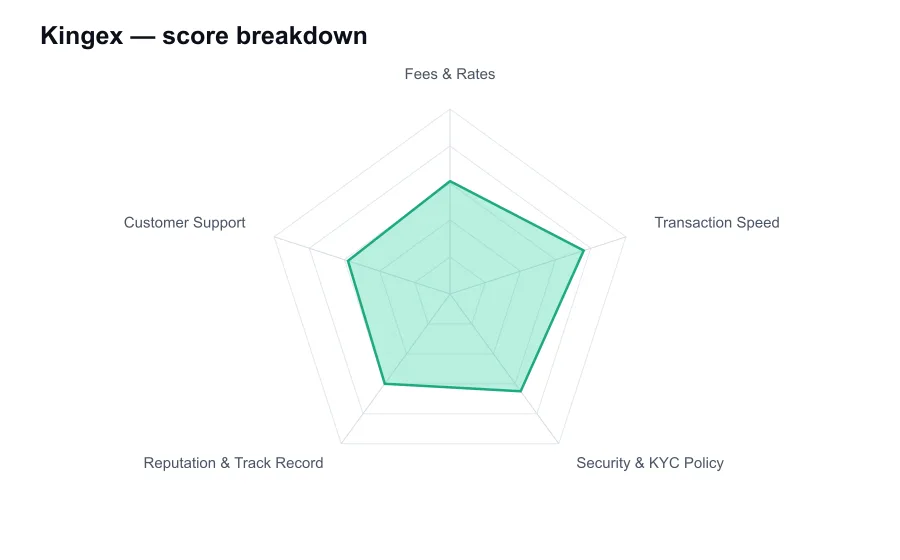
Kingex's headline pricing is based on quoted exchange rates rather than a clean published trading commission. The platform offers floating-rate and fixed-rate options, depending on the pair and market conditions. A floating rate means the final amount can change between the time a quote is shown and the moment the service completes the swap. A fixed rate offers more certainty, but the protection usually costs more because the provider is taking short-term market risk.
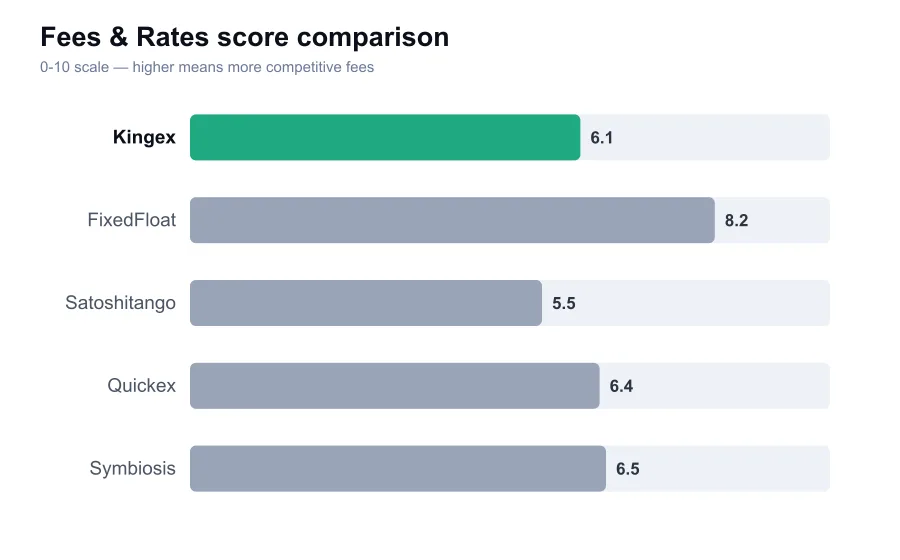
This is where Kingex needs a careful buyer. The fee is effectively embedded in the quote, alongside network charges, liquidity-provider costs, and the service margin. That is normal for instant exchanges, but it makes the headline rate the only number that really matters. Compare the received amount with at least one competing instant exchanger and a liquid spot-market reference. On major pairs, differences can be modest. On illiquid tokens, they can be substantial.
Kingex is not the cheapest route for someone who already has access to a large exchange. A user willing to deposit, place a limit order, and withdraw can often get a sharper price on Kraken, Binance, or OKX, particularly for larger trades. Kingex is selling simplicity and speed, not best-in-class execution. That is a fair trade for a small urgent swap. It becomes a poor trade if repeated often or used for a large portfolio rebalance.
Speed is one of the service's better characteristics. Once the inbound transaction has the required confirmations and automated liquidity is available, many swaps complete in minutes. The actual time depends on the sending chain, its confirmation requirement, congestion, and the destination network. A fast network can produce a quick exchange. Bitcoin deposits, Ethereum congestion, or a token requiring manual processing can turn the same experience into a longer wait.
Users should be wary of treating estimates as guarantees. Instant exchange sites commonly advertise approximate completion times because they cannot control block production, wallet maintenance, or third-party liquidity. Fixed-rate swaps reduce price uncertainty, not necessarily network uncertainty. If a payment is time-sensitive, send early, avoid congested chains where possible, and do a small test transaction. That caution matters most with a first-time address or an unfamiliar network.
The non-custodial design is an important security advantage. Kingex does not ask users to maintain a standing balance in a hosted wallet, so there is less exposure to the risk of a centralized exchange freezing or losing an account balance. Coins are sent for a particular conversion and delivered to the chosen destination. That is a healthier setup than leaving funds indefinitely with a small trading platform.
It does not eliminate risk. During the exchange process, the service and its liquidity partners handle the transaction flow, and a mistaken asset, chain, memo, or destination address can create serious problems. Users need to confirm whether they are sending native USDT on the correct network, not simply any token labeled USDT. They should also avoid sending funds from a smart-contract wallet unless the service explicitly supports it. Blockchain transactions are unforgiving of assumptions.
Kingex markets no-registration swaps, but its terms and operating reality include anti-money-laundering controls. A transaction can be flagged for risk review, and the service may request identification or source-of-funds information before releasing a swap. This is common among instant exchanges and should be expected, particularly for large, unusual, or risk-scored transactions. Anyone who needs absolute no-KYC certainty should not use a centralized swap provider at all.
The possibility of a compliance hold is the main practical drawback of this category. A user may choose Kingex because it seems simpler than an account exchange, only to discover that a flagged transaction requires a support conversation and documents. It is better to understand that possibility before sending. Do not route money needed for a deadline through any instant exchanger, and avoid sending assets linked to questionable sources or mixers if you expect frictionless automated processing.
Kingex has been operating since the late 2010s and has developed a recognizable profile within the instant-swap niche, but its public track record is still much lighter than that of the largest regulated exchanges. It has customer reviews and a visible online presence, yet there is limited public disclosure of the kind investors would expect from a major financial institution. That is not unusual for this business model. It is still a reason to keep transaction sizes proportionate.
Support is available through the website and transaction-specific communication channels. For a normal completed swap, there is little need for support. Its value becomes clear only when a transaction is delayed, an address is incorrect, or a compliance review begins. Reports on instant exchanges tend to be polarized because successful automated swaps are uneventful while the exceptional cases are stressful. Preserve the transaction hash, exchange ID, screenshots, and all correspondence if you need help.
Kingex is a useful tool, not a place to build a whole crypto life. For a small or medium wallet-to-wallet conversion, it can be quick, simple, and less cumbersome than funding an exchange account. For large trades, recurring conversions, fiat purchases, or users who want formal account protections, it is a weaker choice. My view is straightforward: use Kingex for convenience-sensitive swaps after comparing quotes, but do not pay its spread blindly and do not send money you cannot afford to have delayed.