Quickex is a non-custodial instant exchange service aimed at people who want to swap coins without opening a trading account or learning a full exchange interface. It sits in the same broad category as ChangeNOW, SimpleSwap, StealthEX, and LetsExchange. The appeal is obvious: select two assets, provide a destination address, send funds, and wait for delivery. Quickex is not a venue for active traders. It is a convenience product, and its quality depends heavily on the quote it produces at the moment you need it.
The service supports a broad list of mainstream coins, stablecoins, and smaller tokens across networks including Ethereum, Tron, BNB Chain, Polygon, and other popular ecosystems. That catalogue is useful, particularly for someone moving between ecosystems without wanting to route funds through a centralized exchange. Still, token availability should not be confused with deep liquidity. A listed asset can be technically supported while receiving a noticeably weaker rate than BTC, ETH, USDT, or other heavily traded pairs.
Quickex presents both floating and fixed-rate exchange options on many routes. The floating quote is normally better at the screen stage, but it is not a promise. If the market moves while your incoming transaction is waiting for confirmations, the amount delivered can change. That is normal for this business model, yet users often mistake an estimate for a final price. Fixed-rate swaps are more appropriate for a time-sensitive payment or an exact portfolio rebalance, assuming Quickex offers one for the pair and amount selected.
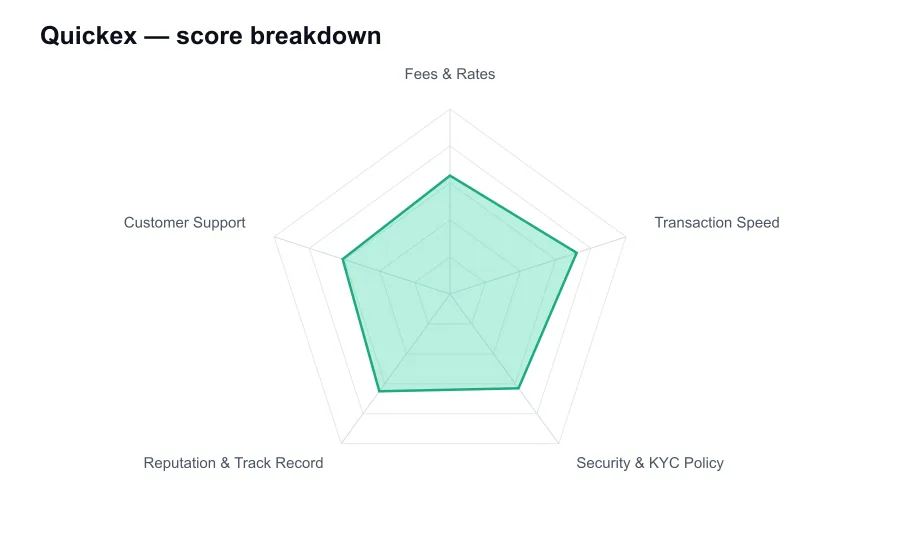
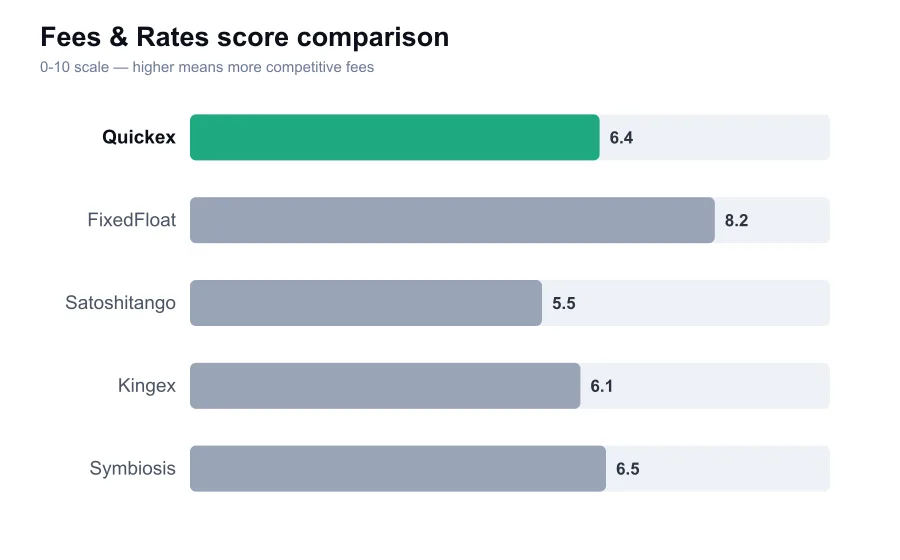
Its fee presentation is decent but not unusually transparent. Quickex does not operate with one neat public percentage that applies to every transaction. The price shown includes its service margin, liquidity-provider pricing, network costs, and the spread associated with the route. That is common among instant exchangers, but it makes genuine comparison essential. A quote that looks cheap in dollars can still be poor in percentage terms, especially on low-value swaps where blockchain fees dominate.
For larger, liquid pairs, Quickex can be reasonably competitive. In ordinary market conditions, its BTC to USDT, ETH to USDC, and major stablecoin routes often land in the middle of the instant-exchange market rather than at its cheapest edge. It is usually more expensive than trading directly on Kraken, Coinbase Advanced, Binance, or OKX, where available. That is the price of avoiding an order book and account registration. Against similar no-account services, it needs to be checked live rather than assumed to be the winner.
The biggest fee trap is the small transaction. Sending a modest amount of BTC, ETH, or an ERC-20 token through an instant exchange can turn a tolerable percentage into a painful one. Quickex displays minimums and estimated outputs before a swap begins, but users should inspect the received amount rather than focusing on a supposedly zero or low platform fee. Network fees are not imaginary costs just because they are rolled into a quote. On Ethereum during busy periods, they can be the deciding factor.
Speed is one of Quickex's better qualities on straightforward routes. Once the deposit gets the required confirmations and the liquidity partner has accepted the order, many swaps settle in roughly five to thirty minutes. Fast chains and internal liquidity routes can be quicker. Bitcoin deposits, congested Ethereum transactions, cross-chain token swaps, and exchanges involving thinly traded assets can easily take longer. Quickex cannot make a slow blockchain fast, and its marketing should be read with that limitation in mind.
The practical process is uncomplicated. The user supplies a receiving address, Quickex creates a deposit address, and the service forwards the exchanged asset after processing. There is no custodial dashboard designed for leaving a balance behind, which is a meaningful advantage over smaller centralized platforms. You do, however, temporarily hand control of the funds to an automated exchange flow. Non-custodial does not mean risk-free. A typo in a destination address, wrong network selection, or a badly timed market move can still be costly.
Quickex promotes exchanges without mandatory account creation or routine KYC. For ordinary transactions that is broadly how the service is designed. Like most services in this sector, though, it reserves the right to request identification or source-of-funds information if automated compliance screening flags an order. Anyone claiming that Quickex guarantees anonymity in every circumstance is overselling it. Transactions remain public on-chain, and a compliance hold is possible, particularly with risky transaction history or unusual amounts.
That conditional KYC model creates a real trade-off. Privacy-conscious users appreciate not submitting documents before every small exchange. A customer whose transfer is paused will have a much less pleasant experience, because support requests, documentation, and review time can turn an instant swap into a multi-day problem. Quickex should explain this possibility more prominently at the point of order. The policy may be standard, but standard does not make it user-friendly.
On security, the absence of a long-term customer balance reduces one obvious exchange risk. There is less incentive to treat Quickex as a wallet, because it is not built to be one. The service uses HTTPS and provides order tracking, but public users do not get the kind of independently audited proof-of-reserves, licensed-entity disclosure, or detailed security reporting expected from a major custodial platform. That does not make Quickex unsafe by default. It does mean its trust model is based on operational history and successful settlement, not institutional transparency.
Quickex has been active for several years and has established a recognizable footprint among instant-swap services, though it does not have the brand depth of ChangeNOW or the exchange pedigree of Kraken. Its public reputation is mixed in the way this whole category tends to be mixed. Many users report clean, rapid swaps. Complaints usually concern a delayed order, an altered floating-rate payout, a compliance review, or frustration over support timing. Those patterns are familiar, but they still matter because users often arrive during a time-sensitive transfer.
Support is available through the website and email, with order IDs doing much of the diagnostic work. During a normal completed swap, you may never need it. During a delayed transaction, the quality of replies becomes much more important. Quickex support appears capable of tracing standard issues, but it does not offer the confidence of a large regulated exchange with telephone escalation, a dedicated account team, and formal service commitments. Keep the transaction hash, screenshots, and order ID from the start.
Quickex is a sensible tool for a moderate-sized, uncomplicated swap between well-supported assets, especially if avoiding a full exchange account matters to you. I would not use it blindly for a large five-figure trade, a token with shallow liquidity, or a transfer where the exact received amount is mission-critical. Test a route with a small amount, compare its quote against StealthEX and at least one major exchange, and choose fixed rate if certainty matters more than a marginally better estimate. It is useful, but it earns trust transaction by transaction rather than through exceptional transparency.