FixedFloat is a specialist instant exchange that built its following around a sharp, minimalist proposition: quick cryptocurrency swaps, no user accounts, no routine KYC, and strong support for Bitcoin and Lightning Network payments. It has always felt more like a tool for technically comfortable crypto users than a polished retail financial service. That focus is part of its appeal. It is also why anyone considering it needs to look harder at operational risk than they might with a large regulated exchange.
The interface is stripped down. Choose the pair, select a floating or fixed rate, enter a destination address, and send the funds. There is no dashboard full of social features, no long onboarding funnel, and usually no identity form standing between you and an exchange quote. For a user who understands wallets, confirmations, and network selection, that can feel refreshingly direct. For a beginner, the lack of hand-holding can make a small mistake much more expensive.
FixedFloat is particularly associated with Bitcoin and Lightning. Lightning payments can settle extremely quickly and at low network cost, making the service attractive for moving between BTC and other crypto assets without waiting through a conventional on-chain Bitcoin cycle. That is a real differentiator. Most general-purpose instant exchanges can process Bitcoin, but fewer make Lightning feel like a core part of the product rather than a barely visible option.
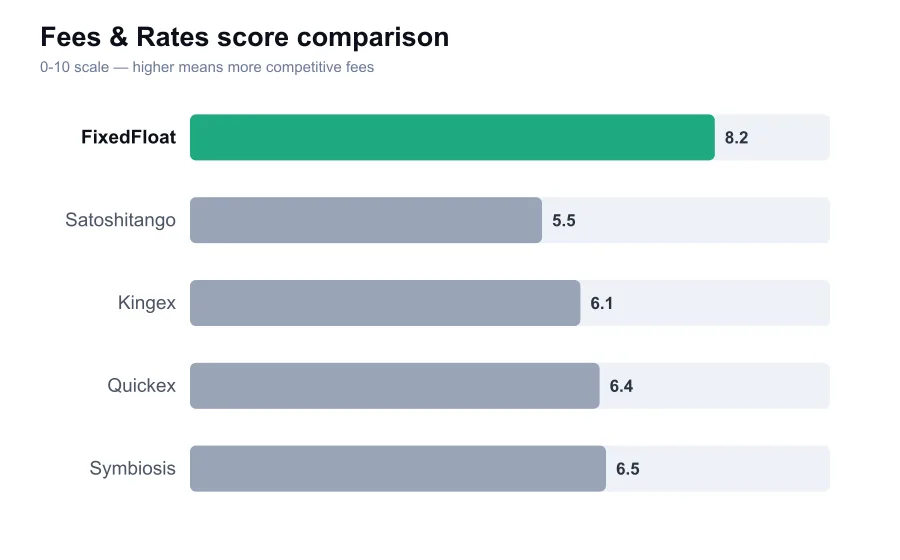
The fee structure is also unusually easy to describe. FixedFloat has publicly advertised a 0.5 percent fee for floating-rate exchanges and a 1 percent fee for fixed-rate exchanges, with network fees accounted for in the transaction economics. That does not mean every quote is the cheapest available. Liquidity spreads still exist, and network conditions still matter. But a stated fee model is much better than forcing customers to guess how much margin has been inserted into a supposedly attractive rate.
The floating option is the value choice. You get market execution after the deposit arrives, so the final amount can rise or fall while the order is being processed. In a stable market and on a fast chain, it is often the sensible option. The fixed rate costs more because FixedFloat assumes the price risk for a limited period. If you are converting a precise invoice amount, sending funds to a time-sensitive recipient, or operating during a sharp market move, paying the higher fixed fee can be rational.
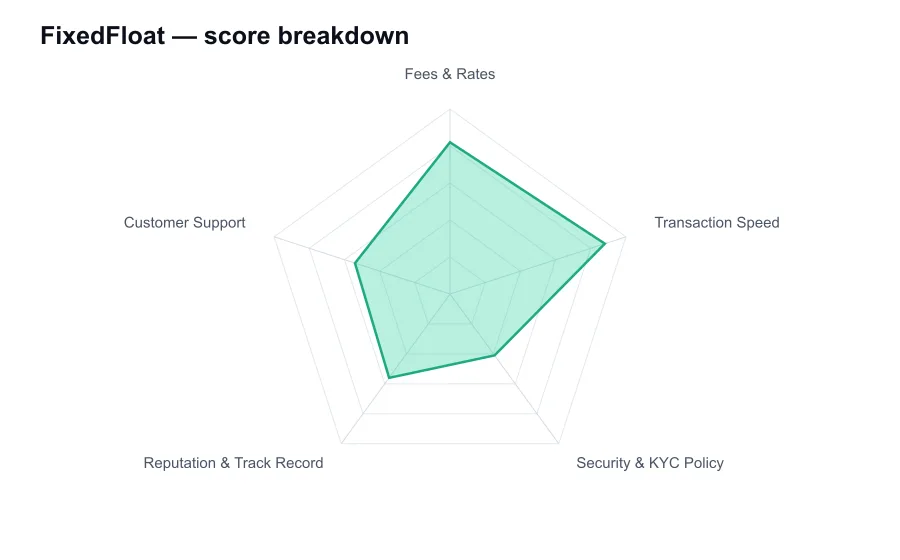
Speed is where FixedFloat has historically been very good. On liquid pairs, especially where Lightning is involved, completion can be extremely fast. The automated exchange flow has little unnecessary ceremony, and the site is built around rapid routing rather than human-managed trading. Still, the speed score needs qualification. A transaction sent on-chain is still subject to the source blockchain, and a swap involving a less liquid token can require more time than a BTC Lightning conversion.
The larger caveat is that fast automation can be unforgiving. Send a token over the wrong network, omit a required tag, or pay after a fixed-rate window expires, and you may need manual intervention. A service optimized for instant swaps is not necessarily optimized for hand-holding through edge cases. Users should read the deposit instructions rather than relying on visual similarity between networks. USDT on Tron, Ethereum, BNB Smart Chain, and other networks are not interchangeable simply because the ticker looks the same.
FixedFloat's no-registration approach is central to its reputation. Routine use has historically not required an account or traditional KYC process, which makes it popular with privacy-minded users and people who want to avoid another password database. But a no-account service should not be treated as a promise of legal immunity or total anonymity. Blockchain transactions are public, providers can apply screening, and terms or operational practices can change. Privacy-conscious users should understand the technology rather than relying on a slogan.
Security is the area where FixedFloat's record demands a hard, not sentimental, assessment. In February 2024, the service reported being attacked after blockchain analysts observed suspicious outflows estimated at roughly $26 million. The incident was serious, and any review that waves it away because the site later operated again is failing its readers. A hack does not automatically prove a platform is unsafe forever, but it is direct evidence that the company's security controls suffered a major failure.
The aftermath matters as much as the theft itself. FixedFloat attributed the incident to an external attack and indicated that it had taken steps to restore operations. Yet public technical disclosure has been limited compared with what a customer would want after an event of that scale. I would like to see a fuller independent accounting of the intrusion, safeguards changed afterward, custody exposure, and customer impact. Without that, users are being asked to make a trust decision with incomplete information.
This issue is especially important because FixedFloat operates without the familiar protections of a regulated brokerage relationship. There is no deposit insurance, no conventional account recovery process, and no obvious route for a consumer to reverse a completed blockchain transfer. The service's noncustodial branding reduces the risk of holding a long-term balance, but every in-progress exchange still creates a period in which the provider is responsible for your deposited coins. That is the precise period a security incident can hurt.
Its reputation is therefore split. Among crypto-native users, FixedFloat has a genuine reputation for speed, Lightning support, and frictionless swaps. Among more cautious users, the 2024 exploit is impossible to ignore, and the lack of extensive public corporate transparency adds weight to that concern. Both views contain truth. The product can be efficient and technically useful while still carrying a higher trust burden than a mature, heavily scrutinized provider.
Support is less elaborate than at ChangeNOW or Changelly. FixedFloat provides online help routes and transaction status information, but it does not project the image of a large multilingual support organization with deep escalation resources. For a smooth automated transaction, that may be irrelevant. For an incorrect deposit, stalled payout, or security-related concern, it becomes crucial. I would not make a large transfer unless I was prepared for the possibility that resolving an exception could take time and require technical evidence.
The practical way to use FixedFloat is narrow and disciplined. It can be excellent for a small or moderate Lightning-enabled conversion where speed matters and you already know the exact network mechanics. Use your own wallets. Test with a small amount. Confirm the receiving chain and address format. Save the order link and transaction IDs. Do not use it as a place to store money, and do not send a life-changing sum because a fixed quote happens to look attractive.
For large conversions, repeated business payments, or funds that need strong institutional recourse, I would look elsewhere. A regulated exchange with transparent corporate information, deeper liquidity, and a more extensive support path may be slower or more invasive, but the tradeoff is sensible. Privacy-focused users should also resist the urge to interpret a no-KYC interface as a guarantee that no transaction will ever be reviewed. Crypto services exist inside a changing legal and blockchain-surveillance environment.
FixedFloat remains one of the more technically compelling instant exchanges, particularly for Lightning users. Its stated 0.5 percent floating and 1 percent fixed fee structure is clearer than many rivals, and its automation can be impressively fast. The 2024 security incident, however, changes the recommendation completely. I can recommend it only for experienced users making carefully sized transactions that they can afford to expose to additional platform risk. The product is clever and useful, but trust should be earned again through transparency, not assumed because the swap screen is fast.