Godex is one of the better-known anonymous-style instant exchange services. It does not try to be a full trading platform, and that is the point. You choose a pair, send the deposit, and receive the converted asset in your own wallet. For people who dislike creating an account for every occasional conversion, Godex has a straightforward appeal. It has also been around long enough to be more recognizable than the newest crop of swap sites, although it still belongs in the higher-risk instant-exchange category rather than the regulated-exchange category.
The service is built around crypto-to-crypto swaps, not fiat purchases, spot charts, or an order book. You do not leave funds sitting in a Godex account because there is no conventional customer balance to manage. That reduces one kind of risk, namely a long-term custodial balance exposed to a platform failure. It does not remove execution risk. Between your deposit arriving and your payout being broadcast, Godex and its counterparties are responsible for the conversion.
Godex has long promoted fixed-rate exchanges as a core feature. A fixed quote is useful in a volatile market because it gives you a stated amount to expect, subject to the service's terms and the deposit arriving within the allowed window. That is generally preferable for a user who is moving a meaningful amount and does not want the rate to drift while Bitcoin confirms. Floating-rate swaps can sometimes produce a better result, but they transfer more market risk to the customer.
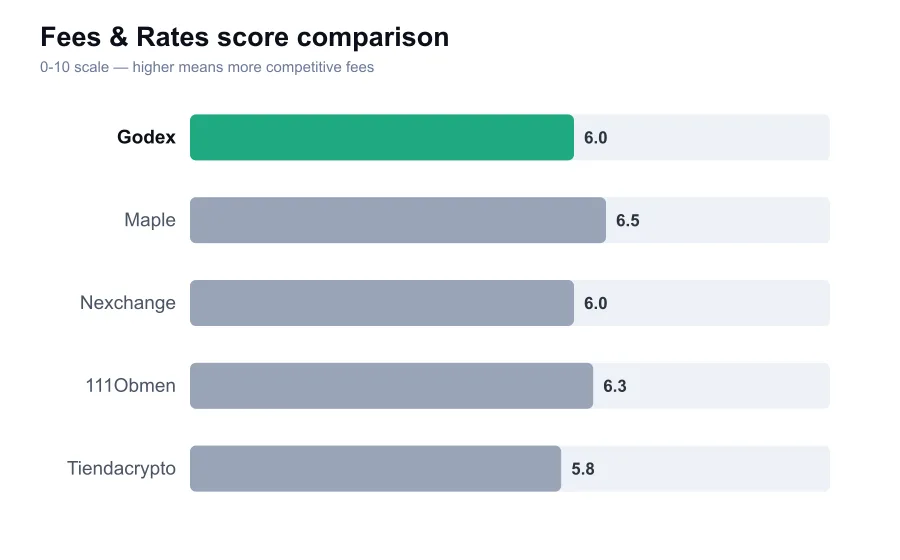
The fee conversation needs a little skepticism. Godex often presents its pricing as having no extra fees, but that does not mean the transaction is free. The provider's compensation is generally included in the exchange rate, while network fees also affect the result. This is normal for instant exchange services. The honest comparison is not "zero fee" against a named percentage. It is the exact number of coins you will receive after all costs, compared with alternatives at the same moment.
For common routes, Godex's quotes can be reasonable, especially when a fixed rate is valuable to you. But it is not consistently the cheapest route. Aggregators such as Trocador may reveal a better price from another partner, and a liquid order-book exchange can beat any instant service if you are willing to deposit, trade, and withdraw. Godex charges for convenience, simplicity, and the ability to avoid an account. That is a fair trade for some users, but it should be a conscious one.
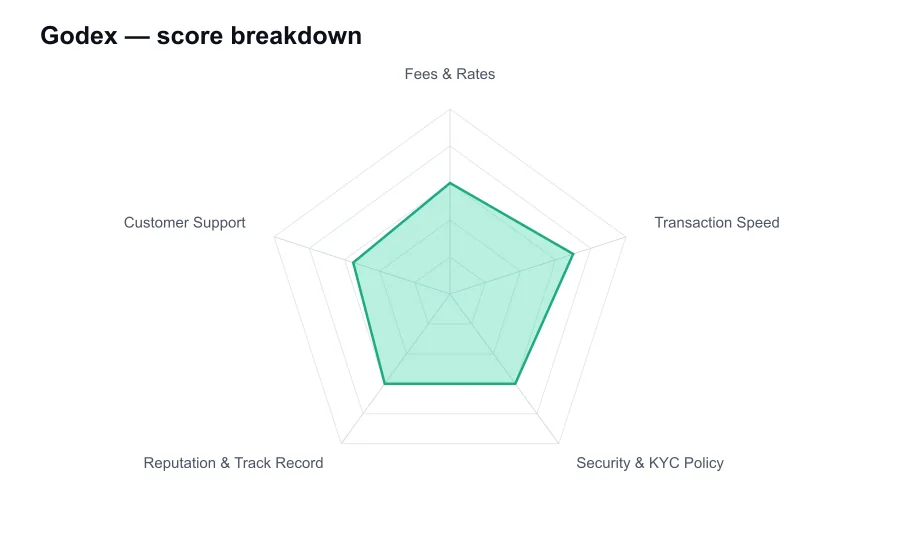
Speed is usually adequate rather than spectacular. A simple route can complete in roughly 5 to 30 minutes after the incoming transaction has the necessary confirmations. That range becomes longer with Bitcoin, congested Ethereum transactions, large swaps needing deeper liquidity, or a chain that takes time to finalize. Godex cannot make blockchain confirmation disappear. It can only process efficiently after it sees the funds. Anyone needing a guaranteed deadline should not rely on any instant exchange.
Godex lists a broad selection of assets, which is handy for converting coins that a mainstream exchange may not support directly. The downside is that a long asset list invites mistakes. A user must select the correct chain for USDT, USDC, or any wrapped asset, observe minimum deposit limits, and check whether a memo or destination tag is required. Those are not small details. A technically correct trade pair can still fail if the network selection is wrong.
The privacy angle is real but often overstated by users. Godex has been associated with no-registration swaps and a relatively light front-end KYC process. Still, it operates under an anti-money-laundering policy and can request verification or investigate a transaction that triggers risk controls. A no-KYC default is not a promise that no transaction will ever be reviewed. If funds are sourced from a sanctioned service, connected to theft, or otherwise flagged, the customer may face a delay and a request for information.
That policy puts Godex in the middle of the privacy spectrum. It is more convenient than a regulated exchange that asks for identity documents before you can trade. It is less predictable than a regulated exchange because the review can happen after the funds are already in motion. For ordinary, clean-wallet swaps, that distinction may never matter. For someone moving funds with a complicated history, it matters a great deal. Do not send money you urgently need if you cannot tolerate a compliance hold.
Godex's reputation is decent for its niche, not spotless and not institutional. It has a longer operating history and far more name recognition than obscure instant exchangers. At the same time, independent discussion includes the standard complaints seen across this category: slow transactions, rate expectations that did not match the result, and frustration during verification or support exchanges. Those complaints do not prove misconduct by themselves, but they are a reminder that support performance defines the experience when a swap goes wrong.
Customer support is available through its site channels, and Godex markets round-the-clock assistance. Routine questions are usually easier than complex transaction disputes. Send the exchange ID, deposit hash, amount, asset, and receiving address in the first message if there is a problem. That shortens the back-and-forth. I would also keep screenshots of the quote and transaction page, because a verbal description of a changing crypto rate is not very useful to a support agent.
Security is mostly a matter of limiting exposure. Godex's noncustodial-style transaction model is safer than storing a portfolio at a small exchange for months, but it is not trustless. You are still trusting the service with assets during execution. Use a hardware wallet or reputable self-custody wallet for the receiving side, bookmark the genuine domain, and ignore search ads and imitation links. Phishing is a much more common threat to ordinary users than a sophisticated protocol exploit.
Godex is strongest as a practical tool for a user who already understands wallets and simply needs a one-time conversion. Its fixed-rate option is meaningful, the lack of routine account creation is convenient, and its history is adequate enough for modest use. I would not call it the automatic best price, nor would I use it for a transaction that cannot withstand an hour or two of uncertainty. Its value is convenience, not perfection.
My final take is that Godex remains a credible mid-tier instant exchanger. It is more established than many similar services and offers a sensible fixed-rate option, but its quoted-rate model and potential compliance reviews mean it is not as predictable as a major regulated venue. Compare its final output, start with a modest amount, and use it for the jobs it is good at. For frequent trading, fiat access, or large transfers requiring formal accountability, it is the wrong tool.