AvanChange operates in the practical end of the crypto exchange market, where the job is to convert one asset or payment method into another without asking the customer to learn a professional trading interface. It is an exchanger, not a deep-liquidity spot market. That distinction sets the expectations correctly. You come here for a particular route, often involving a stablecoin, a card, or an e-wallet, rather than for advanced charting and maker orders.
The service offers a familiar exchange form: select what you send, select what you receive, enter the amount and destination details, then follow the payment instructions. This can feel refreshingly direct next to a full exchange dashboard. It also means the customer needs to take more responsibility for checking every field. A mistaken card number, wallet network, or payment reference can turn an easy swap into a support case.
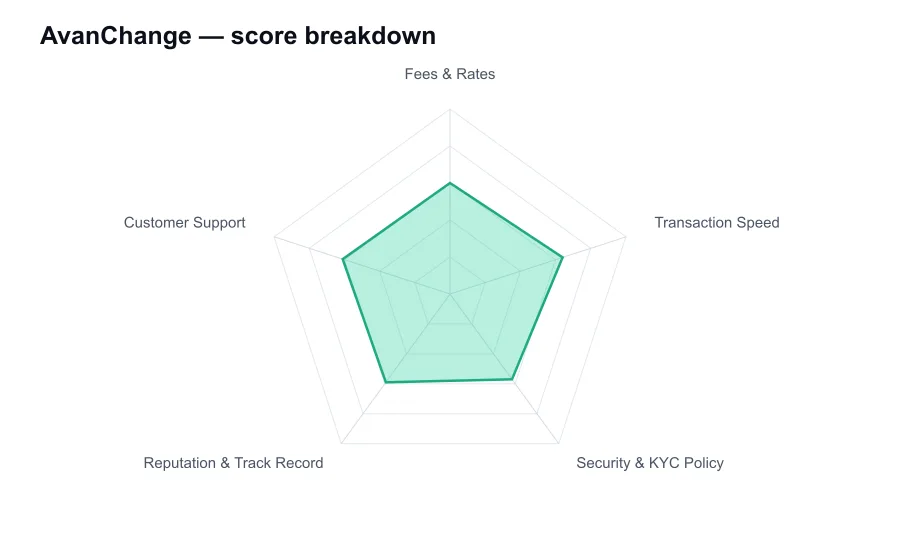
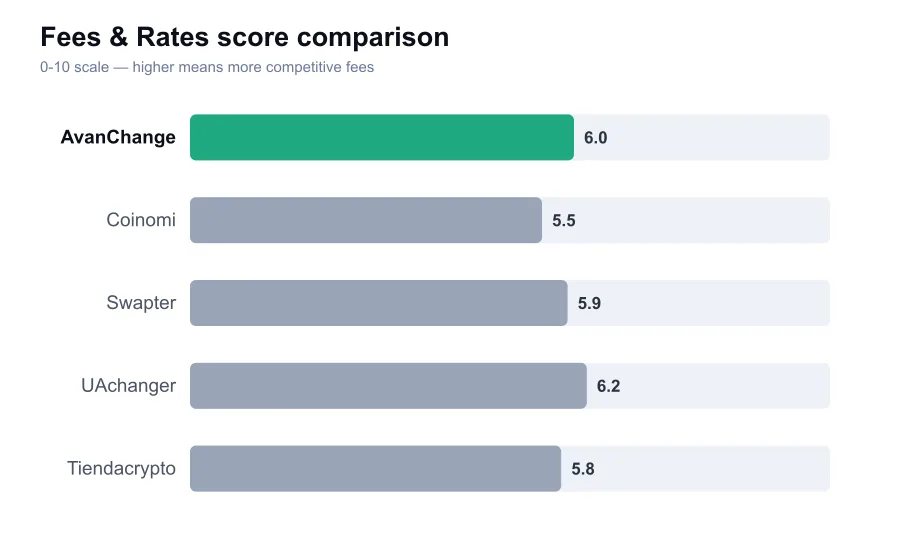
AvanChange's quoted rate is its real fee schedule. Like many independent exchangers, it does not work from one public flat percentage across every route. Its margin, liquidity cost, network cost, and payment risk are largely baked into the amount shown on the order page. That can be perfectly fair, but it makes marketing claims about low fees meaningless unless you compare the final payout with other live quotes.
For stablecoin-to-stablecoin or mainstream crypto swaps, the price can be acceptable, especially if the alternative requires a deposit, a trade, and a withdrawal from a larger exchange. For card purchases and fiat cash-outs, expect the convenience premium to be higher. Large regulated exchanges frequently beat it on raw execution cost, but they may not support the same local payment route or may demand more account verification. AvanChange sells convenience, not wholesale pricing.
Do not assume the rate is protected until the terms say it is. A floating quote can shift between payment initiation and the service receiving enough confirmations. This matters most during sharp Bitcoin or Ether moves. If a route uses a fixed rate, read the time limit and payment instructions closely. A fixed rate is only valuable if you can make the exact payment promptly and avoid a bank or wallet delay that puts the order outside its protected window.
Speed depends heavily on what sits at either end of the order. Crypto transactions on faster networks can be completed rapidly once the inbound transfer is recognized. Bitcoin and Ethereum during congestion are naturally slower, and the service cannot bypass block confirmation rules. An exchange that promises instant completion while waiting for an unconfirmed Bitcoin payment is selling fantasy. A realistic process begins only after the payment can be safely credited.
The weaker point is not usually the crypto side but the payment rails. Card transfers, banks, and electronic payment systems can trigger fraud filters or require a human review. That may be sensible from the operator's perspective, but it is inconvenient if you expected an immediate payout. AvanChange is best used when you have some time buffer. It is not where I would send money five minutes before an important payment deadline.
There is value in the lower-friction approach used by services like this. Many users want to make an occasional swap without submitting documents to a large exchange and without leaving funds on a custodial platform. Yet the reality is more nuanced than the phrase no-KYC suggests. The service can request identification or transaction information if compliance concerns arise, especially for fiat-facing payments. Anyone who cannot tolerate that possibility should not start a time-sensitive order.
Security information is less extensive than what customers receive from a major exchange with long public reporting, formal licensing pages, bug-bounty programs, and detailed asset-custody policies. That is not an automatic red flag, but it lowers the margin for trust. Use the official domain, verify HTTPS and the payment details shown in your order, and ignore anyone claiming on Telegram or email that your destination address has changed. That is a classic exchanger impersonation tactic.
AvanChange's reputation should be judged as an active service in the exchanger ecosystem, not as a household-name financial institution. Listing-site feedback, public comments, and the longevity of the domain are relevant evidence, but none is proof that every route will be smooth. Read recent complaints carefully. The important question is whether disputes show a repeated pattern of unexplained holds or whether they mainly involve incorrect payments, blockchain delays, and normal compliance checks.
Reserves deserve attention before placing a sizable order. An apparent route may be available while actual immediately deployable reserve is limited, especially for less common currencies or payment systems. If the amount is substantial, ask support whether the order can be processed at the displayed rate and whether it will be automatic or manual. A legitimate operator should be able to explain limits and timing before you send funds, even if it cannot guarantee bank processing.
Support is central to AvanChange's user experience because the product is a transaction, not a persistent account relationship. A response that says where an order stands is more valuable than polished sales chat. Provide the order number, sending address, transaction hash, amount, and timestamp in one message. If a payment was made from a third party's account, say so immediately, since name mismatches are a common reason for compliance questions.
I like AvanChange more as a route-finder and execution tool than as a destination for recurring activity. It can save time for users who already understand wallets, networks, and payment details. The interface removes some exchange complexity, but it does not remove transaction risk. Test a route with a small amount before trusting it with a larger transfer, particularly if the payout depends on a local card or banking channel.
AvanChange earns a middling but workable recommendation. It has the appeal of a focused exchanger and may be a good answer to a specific conversion problem, but it does not beat a major exchange on transparency, depth, or predictable pricing. Use it for the routes it handles well, and compare the delivered amount rather than chasing an advertised fee. Careful users can get real utility here. Users who need formal protections and consistent large-volume execution should shop elsewhere.