WmMoney appears to target the everyday exchanger market, where users want to move between crypto, electronic money, bank transfers, and sometimes card-based payment methods without learning a trading terminal. That audience values convenience, but it is also exposed to the least forgiving kind of mistake: sending money to a counterparty before receiving anything back. The service should therefore be judged less by its marketing language and more by quote discipline, support quality, and how transparently it handles exceptions.
This is not the same proposition as using a major centralized exchange. A large venue normally gives you an order book, a stated trading fee, account controls, and a broad public compliance record. WmMoney is better understood as a conversion desk with an online form. That can be quicker for a single route, particularly where local payment rails are involved, but it gives the customer less visibility into how the rate is made and less room to intervene after an order is funded.
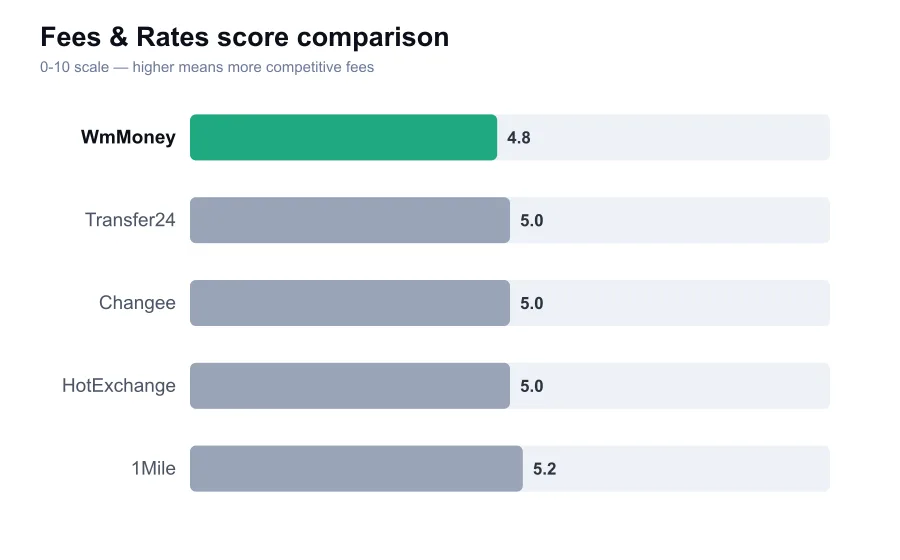
Fees are likely embedded in the exchange rate rather than presented as one clean percentage. That is standard for this business model, though it makes comparisons harder than they should be. A customer should compare the exact number of coins or fiat units they will receive, not the advertised market price and not a vague claim of low commission. If a route shows an attractive rate, check the minimum, maximum, reserve, and any stated payment-system fee before treating it as the real all-in price.
WmMoney can be reasonable on routes that are awkward to complete through a mainstream exchange, but that convenience carries a cost. Electronic money conversions and card payouts are especially prone to wider spreads because the provider is assuming payment reversal, acquiring, and settlement risk. For a small urgent order, a slightly weaker rate may be tolerable. For repeated conversions or a substantial amount, a 1 percent or 2 percent difference compounds quickly, and transparent exchange or P2P alternatives may be cheaper.
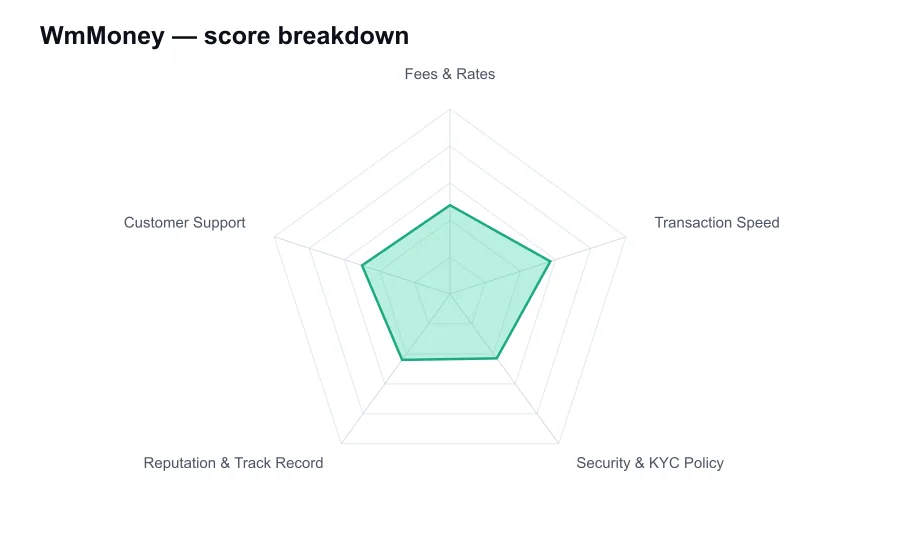
I would score its fees below average until a user can independently verify the final output across several live quotes. A service with no explicit transaction fee can still be expensive. There is also a practical issue: floating quotes in a fast market can produce a result that differs from what the customer saw at the start. Read the rate rules before paying, and do not proceed if the terms do not state what happens when the payment arrives late, short, or from a third party.
Speed has the potential to be good on a clean, well-funded order. Crypto transfers on fast networks can be processed promptly, while payment-system payouts may depend on the receiving institution and working hours. The advertised completion window matters less than the actual mechanics. An exchange can only release an outbound asset after it sees the incoming payment, validates it, and completes any required compliance check.
That last stage is where smaller providers separate themselves. A transaction that needs a human review can sit longer than a user expects, especially if the sender name does not match the order details or a bank payment lacks a clear reference. WmMoney is not the place to send funds that must land within minutes unless you have already completed a successful test on the same route. The sensible expectation is prompt service for normal cases, not guaranteed instant settlement.
Security information is the largest unanswered question for a customer deciding whether to use it. A secure-looking site, HTTPS, and an order number are baseline requirements, not proof that operational funds are segregated or that private keys are protected well. I could not base a high score on publicly demonstrated proof of reserves, a recognized security audit, or a detailed governance and incident-response record. That does not prove poor practice. It does mean the customer bears a meaningful evidence gap.
The KYC question requires plain language. WmMoney may be usable without the extensive account verification expected at a regulated exchange, but no responsible user should read that as an unconditional anonymity promise. AML screening, fraud prevention, suspicious-transaction reviews, and requests for source documentation can arise after a payment is made. If your financial privacy needs are absolute, this model is unsuitable because the provider can freeze an order while asking for information.
A practical safeguard is to use only your own payment account and wallet, enter the exact requested details, and avoid intermediaries. Do not split an order unless support explicitly tells you to. Preserve screenshots before payment and do not rely on a chat transcript alone. If a problem occurs, the transaction hash, bank receipt, timestamp, and order ID are the evidence that lets a legitimate support team trace the funds. Without them, even a simple correction becomes harder.
WmMoney's public reputation looks narrower than that of long-running international brands. It may have user feedback in exchange-monitoring communities, but users should inspect the dates and substance rather than just the aggregate rating. A mature reputation is built from years of independently visible orders, consistent terms, and credible resolution of complaints. A list of short five-star remarks does not tell you how the operator behaves when an order is delayed or a payment is disputed.
That lack of deep public history makes WmMoney more appropriate for modest transactions than for capital you cannot afford to have tied up. Search for reports tied to the exact service name and domain, not just similar names. Check whether contact details, legal terms, and listed reserves are internally consistent. If a provider's identity changes frequently or it only responds through informal messaging accounts, I would walk away regardless of the quoted rate.
Support is a mixed but important consideration. An operator handling manual payment directions needs responsive human support, not merely automated acknowledgements. Before placing a meaningful order, see whether the service publishes a clear contact channel and working schedule. A decent response should explain whether funds are awaiting confirmations, payment verification, liquidity replenishment, or compliance review. Vague assurances that an order is being processed are not good enough after the normal stated time has passed.
My judgment is that WmMoney is a situational tool, not a default exchange. It may be useful where it delivers a better final result on a difficult payment route and the user has tested the service successfully. It lacks the public transparency to justify blind trust or a large first transfer. Compare the payout, begin conservatively, and use a bigger regulated venue if your priority is clear fees, documented controls, and a robust escalation path.