HotExchange presents itself as a lightweight crypto swap service rather than a full trading venue. That distinction matters. You are not getting an order book, a regulated brokerage account, or the kind of transparent market infrastructure offered by Kraken, Coinbase, or Bitstamp. You are trusting a website to quote a conversion, receive one asset, and send another. For a small, uncomplicated swap, that can be convenient. For serious money, the lack of a deep public record changes the risk calculation immediately.
The service appears to sit in the crowded end of the instant-exchange market, where dozens of brands promise quick conversions without the friction of a conventional account. This is a market segment where appearances can be misleading. A clean quote page and a long coin list are easy to build. What separates a credible provider from a disposable one is clear ownership, operating history, liquidity sources, published terms, and a support team that can solve a failed transaction without disappearing behind a ticket form. HotExchange does not make that case as strongly as established competitors do.
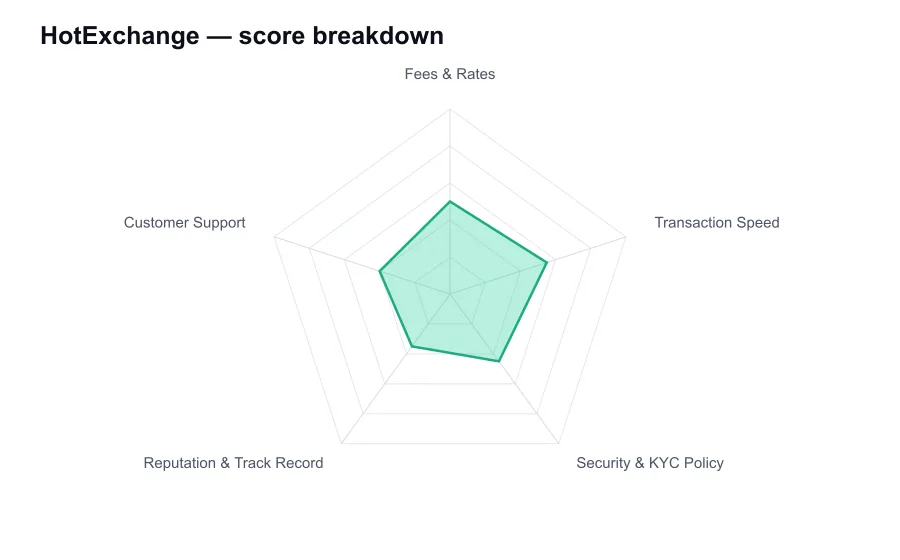
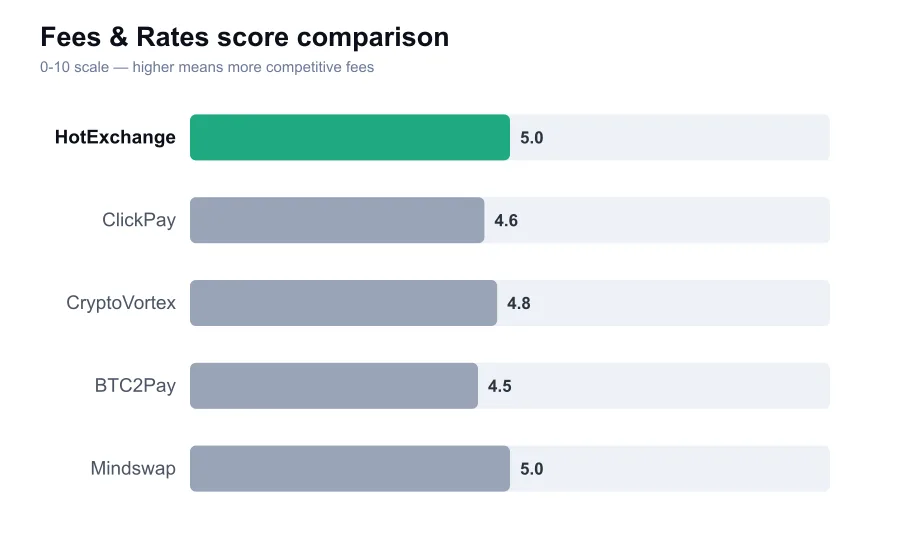
Pricing is the first area where I would slow down. I could not verify a durable, public fee schedule that states a flat percentage for every swap, nor a detailed explanation of how its quoted rate is constructed. That does not mean a quote is automatically bad. Instant exchangers often embed their margin in the rate, and network fees can change minute to minute. But customers deserve to know whether they are paying a visible service fee, a liquidity spread, a network fee, or all three. With HotExchange, the final number on the confirmation screen should be treated as the fee disclosure.
That means comparing the received amount, not merely the headline exchange rate. Open the same pair on a reputable alternative such as ChangeNOW, SimpleSwap, or a major spot exchange, then compare the actual output after all charges. For a modest BTC to USDT or ETH to BTC swap, a difference of one or two percent can be more important than a supposedly fast checkout. A service with no stated commission can still be expensive if its rate is padded. HotExchange has not earned enough transparency points for me to assume its quotes are routinely competitive.
Fixed-rate language also deserves careful reading wherever it appears. A fixed quote normally protects a customer only for a limited deposit window and only if the received amount meets the stated conditions. Send late, send less than required, or use a congested network, and the transaction may fall back to a floating rate. That is standard industry practice, but it needs plain explanation. I would take screenshots of the quote, the deposit address, the expected amount, and the order identifier before sending anything. Those basics make a support dispute much easier to document.
Speed is probably the reason a user would consider HotExchange in the first place. A simple swap can be completed after one or more block confirmations, plus the provider's own liquidity and payout processing. For fast chains, that may feel quick. Bitcoin and Ethereum transfers are different stories during congestion, especially if the customer uses a low network fee. No exchanger can make an underpriced Bitcoin transaction confirm quickly, and no instant-swap brand should imply that it can. The realistic question is whether the provider releases the payout promptly after receiving confirmed funds.
I have not found enough independently verifiable operational reporting to give HotExchange a top speed score. There is a large difference between displaying an estimated processing time and demonstrating consistent settlement performance across hundreds of public customer reports. A good service tells users what stage an order is in, acknowledges a delayed deposit, and provides a transaction hash for the payout. Without that visibility, a normal blockchain delay can look exactly like an internal problem. First-time users should test with an amount they can afford to have tied up for a day.
The security model needs similarly cautious treatment. HotExchange is not a self-custody wallet. During a swap, the customer temporarily gives up control of the deposited asset and relies on the operator to complete its side of the transaction. That is counterparty risk, even if the funds are only held briefly. The sensible rule is to verify the domain character by character, avoid links from social media advertisements, use a fresh browser session, and never let a support representative persuade you to send funds to a replacement address through chat.
Its KYC policy should not be misunderstood either. A service may market a low-friction swap flow while retaining the right to request identity documents or source-of-funds information for an order it flags. That is common among non-custodial swap interfaces because compliance screening happens behind the scenes. The problem is not that checks exist. The problem is unclear escalation rules, because a customer can discover a verification request only after funds are already deposited. Anyone needing certainty that no documents will be requested should not assume HotExchange offers that certainty without written confirmation from its current terms.
Public reputation is where HotExchange looks least convincing. I do not see the long, easily audited trail of corporate disclosures, regulatory registrations, major security reporting, and years of broadly distributed customer feedback that would justify handing it a large balance. A handful of reviews or social comments does not establish reliability. Review platforms can be useful, but they are vulnerable to selective solicitation, affiliate promotion, and fake complaints as well. The useful signals are detailed reports with transaction IDs, consistent timeframes, and evidence that the company answered problems publicly.
That doesn't make HotExchange uniquely suspect. It does put it in the category of small providers that must be judged transaction by transaction. An established name can fail too, but it usually leaves a clearer path for escalation and has more to lose from a public service failure. HotExchange has a thinner reputational cushion. I would not use it as a storage destination, a recurring settlement rail, or a place to exchange funds needed for a time-sensitive purchase. The convenience case is limited to occasional, low-value conversions.
Support is difficult to grade generously without a strong, documented record of resolutions. An email form or live chat badge is not the same as accountable service. What matters is whether agents can identify a transaction, explain a delay in specific blockchain terms, and provide a resolution timetable. Before depositing, I would check whether the site exposes a real support channel, an order lookup tool, and terms describing failed payments, wrong-network deposits, and refund deductions. Those details are boring until an order goes wrong, then they are the whole product.
There are a few practical ways to reduce risk. Send a small test swap first. Use assets and networks you understand, not wrapped tokens with similarly named tickers. Keep records of your wallet transaction hash and the exact address displayed by the order page. Do not split a deposit unless the instructions explicitly allow it, and do not send a second payment simply because a chat account claims the first one is missing. Real support can work from an order ID and on-chain evidence.
HotExchange may appeal to someone who values a quick swap page and has a small amount to convert, but the available transparency does not justify blind trust. The absence of a readily verifiable fee framework, mature reputation record, and clearly documented compliance process leaves too much for the customer to discover after initiating a transaction. I'd pick a better-known provider for anything substantial, even if the quote is marginally less attractive. HotExchange is a service to test cautiously, not a platform to make part of your financial routine.