ClickPay is a difficult name to assess without care because it is generic and has been used across payment related services. In the crypto exchange context, that alone creates a practical concern: users must be certain they are dealing with the intended operator and not a similarly named payment product, clone, or advertising redirect. Brand ambiguity is not a cosmetic issue in crypto. It is exactly how people end up sending assets to the wrong place.
Assuming the intended ClickPay service is being used as a quick exchange or payment conversion route, its market position is not that of a major global exchange. It is a convenience layer. The appeal is a simple payment style experience, usually aimed at users who want a transaction completed with minimal trading knowledge. The problem is that frictionless design can hide the details a careful customer needs before committing funds.
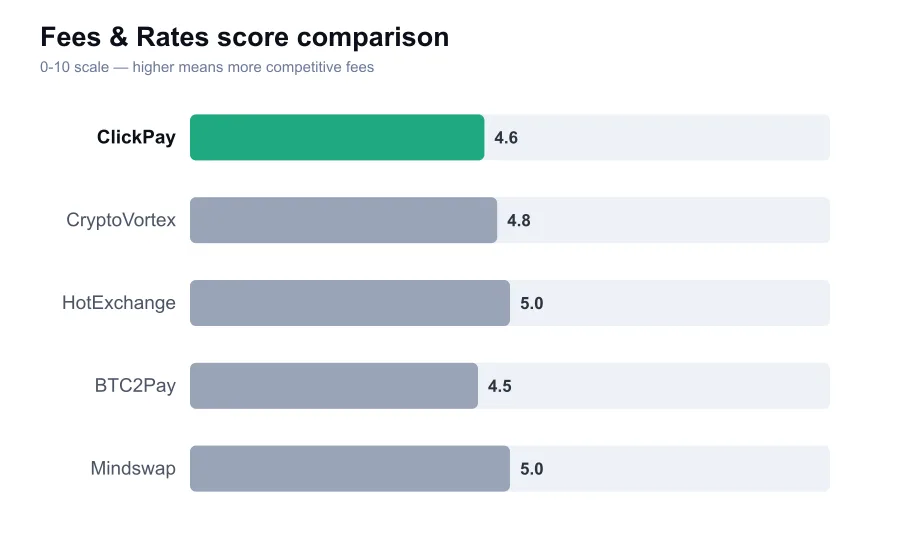
Price is the first detail to expose. ClickPay should not be evaluated by a claim of low commission unless the site also shows the conversion rate, any payment method surcharge, the network fee, and the final delivery amount. A card funded crypto purchase and a crypto to crypto exchange can have radically different economics even if both are presented under one familiar checkout flow. Payment processors, chargeback risk, and liquidity spreads all have to be paid for by someone.
That someone is usually the customer. With smaller payment oriented exchange services, the total charge is often distributed across the quote instead of listed as one simple percentage. This makes the service look tidy, but it makes comparison harder. The disciplined approach is to calculate the effective cost from the amount sent and the amount received, then compare it to a known benchmark. A quote that looks convenient can still be expensive after the spread is measured.
ClickPay may make sense for a low value purchase where speed and simplicity outweigh a few percentage points of price difference. It is much harder to justify for repeated activity. A user making weekly conversions can save meaningful money by using an exchange with transparent spot fees and withdrawing in batches. Convenience has a price, and ClickPay is best judged as a payment tool rather than a low cost trading venue.
Its speed will depend heavily on how it is funded. A crypto deposit is generally constrained by blockchain confirmations. Card transactions can appear immediate but may face issuer checks, 3D Secure prompts, or fraud controls. Bank transfers have their own timetable. Even after payment approval, the crypto delivery side may be delayed by wallet processing, network congestion, or an internal review. Promising yourself an instant outcome is a mistake with any provider in this category.
The right way to use a service like ClickPay is to leave room for that uncertainty. Do not make a purchase for a token sale closing in minutes, do not rely on it for an urgent merchant payment, and do not send funds to an address you have not independently confirmed. If the recipient needs a specific token standard or a memo, check it before initiating the order. Recovery from a wrong network payment can range from difficult to impossible.
KYC is especially relevant for payment linked products. Card issuers and payment providers operate under fraud and anti money laundering rules, so identity checks are not unusual even where the front end looks lightweight. A user should read the verification policy before payment, not after an order is held. The important practical question is whether you can meet the likely request for identity, payment ownership, and source of funds evidence if the transaction is flagged.
The safety picture is weakened by the limited public visibility associated with a small and generically named provider. I would want to see a clearly identified legal operator, coherent terms, a privacy policy that identifies the data controller, and support details that can be tested. If those basics are absent or contradictory, stop. A smooth landing page and a padlock icon cannot compensate for uncertain ownership or weak disclosure.
There is also a cybersecurity angle that deserves more attention than it gets. Search for ClickPay and you may encounter multiple unrelated results. Never use a domain copied from a social post or a sponsored ad without verifying it from a trusted source. Support staff should never ask for a wallet seed phrase, remote computer access, or an additional transfer to release an existing transaction. Those are classic fraud signals, not normal exchange procedures.
Reputation is therefore ClickPay's softest area. The provider does not carry the broad, easily researched history of a Coinbase, Kraken, Bitstamp, or established specialist payment company. That is not a verdict on every transaction it processes. It is a reason to limit exposure and demand more evidence before using it regularly. Reputation is earned through years of accessible policies, consistent service, and accountable handling of problems, not through a polished checkout.
Support quality becomes crucial if a card payment is charged but crypto has not arrived. A capable team can reconcile the authorization, identify the transaction, and state whether a reversal, resubmission, or additional information is needed. A weak team leaves the customer bouncing between the bank and the exchange. Before using ClickPay, check whether it offers a traceable ticket channel and whether its support information includes realistic response expectations.
For the right person, ClickPay may still have a place. A technically competent user making a small, non urgent payment or conversion can use it cautiously if the live quote is acceptable and the operator's details check out. Keep the amount low until there is a successful history. Use a wallet you control, and document the transaction from the first screen through to the blockchain hash.
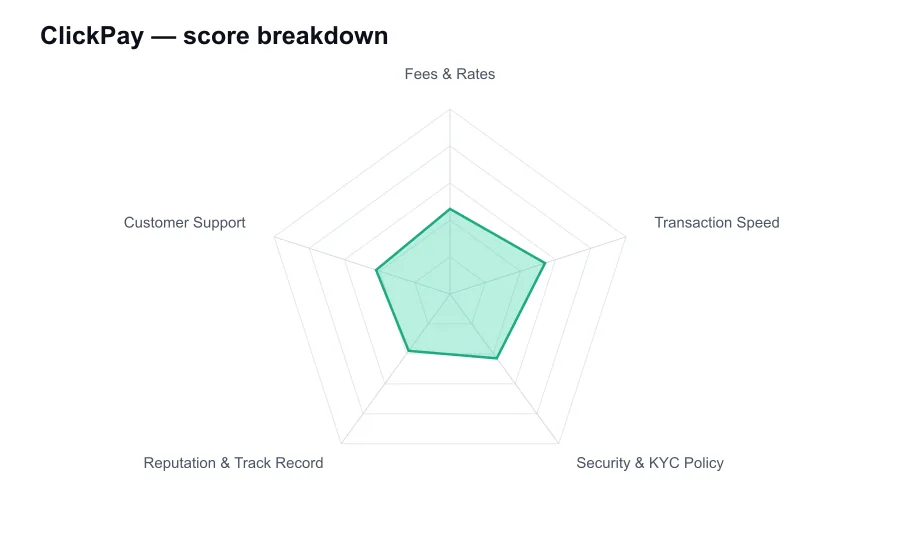
My final view is more skeptical here than with a clearly established exchange. The generic brand name, likely quote based costs, and limited public track record create too many reasons to keep transactions small. ClickPay may deliver convenience, but convenience is not the same as trust. Users who want card buying, large orders, or dependable recourse should choose a recognized regulated platform with transparent fees and an identifiable support structure.