BtcChange24 is the kind of name that immediately places a service in the smaller, always-open crypto exchanger market. The promise is obvious, convert one digital asset into another without joining a traditional exchange and without learning an order book. That is useful for someone who already has a self-custody wallet and needs a simple conversion. It is also a business model where the user has to do more due diligence than the glossy interface suggests, because funds are entrusted to the operator in the middle of the transaction.
A service like BtcChange24 should not be judged by how many coins it lists or how quickly it says an order can be created. Those are easy claims. The revealing questions are whether the rate calculation is understandable, whether settlement delays are explained with actual transaction data, and whether the firm has a record that survives beyond its own website. On those measures, BtcChange24 does not appear to offer the breadth of independently verifiable information available from long-standing brands such as Kraken, Coinbase, or even mature instant-swap services with substantial review histories.
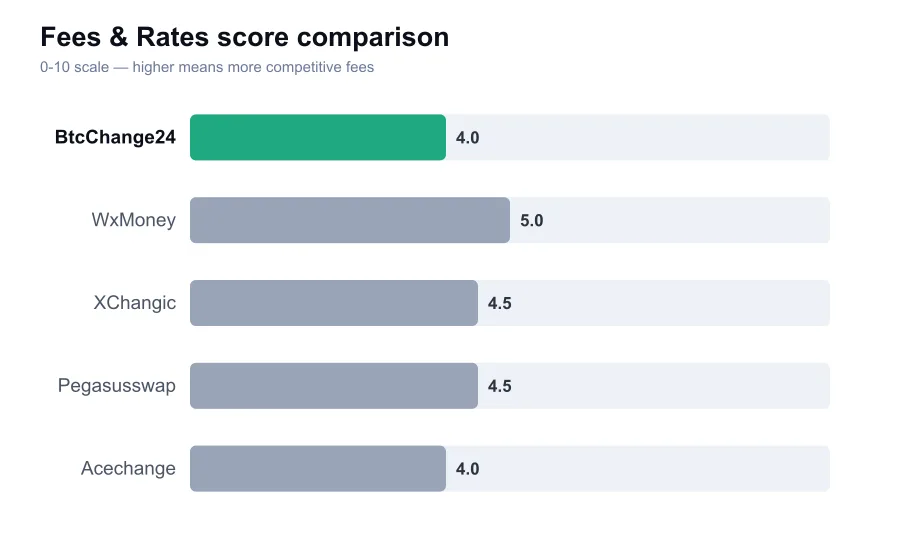
The fee question is more complicated than a single percentage. Some exchangers charge a visible service fee. Others show a floating exchange rate with their compensation embedded in the spread. Others add the outbound network fee near the end of the order. A customer only needs one figure in practice, the number of coins or tokens that will arrive in the destination wallet. BtcChange24 should be judged on that final output. If the site does not plainly itemize each component, then a customer should assume the quote itself contains the provider's margin.
This is especially important on stablecoin swaps. USDT and USDC can be inexpensive to move on some networks and expensive on Ethereum. If a BtcChange24 quote seems unusually favorable, confirm that the destination network is exactly the one you intended and that the payout fee is included in the amount shown. The ticker alone is not enough. Sending a token on an unsupported chain is one of the most common and costly errors in this sector, and a small exchanger may have limited ability or willingness to recover it.
Bitcoin transactions create another source of false expectations. The service cannot start a reliable conversion until the incoming payment is sufficiently confirmed according to its own policy. A deposit sent with too low a mining fee can sit in the mempool for hours. A replacement-by-fee transaction can further complicate processing. BtcChange24 may be able to complete the payout quickly after confirmation, but it cannot turn a slow incoming transfer into an instant settlement. Customers should distinguish network delay from provider delay, while still expecting the provider to show meaningful status information.
I would not give BtcChange24 a high speed rating because public, independently checkable evidence of consistent execution is limited. That is not an accusation of slow processing. It is a refusal to treat an estimate on a checkout page as performance data. Fast-chain swaps may complete in minutes under good conditions. A Bitcoin-based order can take much longer. For any transaction tied to a travel booking, a liquidation deadline, or an OTC deal, use a platform with stronger operational reporting or leave much more time than the advertised estimate.
The security conversation begins with custody. The term non-custodial is often used loosely in crypto marketing. If you send coins to an exchanger's deposit address, it controls those coins until it sends the payout, even if it never creates a traditional account balance for you. That is limited-duration custody and it still exposes you to the operator's security and solvency practices. BtcChange24 should therefore be used as a transfer service, not as a wallet. Keep the rest of your holdings in an address you control.
Website security is just as practical. Bookmark the verified domain once you have checked it carefully. Do not use links in unsolicited Telegram, Discord, email, or search advertisements. Never reveal a seed phrase to resolve an exchange issue, because no legitimate support agent needs it. If a supposed representative says an order requires an additional transfer to unlock funds, stop and verify through the provider's published channel. That pattern is a standard crypto scam, not a normal compliance procedure.
KYC is an area where customers should be realistic. A quick swap interface may permit an order without advance registration, but that does not make every deposit exempt from screening. Providers can pause transactions based on address-risk tools, sanctions screening, transaction patterns, or internal limits. I could not establish a particularly detailed public framework that tells a user exactly how BtcChange24 handles each scenario. That lack of precision is a meaningful disadvantage for anyone whose coins have an uncertain transaction history or who cannot provide documents promptly.
Its reputation is modest rather than established. BtcChange24 does not have the broad, hard-to-fake public record that lets a reviewer confidently separate isolated complaints from a systemic issue. A couple of favorable comments are not sufficient proof of reliable operations, and a couple of negative posts are not proof of fraud. The right response to limited evidence is not panic, it is smaller exposure. Do not make a large first order simply because the quoted rate is tempting or because a review widget contains five-star ratings.
Support is where smaller platforms either build loyalty or lose it. A useful team can explain whether a deposit has reached the required number of confirmations, identify the payout transaction hash, and state whether a compliance hold is active. A weak team sends vague assurances while the customer watches an order page. Before using BtcChange24, check for a current support route and read the rules for underpayments, overpayments, duplicate deposits, expired orders, and refunds. Those cases expose the difference between a real operation and a thin front end.
The safest practical procedure is dull but effective. Start with a small amount. Use an asset and network you have used before. Copy addresses rather than retyping them, then verify the first and last characters. Wait for the entire cycle to finish. Confirm that the payout reached your own wallet and that the amount matches the expected output after any disclosed network charge. Only then should you decide whether the service deserves another transaction.
BtcChange24 might work for an informed user seeking a one-time conversion and willing to accept a higher level of uncertainty than on a major exchange. It is not where I would send a treasury balance, payroll funds, or the proceeds of a property sale. The apparent simplicity is real, but simplicity does not replace accountability. In crypto, every intermediary needs to earn trust with disclosure and history, and BtcChange24 has not accumulated enough visible evidence to earn a strong recommendation.
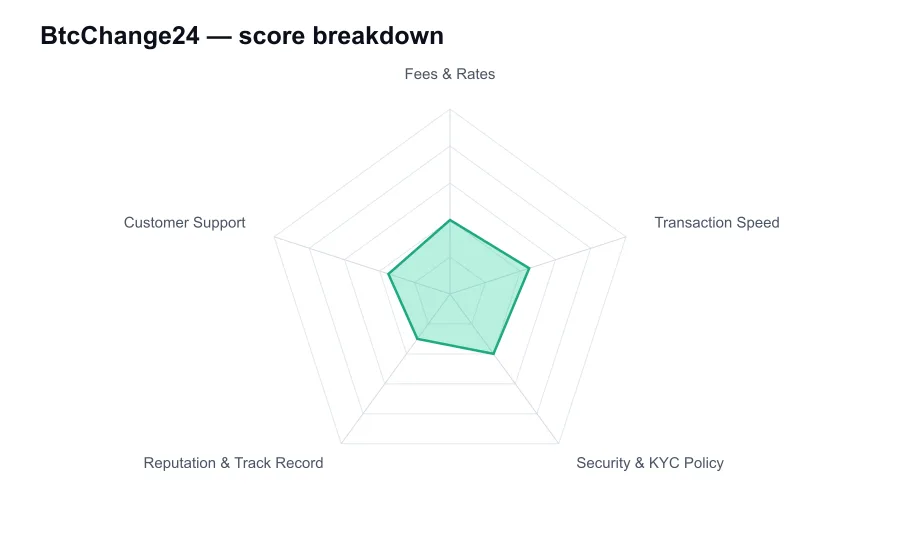
My final take is guarded. BtcChange24 may be functional for small swaps, but its limited public transparency makes it difficult to rate highly on fees, security, reputation, or support. The right customer is not looking for certainty, but for a convenient test transaction and is prepared to document every step. Everyone else should choose a service with clearer rate disclosures, a stronger support record, and more public evidence of how it handles problems.