Moneta365 presents the kind of name that suggests always-open online money exchange, and that is probably the service's intended appeal. Crypto users often want a direct route at inconvenient hours, without waiting for a bank desk or navigating a full trading terminal. The problem is that a 24-hour promise is only useful if the business behind it is transparent about rates, reserves, compliance checks, and human support when automation fails.
This is not a provider I would place in the same trust bracket as a major exchange with extensive licensing disclosures, public incident reporting, and years of easily traceable market activity. Moneta365 appears closer to the small exchanger end of the market. That does not automatically disqualify it. Plenty of niche services can execute straightforward orders well. It does mean users need to examine the order mechanics much more carefully than they would with a familiar platform.
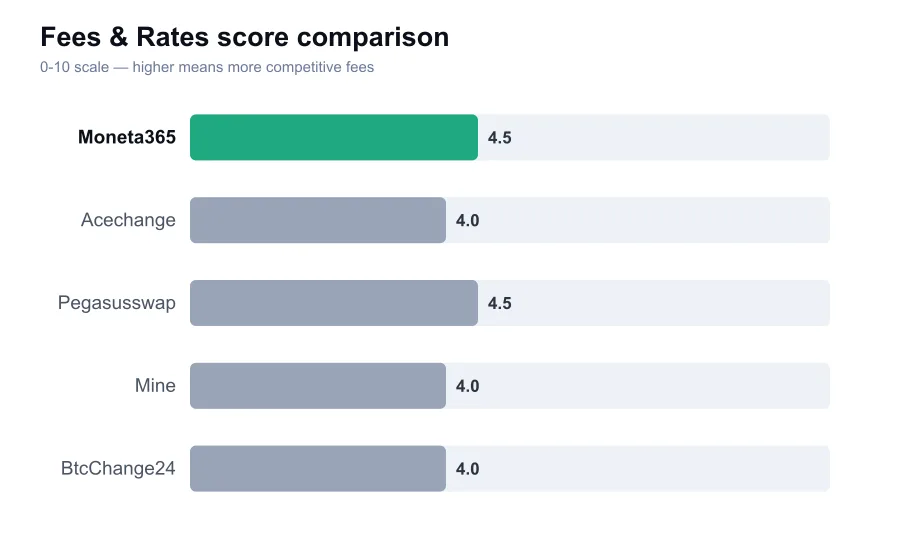
Fees are where small exchangers often make their best sales pitch and their least clear disclosure. A quote may show no separate commission, yet the rate can still include a meaningful spread. For that reason, I would ignore any claim that Moneta365 is cheap until the final expected payout has been compared with alternatives at the same time. Use the same source asset, amount, network, and destination asset. Otherwise the comparison is meaningless.
A good rate is not simply the highest number on a page. It needs to be a rate the provider honors after the deposit arrives. If the exchange is floating rate, price movement during blockchain confirmations can affect the final payout. If it is fixed rate, the quote window, required payment amount, and required number of confirmations should be obvious. Moneta365 needs to make that distinction unmistakable. Customers should never discover it only after a payout is smaller than expected.
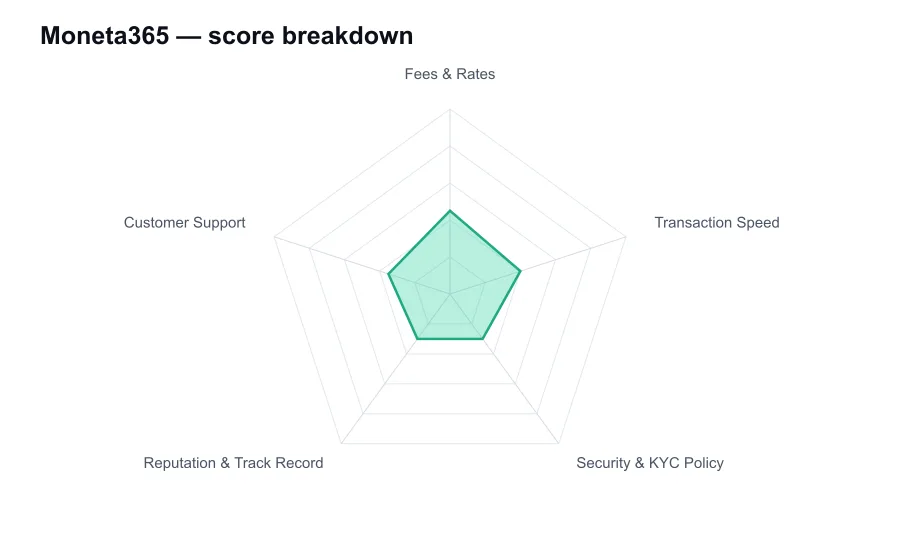
I could not independently verify a comprehensive, enduring fee schedule or a clear published markup methodology for Moneta365. That leaves its pricing in the adequate but unproven category. A small test may reveal a competitive route, particularly where the service has demand or established liquidity. It does not justify assuming that the same pricing will remain competitive for a larger conversion, an illiquid token, or a period of sharp market volatility.
Speed is not just about a countdown timer. It is about the whole process from deposit detection to payout broadcast, plus the confirmation time on the receiving chain. Reliable exchangers show progress clearly: waiting for payment, confirming payment, exchanging, and sent. They also provide the outgoing transaction ID once a payout has been broadcast. Without that visibility, users have no way to separate normal blockchain delay from internal inactivity.
Moneta365 may complete ordinary, low-risk transfers quickly, but I could not locate enough independent performance evidence to state typical settlement times with confidence. Any claim such as five minutes or ten minutes should be treated as a best-case scenario, not a promise. Bitcoin deposits, congested Ethereum transactions, and manual compliance checks can turn a quick conversion into a long wait. A provider earns a good speed score only by documenting that reality and handling exceptions well.
The security and KYC question is more serious. No-KYC language has become a marketing shortcut in crypto, but reputable exchange operators still need mechanisms to address fraud, sanctions, and suspicious activity. The honest approach is to disclose that an order can be screened, describe the documents that may be requested, explain how long review usually takes, and state what happens if the customer cannot complete verification. Ambiguous wording leaves too much power with the service after it has received an irreversible payment.
I could not independently confirm that Moneta365 has published sufficiently detailed policies on those points. There is also no widely visible public proof of reserves, security audit, or mature incident disclosure record that would justify a high confidence rating. The fact that a user can potentially transact without creating an account may reduce one type of personal-data exposure, but it does not remove counterparty risk. The service still has a temporary role in the path of the funds.
Reputation should be earned slowly. A page of five-star comments can be useful as a signal, but it is not the hard evidence I look for. I want to see whether the same brand and domain have operated consistently, whether dissatisfied customers receive specific responses, whether the company explains failed transactions, and whether independent communities report repeatable results over time. Moneta365 does not have a sufficiently strong, broadly documented footprint for me to rate it highly on that basis.
One risk with lesser-known services is that the first several transactions go through flawlessly. That is precisely how trust grows. The real measure arrives with a mismatched network, a payment shortfall, a flagged wallet, or a refund request. A larger venue may be bureaucratic, but it usually has established case handling and published rules. Moneta365 must show those capabilities, not merely say that support is available around the clock.
Support is therefore not a minor score category here. Ask a specific question before making an order. Ask whether the exact token contract and network are supported, how many confirmations are required, and whether the quote is fixed or floating. A useful answer should be direct, consistent with the site rules, and not pressure you to deposit first. If support cannot answer those basics, walking away is the correct decision.
For an actual test, use a small amount from a wallet you control. Check the recipient address character by character and avoid sending from an exchange that may impose a travel-rule delay or a minimum withdrawal policy. Keep a record of the advertised rate, your inbound transaction hash, and the eventual payout hash. That is not paranoia. It is the minimum paper trail needed if an order is disputed.
Moneta365 has a plausible place as a convenience-led exchanger for users willing to do their own verification. I do not see enough public evidence to present it as a secure, low-friction substitute for a recognized exchange. Pricing may be workable, and routine speed may be fine, but neither compensates for unclear security documentation and limited reputation depth. It should be approached with limits, not loyalty.
My final take is that Moneta365 has not yet made a compelling public case for trust at scale. A small successful order could justify another small order, but it would not justify moving savings, payroll, or a trading bankroll through the service. The market already offers many conversion options. Moneta365 needs clear fee disclosure, candid KYC terms, and a longer visible record before it can stand out for the right reasons.