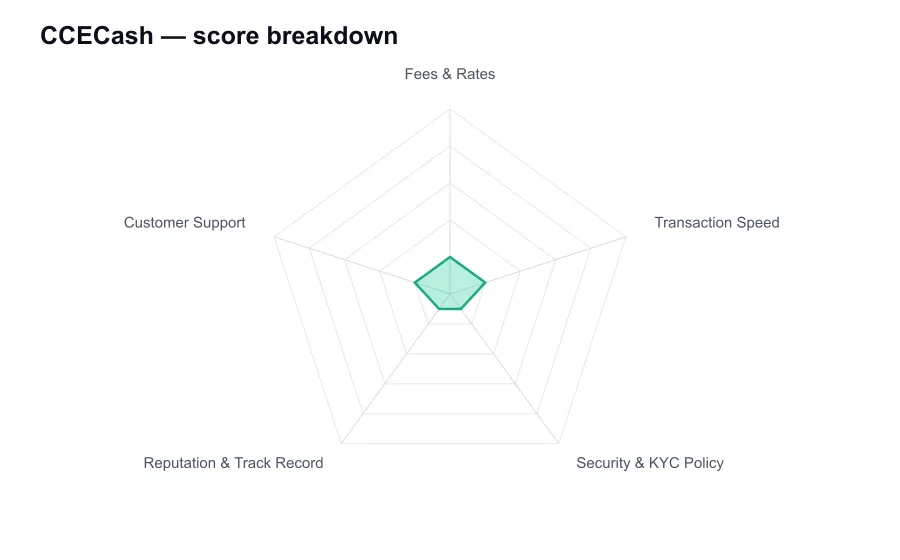
CCECash is another provider that should be approached from the evidence outward, not from the marketing inward. In the crypto exchange market, a service can promise rapid swaps and attractive rates in a few lines of copy. What separates a credible operation from a risky one is the quality of information available before customers transfer assets. On that standard, CCECash does not provide a reassuringly established public profile.
The name itself is not a guarantee of association with a regulated exchange, a payment company, or a recognized financial institution. Users should be extremely careful with assumed affiliations in this sector. Before using any provider, verify the exact web domain through independent sources, inspect the terms and privacy policy, and confirm that contact details match across official channels. Search ads and social-media links are common places for impersonation attempts.
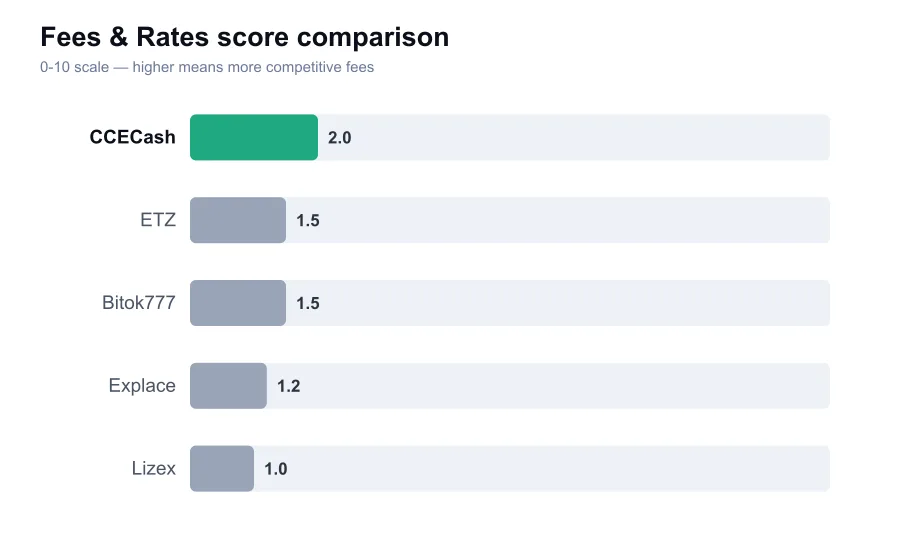
CCECash's fee position cannot be rated as competitive with confidence. A swap service can make money through a listed charge, a price spread, routing economics, withdrawal costs, or some combination of those. If a provider does not show an intelligible quote breakdown, customers cannot tell whether they are receiving a fair deal. The difference may be modest on a liquid pair, but it can be material on a fast-moving or lower-volume asset.
The practical comparison is simple. Look at the amount of crypto sent, the displayed rate, the stated fee, the expected amount received, and the destination network. Then obtain equivalent quotes from established competitors and, if possible, check the mid-market price on a liquid exchange. Do this before each transaction, not once. Crypto market conditions and network costs can change sharply within minutes.
Avoid being seduced by a fee-free label. A provider can honestly charge no separate service fee while still giving a weak rate. Conversely, a visible fee can coexist with a better final payout. The final number is what matters. CCECash has not accumulated enough independently archived pricing or detailed customer reporting for a reviewer to say that its quotes consistently beat, match, or trail the market.
Claims of fast processing have the same limitation. The time for a swap involves the deposit network, the provider's internal processing, liquidity availability, any risk screening, and the outgoing network. A smooth USDT transfer on Tron may finish rapidly. A BTC transaction with low fees, or an ERC-20 payout during congestion, will not. Honest providers explain this rather than attaching a universal instant label to every trade.
CCECash lacks a sufficiently robust public history of completed-order reporting and issue resolution to inspire confidence in its speed under pressure. That matters more than a nominal average. A user can tolerate a ten-minute swap if the platform provides a status page and clear updates. A user cannot easily tolerate an unexplained hold while the market moves and support is silent.
Security should begin with the simple fact that blockchain transfers are generally final. If CCECash receives a deposit and something goes wrong, the customer depends on its systems and staff to make things right. That is why clear legal accountability, a documented dispute process, and visible security practices are essential. I could not verify enough public material about CCECash's controls, ownership, or incident management to give it a passing security score.
No-KYC marketing also needs a reality check. A service might not require account registration for every swap, but transaction-monitoring rules can still lead to additional checks. That can affect the timing and recovery of funds. Users who would be unable or unwilling to provide identification should not assume a lightly documented converter is a dependable route. They should understand the legal and operational risks before initiating anything.
If verification is triggered, a good provider tells the customer what is being requested, how documents are handled, and what happens if the review cannot be completed. A poor provider leaves users guessing. The lack of detailed, independently verifiable public policy around CCECash makes this a serious concern. Never submit sensitive documents until you have verified the official domain and read the privacy terms carefully.
Public reputation is not built by being impossible to research. New firms can compensate for a short operating history with named leadership, company registrations, open communication, security disclosures, and responsive customer engagement. CCECash has not created enough of that evidence in public view. Its modest visibility means there are fewer reliable signals to distinguish a normal young operation from one that simply has not earned trust.
Customer support is the most important unknown. A chatbot may handle simple questions, but a crypto problem requires an accountable human with access to transaction data. Customers should expect a case reference, request updates through an official channel, and receive an explanation tied to transaction hashes rather than vague assurances. Until CCECash proves this capability publicly, users should assume support risk is high.
There is no compelling reason for a mainstream user to make CCECash their default exchange or swap tool. The market has plenty of competitors with more public documentation, stronger brand recognition, and a longer record of resolving problems. A small test, performed with money one can afford to lose and after verifying the domain, is the maximum exposure I would consider defensible.
My final assessment is severe because the standard should be severe. CCECash may offer a functional service, but a functional interface is not enough for a business entrusted with irreversible assets. Its unclear public footprint leaves too many unanswered questions around rates, security, KYC handling, and support. Until it provides more verifiable information and earns a visible track record, caution is the rational position.