CoinDrop is an unusually difficult brand to review because the name is generic enough to be used by more than one crypto project, campaign, wallet feature, or promotional service. That ambiguity is not a trivial naming issue. In crypto, where phishing sites routinely borrow familiar words and visual identities, a user must be able to identify the exact legal business and official domain before discussing rates, token support, or account security.
I could not confidently match CoinDrop, as named here, to one established exchange provider with a verifiable official website and a broad operating record. For that reason, I am not assigning it the borrowed reputation of similarly named businesses. A review that silently assumes the intended company would be worse than useless. It could send a reader to the wrong site, or give a fraudulent clone credibility it has not earned.
The lack of a confirmed identity limits what can honestly be said about its service model. CoinDrop might be an instant converter, a centralized trading platform, a brokerage, a rewards product, or a token distribution tool. Each has different fee mechanics. A swap service tends to bury costs in the quoted exchange rate, while an order-book exchange can charge maker and taker fees, withdrawal fees, and margin-related costs. Without a verified product, specific price claims would be invented.
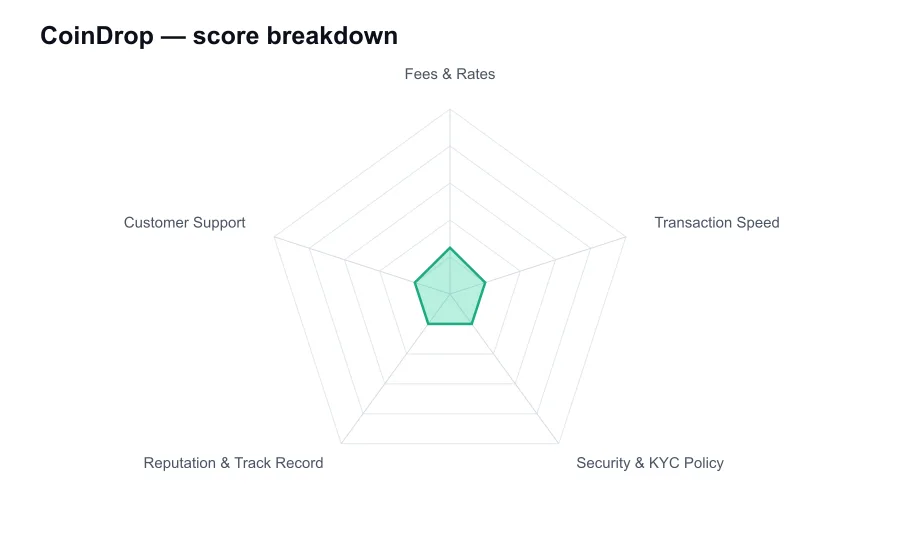
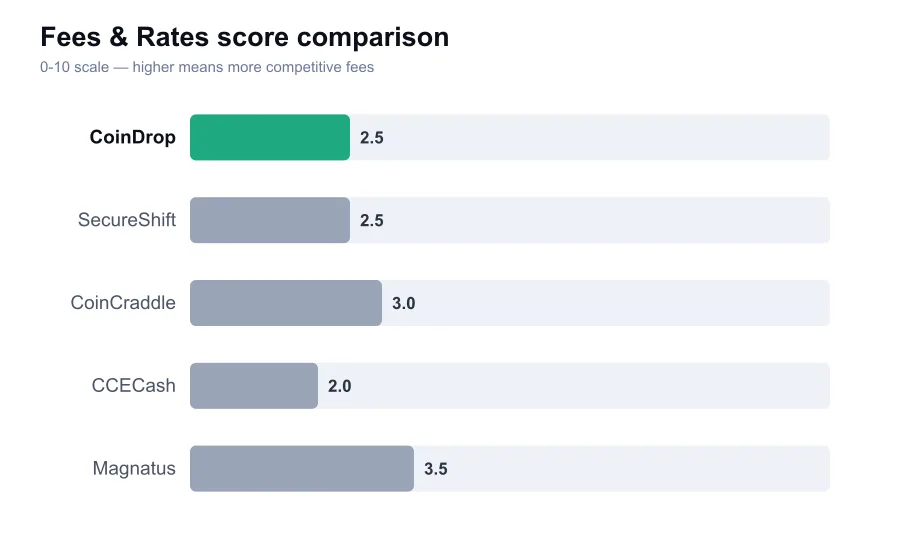
That said, CoinDrop does not earn a pass on fee transparency. A customer should be able to see a full schedule before creating an account or transferring an asset. The important figure is not just a percentage called commission. It is the difference between the expected market value and the amount that arrives, plus every blockchain charge and any minimum withdrawal requirement. I could not verify that CoinDrop provides those details in a reliable public form.
Speed should be examined with the same discipline. A crypto transaction can be fast at the network level and still be slow in practice because a provider has not released the payout, cannot obtain liquidity, or has flagged an order for review. Ethereum, Bitcoin, Solana, and stablecoins all have different confirmation patterns. A trustworthy service says which networks it supports, how many confirmations it needs, and what its normal processing window means in plain language.
No such independently corroborated operational standard is available for CoinDrop. I found insufficient evidence to say that it handles deposits promptly, processes swaps consistently, or honors withdrawals during busy periods. This is a major distinction between a new product and a usable financial service. Early-stage software can have bugs. An early-stage custodian handling real money must still offer an accountable process when a user is affected by one.
Security is less about a site claiming to use encryption and more about how it limits harm after the inevitable phishing email, compromised password, or operational fault. Mature services publish security guidance, allow two-factor authentication, warn against impersonators, and give customers a way to lock down withdrawals. For custodial platforms, users should also be able to understand who holds assets and what, if anything, segregates customer funds from company funds.
I could not verify CoinDrop's approach to those questions. I also could not confirm whether it is noncustodial, whether it stores balances, whether it uses external liquidity partners, or whether it conducts identity checks. That uncertainty means users should not infer privacy from the brand name or from a short sign-up process. A transaction can still be screened, paused, or linked to personal data, and a user can still lose funds if the service's wallet management is weak.
KYC policy deserves particular attention because it is often misunderstood. A platform may advertise quick access yet request government identification when a transaction meets a risk threshold. That is not inherently improper. What matters is that the trigger, review process, document retention policy, and expected resolution path are accessible in advance. A user should never discover after depositing funds that an undefined compliance decision controls whether they can receive them back.
CoinDrop's public reputation is too diffuse to support a strong score. I could not establish a sufficient body of attributable customer feedback, credible editorial coverage, regulatory references, or incident disclosures for this exact service. Review sites full of short five-star comments are not persuasive in isolation. The useful reports describe the asset, network, time frame, outcome, and the provider's response. Without that kind of record, reputation remains unproven rather than merely mixed.
Support is the area that exposes a weak service fastest. A good support team can explain why a deposit is pending, identify a missing tag or memo, and tell a customer what action is possible. A bad one repeats scripts, sends customers to a bot, or disappears after a transfer. I could not verify CoinDrop's support channels, staffing hours, response targets, or dispute process. Anyone considering it should treat that unknown as a serious financial risk.
There are sensible steps for readers who encounter a CoinDrop offer. Do not use a search ad as proof of the official site. Verify the domain through a company record or trusted public announcement, inspect the full terms before connecting a wallet, and make sure the receiving wallet and network are correct. A legitimate service will not ask for a recovery payment, a deposit to upgrade a withdrawal tier, or a separate tax charge before it releases your own crypto.
The practical alternative depends on the job. For recurring buying and selling, regulated exchanges with transparent trading fees are more appropriate. For a one-off asset conversion, established noncustodial swap providers may be preferable, although users should still compare quotes and check compliance policies. For long-term holdings, a self-custody wallet and a clearly sourced purchase route are usually safer than leaving funds with a lightly documented intermediary.
CoinDrop may eventually develop a public record that supports a more favorable review, but it has not done so in a way I can verify today. The brand's ambiguity creates an extra layer of risk because users can be redirected toward an impersonator without realizing it. Until there is a confirmed operator, a clear product description, transparent charges, and meaningful independent history, I would not treat CoinDrop as a trusted exchange. Caution here is not pessimism, it is basic asset protection.