Magnatus sits at the obscure end of the crypto exchange market, where polished names and simple conversion forms can create an impression of scale that public evidence does not necessarily support. I could not identify a broad, independently documented operating history, recognized regulatory profile, or substantial public security record that would put Magnatus alongside established exchange brands. That lack of visibility is the central fact of this review, and it affects every score that follows.
There is nothing inherently wrong with a small provider. Some are built by competent operators and serve a narrow customer base well. But crypto exchange is one of the least forgiving businesses in which to ask customers for blind trust. Payments are irreversible, wallet errors are common, fraud screening is unpredictable, and a customer can lose access to substantial value during a dispute. A provider must earn confidence through transparent rules and a visible record, not through a promising name.
Magnatus should first be assessed as an execution counterparty, not as a website. Who receives the inbound asset? Is the service acting as principal or sourcing liquidity elsewhere? Does it hold an order in a hot wallet while processing it? What legal entity governs the transaction, and under which jurisdiction are disputes handled? If the site does not answer those questions clearly, users should recognize that they are accepting substantial uncertainty in exchange for convenience.
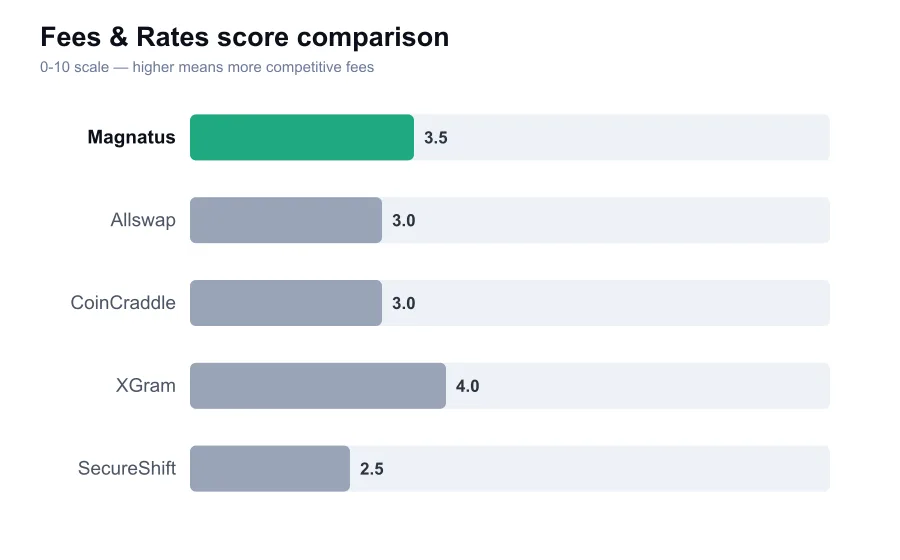
Fees are especially hard to evaluate without reliable rate history or a permanent pricing policy. Many conversion services make the separate commission look small or nonexistent while embedding the real cost in the spread. That business model can be fair if the quote is competitive and honored. It becomes poor value when the user receives significantly less than they would at a liquid exchange after accounting for withdrawal and network fees.
Before using Magnatus, compare the final destination amount with a quote from at least two recognized instant-swap providers and with the equivalent trade on a liquid exchange. Use the exact same network. A USDT route on Tron is not comparable to a USDT route on Ethereum, because network costs and available liquidity differ. Make the comparison immediately, since prices move. If Magnatus cannot beat or closely match alternatives, it has not earned a premium for trust or service.
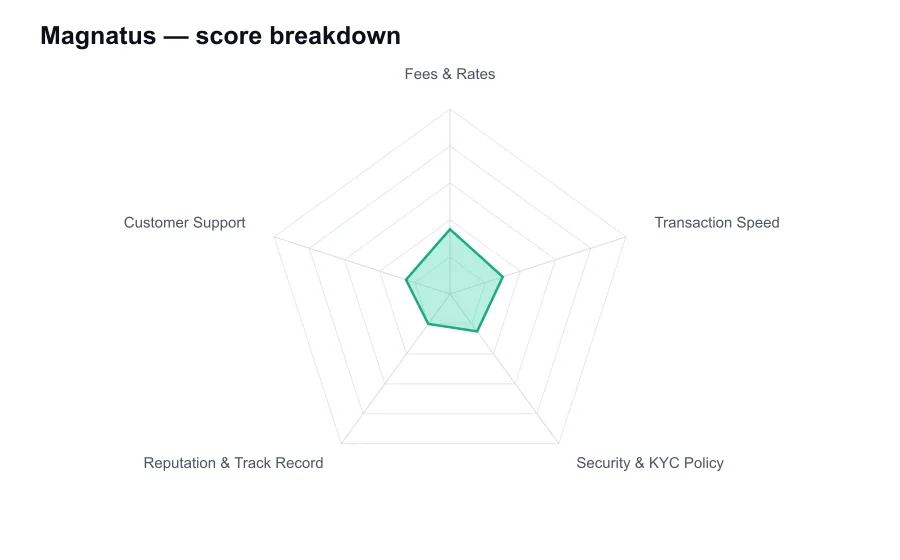
I could not independently verify a consistent public fee schedule, fixed-rate terms, or route-specific spread disclosure for Magnatus. That means I cannot credit it with low fees simply because it may show an attractive headline. The fee score is intentionally low. Customers need an auditable quote and a predictable rule for what happens if they underpay, overpay, or pay after the rate timer expires. Those details separate a real financial service from a gamble with a checkout page.
Speed deserves similar restraint. Crypto settlement has two clocks: the blockchain's clock and the operator's clock. A provider cannot make a Bitcoin block arrive faster, but it can choose confirmation thresholds, maintain liquidity, broadcast outgoing transactions promptly, and communicate delays honestly. A competent status page should show the order state and outgoing hash. It should not leave a customer refreshing a browser while support repeats that the request is being processed.
There is not enough dependable public performance data for me to assign Magnatus a strong speed score. Routine swaps may complete quickly, especially on faster networks with liquid assets. Yet no reviewer should turn that possibility into a blanket claim. The risk is that an order becomes manual at the precise moment price volatility matters, and the user has no documented service standard to rely on. For deadline-sensitive payments, that risk alone makes Magnatus a poor choice.
The security case is weaker still because there is no widely recognized public audit, reserve attestation, penetration-test disclosure, or incident history that I can confidently link to Magnatus. Such materials are not a guarantee of safety, but their absence leaves the public with little basis for judging operational maturity. A secure-looking padlock in a browser verifies an encrypted connection, not that the exchange will safeguard an order or return funds after a problem.
KYC policy needs to be treated as a live risk, even where an exchanger appears to permit account-free transactions. Transaction monitoring tools can trigger requests for identification, source-of-funds material, or a selfie. A fair operator says this before the deposit, explains how data is protected, and provides a time-bound review and refund path. If Magnatus offers vague compliance terms, customers should assume that a flagged transaction could become difficult to resolve.
Reputation is not something Magnatus can claim through isolated positive ratings or affiliate traffic. The relevant questions are whether independent users describe consistent outcomes over a long period, whether negative reports receive specific public responses, and whether the same team has maintained the same service through difficult market conditions. I could not find enough durable, high-quality evidence to give it more than a very low reputation score. Unknown is not identical to unsafe, but unknown should never be priced as trusted.
Support can partly offset the weaknesses of a smaller operation, provided it is genuinely capable. A good agent can identify a transaction hash, explain confirmation requirements, and tell the user exactly what documentation is necessary. A weak operation offers only generic chat replies or silence. There is insufficient independent evidence about Magnatus's resolution performance, working hours, or escalation process. I would test support with a detailed question before I tested the payment flow.
If you choose to make that test, use a fresh small amount and a wallet you control. Do not use borrowed money, funds needed for bills, or a time-sensitive payment. Confirm the token contract, chain, memo requirements, and receiving-wallet compatibility. Save everything. A screenshot of the quote and a copy of the terms can be important if the stated payout differs from what arrives. Never send a second payment merely because someone in chat says the first one is missing.
Magnatus does not offer enough independently verifiable assurance to justify a place in a cautious investor's normal exchange rotation. The possible upside is a convenient route or a favorable one-time quote. The potential downside is an opaque process with limited recourse if anything goes wrong. That is a poor risk-reward equation when better known options are available for most common asset pairs.
My final judgment is harsher than it would be for a transparent young company, because handling irreversible crypto creates a high duty of proof. Magnatus has not met that proof threshold publicly. I would not recommend it for large swaps, first purchases, or transactions where timing matters. Until it establishes a clear identity, published operational policies, and a sustained independent record, the prudent response is to look elsewhere.