SecureShift sounds like an instant crypto swap service, a category built around convenience rather than traditional exchange accounts. That positioning can be useful. A good instant exchanger lets someone convert one asset into another without learning an order book or parking funds on a large custodial platform. The trouble is that a security-themed name is not evidence of security, and I could not independently verify a well established operator, official domain, or robust market record for SecureShift.
The name creates a familiar crypto marketing trap. Words such as secure, safe, trust, protected, and shield are common in branding because they answer the customer's biggest fear before the customer has asked a question. A serious provider earns that language by publishing its policies, explaining its controls, and dealing transparently with failures. SecureShift does not presently offer enough verifiable material for a reviewer to confirm that it has earned the promise implied by its branding.
There is no reason an unknown swap service cannot offer decent quotes, but there is also no reason to assume it does. Instant exchanges commonly earn revenue from a combination of provider fees, partner liquidity spreads, network costs, and fixed-rate protection. The customer needs to know whether the rate will float after the deposit arrives. A quote that looks attractive at the start can become poor value if the provider reserves broad discretion to adjust the payout later.
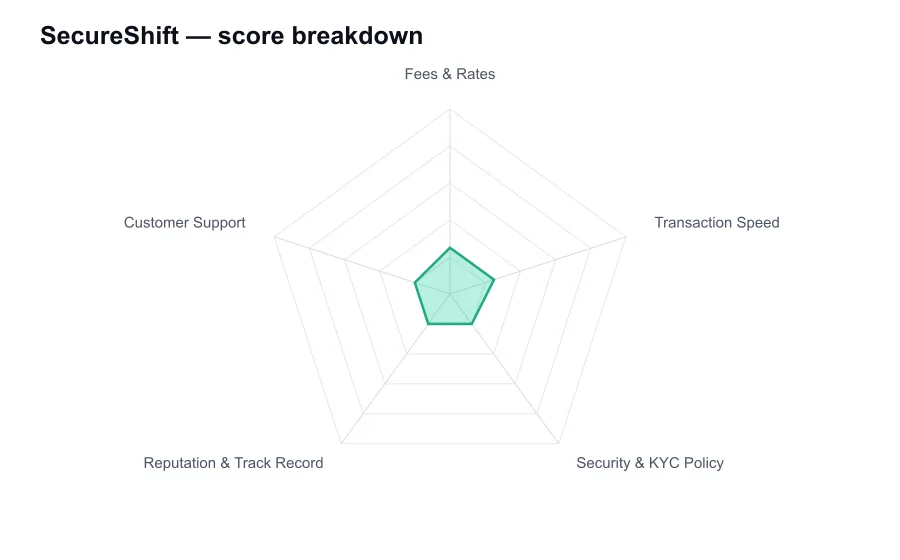
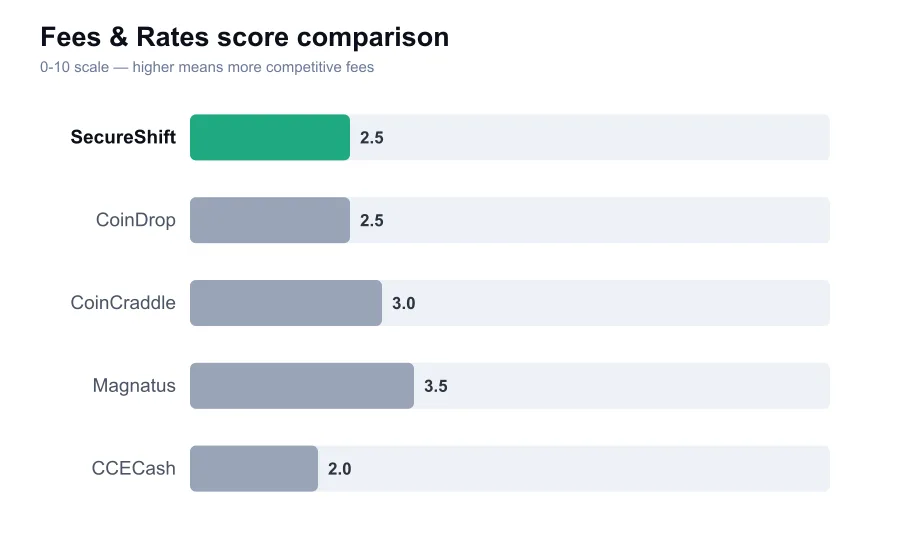
I could not confirm SecureShift's fee schedule or its method for displaying spread. That earns a weak score. A reliable service shows the deposit amount, expected receive amount, network, rate type, and minimum or maximum limits before the transaction begins. If a rate is fixed, it should say for how long and under what conditions. If it floats, it should explain what price source applies. Anything less makes price comparison too difficult for careful users.
Speed is often marketed aggressively in this category, but a realistic assessment needs more than a claimed average. Swaps are constrained by the confirmation requirements of the incoming chain, the availability of the outgoing asset, and the internal checks the provider applies. A fast chain does not guarantee instant delivery. During volatility, liquidity providers can fail, wallet systems can go offline, and compliance teams can put a transaction into manual review.
I found no strong independent evidence of SecureShift's normal completion times or behavior during exceptions. That does not mean every transaction will fail. It means users should not use it for a deadline-sensitive payment, an arbitrage trade, or a transfer required to avoid liquidation. Those uses demand a service with documented reliability and a support process that can intervene promptly. Unknown swap desks are the wrong place to take that kind of timing risk.
The security assessment is necessarily conservative. I could not verify whether SecureShift is genuinely noncustodial, whether it retains transaction data, how it protects operational wallets, or whether it has received any credible security audit. Noncustodial is not a magic word anyway. A user may retain their private keys before and after a swap, but the service still receives a deposit and must correctly send the exchanged asset to the destination address. That handoff remains a counterparty risk.
A competent provider also makes its KYC policy unambiguous. The phrase no registration may simply mean no account is needed for ordinary use. It does not necessarily mean no compliance screening, and it certainly does not guarantee that funds will not be held for review. A fair policy tells customers which situations can trigger verification and what happens if they decline. I could not independently establish those details for SecureShift.
Reputation takes time, and it cannot be built through a few anonymous testimonials. The useful signals are years of public operation, named executives or legal entities, clear terms, meaningful third-party coverage, visible responses to complaints, and a record of treating users fairly during disputes. SecureShift does not have enough confirmed evidence across those areas for me to classify it as established. It remains an unproven counterparty rather than a credible challenger to known swap services.
Support deserves attention because it is the only lifeline after a swap goes wrong. The standard should be simple: can a customer provide an order ID and transaction hash, reach a human, and receive a specific explanation? A provider does not need a phone line to be competent, but it does need a dependable ticket route, stated hours, and a response that moves the case forward. I could not verify that SecureShift offers that level of service.
That means the safe operating posture is narrow. Never send a life-changing amount to SecureShift. Do not use it to convert proceeds from a sale, move treasury funds, or make a payment that must arrive today. If someone chooses to experiment, they should send a very small amount from a wallet they control, record every address and transaction hash, confirm the destination network twice, and refrain from sending follow-up deposits if an order becomes stuck.
There are better benchmark choices. For simple crypto purchases, a transparent centralized exchange may be slower to onboard because of KYC, but it gives users a visible legal counterparty and a clearer fee framework. For swaps, established services still require quote comparison, yet they provide a longer trail of public feedback and support documentation. SecureShift has not demonstrated a feature powerful enough to justify giving up those advantages.
I am particularly wary of any security-branded platform that cannot be verified independently, because users may lower their guard precisely because the name sounds reassuring. The correct response is the opposite. Confirm the exact site, look for legal pages that identify an entity and jurisdiction, review transaction limits, and search for detailed problem reports. If there is no transparent explanation for a delay, do not submit more documents or money simply because a chat agent says it is required.
SecureShift may be harmless, but harmless is not the standard for handling crypto. The standard is demonstrated reliability, transparent pricing, credible controls, and accessible recourse when a transaction fails. I cannot find sufficient evidence of those qualities here. My recommendation is to avoid SecureShift for any meaningful transaction and choose a provider whose security claims can be tested against a public record rather than accepted on faith.