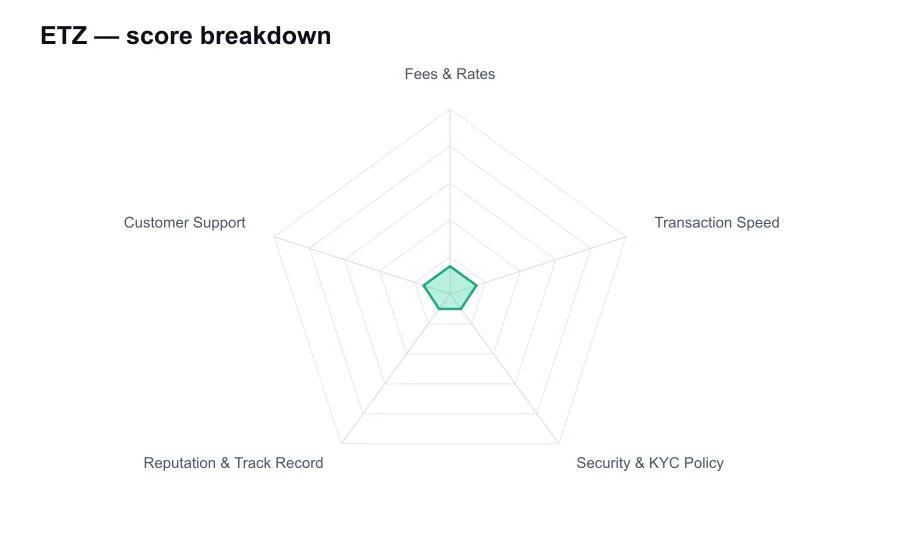
ETZ is a difficult provider to assess because the name is not supported by a clear, established public exchange identity. In crypto, that is not a minor research inconvenience. It is central to the risk assessment. A trustworthy exchange should be easy to identify, with a verifiable legal operator, a consistent official domain, accessible terms, an operating history, and independent references that point to the same business. I could not confidently establish those basics for an exchange provider called ETZ, so I would not treat it as a normal competitor to recognized platforms.
That lack of a confirmed official website is why this review does not list a URL. Search results, cloned branding, app listings, social profiles, and promotional pages are not enough to establish that a site is the genuine operator. Crypto scammers regularly reuse short names, logos, and generic exchange language. A reader should never deposit because a website looks polished or because a Telegram contact says it is the official platform. The burden is on the provider to make its identity easy to verify.
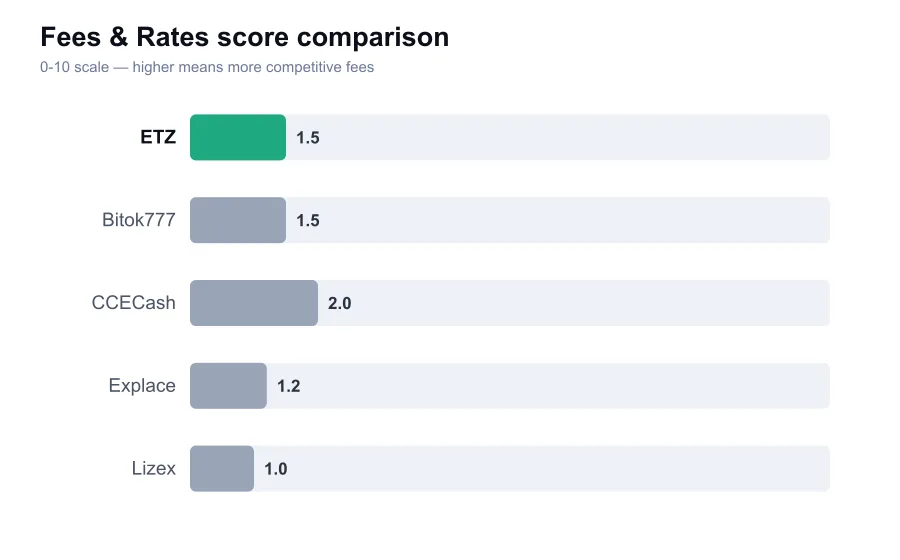
The first problem is fees. I could not locate a reliable, authoritative schedule showing ETZ's spot fees, spread methodology, withdrawal charges, conversion costs, or minimum order rules. That means there is no sound basis for calling it cheap. Any provider can show an attractive trading screen while charging a poor withdrawal fee, embedding a steep spread into the quote, or introducing a surprise condition before funds can leave. A fee score cannot be generous when the underlying numbers are not independently verifiable.
This is especially important because crypto exchange fraud often uses low or zero fee claims as bait. Users may be offered profitable signals, bonuses, or supposed arbitrage opportunities, then discover that they need to pay a tax, unlock fee, verification deposit, or liquidity charge to withdraw. Legitimate exchanges deduct stated fees from a balance or transaction. They do not demand additional crypto payments to release funds. If anyone representing ETZ asks for such a payment, stop immediately and do not send more.
Transaction speed is also impossible to judge in the normal way. A provider can claim instant settlement, but the real test is whether a withdrawal reaches an independently controlled wallet and appears on-chain without arbitrary delay. Screenshots of account balances are not proof. Neither are internal transfer confirmations. An exchange that cannot demonstrate ordinary withdrawals, clear confirmation requirements, and transparent network status should be treated as unproven, regardless of how fast its dashboard appears.
For anyone who has already opened an ETZ account, the safest test is a withdrawal test, not another deposit. Attempt to withdraw the smallest allowed amount to a wallet you control. Check whether the destination transaction can be found on the relevant blockchain explorer. Do not increase the deposit after a support agent promises that a larger balance is needed to unlock the account. That pattern is common in advance-fee scams and has nothing to do with normal blockchain operations.
Security claims are equally thin without public documentation. I could not verify whether ETZ offers meaningful account protections such as two-factor authentication, withdrawal address allowlisting, device management, anti-phishing codes, session controls, proof-of-reserves reporting, or published security practices. Even if some of those features exist, users should not have to infer them from marketing. A serious platform documents how accounts are secured and explains what it does with customer assets.
KYC is another area where opacity can become dangerous. Reputable exchanges state whether identity verification is required, what documents are collected, which entity processes them, how long records are retained, and in which jurisdictions the service operates. A vague promise of no KYC can be risky if it is paired with a later demand for a passport, selfie, or additional payment after funds are locked. Do not upload sensitive identification documents to a platform whose operator and privacy practices you cannot verify.
There is no reliable track record to credit here. A short name alone cannot establish years in business, licensing, reserve practices, or a history of handling customer withdrawals through difficult market conditions. The major crypto failures of recent years taught a harsh lesson: brand visibility is not proof of solvency. For a scarcely documented provider, the standard should be even higher. If independent evidence is absent, the rational assumption is not neutrality. It is elevated counterparty risk.
A strong reputation comes from more than social media followers or star ratings on an easily manipulated review page. Look for a named legal company, jurisdictional registrations where relevant, long-running coverage from credible publications, archived policy pages, known executives, and user reports that can be cross-checked across sources. ETZ does not clear that bar based on information I could confidently verify. That does not prove misconduct by itself, but it makes a positive recommendation irresponsible.
Customer support should be judged by accountability, not responsiveness alone. Fast Telegram replies can be part of a scam operation. What matters is whether users can reach a documented support channel, receive case references, understand the escalation process, and obtain a clear answer about withdrawals and account restrictions. I found no dependable evidence of a formal support operation for ETZ. That leaves customers exposed if a deposit is delayed or an account is suddenly restricted.
The risks are amplified for newcomers because an unfamiliar exchange can look more legitimate than it is. Slick charts, fake liquidity figures, and copied legal pages are cheap to produce. A new user may also fail to distinguish a blockchain withdrawal from an internal balance adjustment. Before trusting any provider using the ETZ name, verify the exact domain through a company filing or a well-established third-party source, then test a tiny withdrawal. If that verification cannot be completed, do not deposit.
There are plenty of safer alternatives depending on the task. For regulated fiat access, consider a well-known exchange available in your country, such as Kraken or Coinbase. For a wallet-to-wallet conversion, established instant-swap providers may be more suitable, though they still need quote comparison and caution. For decentralized trading, use recognized self-custody protocols only after learning how approvals, slippage, and token contracts work. None of those options remove risk, but each offers more information than an unverified name.
My view is blunt: ETZ should be treated as unverified and high risk until its operator, official website, policies, withdrawal record, and security controls can be independently confirmed. That is not a claim that every entity using the name is fraudulent. It is a refusal to fill missing facts with optimism. In crypto, the cheapest lesson is the one learned before a deposit. Keep funds in a wallet you control or use a provider with a demonstrable record.