Curve is one of DeFi's foundational decentralized exchanges, built primarily for assets that should trade close to the same price. Stablecoins, wrapped versions of major assets and liquid staking tokens are its natural territory. A swap from USDC to USDT or from one Ether staking derivative to another is where Curve can still look remarkably efficient. It is not designed to be the universal home for every volatile token trade, and judging it by that standard misses the point.
The protocol's automated market maker uses a specialized pricing curve that concentrates liquidity around an expected peg. That lets it offer low slippage for like-priced assets with less capital than a generic constant-product pool would require. For a large stablecoin swap, this has historically made Curve a serious alternative to centralized exchanges and a core liquidity source for aggregators. Many users interact with Curve without realizing it, because an aggregator routes the trade there.
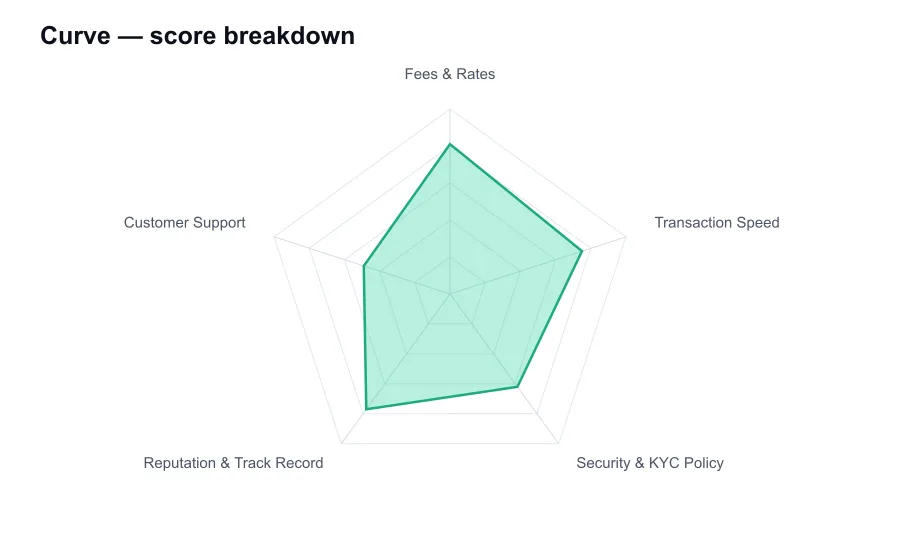
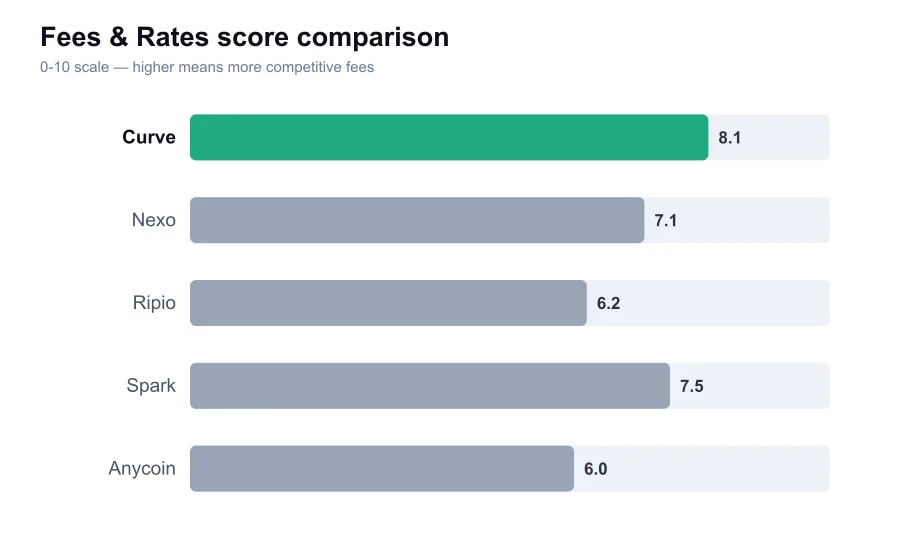
Its fee structure is usually competitive. Traditional Curve pools commonly charge a 0.04% swap fee, although pool configurations can differ and newer pool types may use different parameters. Part of the fee goes to liquidity providers, and the protocol has historically directed an admin share toward governance-related recipients. The relevant number for a trader is the quoted output after fees and price impact, not a generic headline rate.
For stable assets, Curve frequently beats a higher nominal fee elsewhere because slippage is lower. That is why comparing a 0.04% Curve trade with a 0.05% or 0.30% pool on another DEX can be misleading. On the other hand, a pool is only efficient while its assets remain genuinely close in value. During a depeg, the curve that protects normal swaps can leave liquidity providers holding the asset the market is trying to abandon.
Liquidity provision is not passive cash yield. Stablecoin pool depositors receive swap fees and often token incentives, but they accept pool composition risk. If USDT, USDC, DAI or a smaller stablecoin loses market confidence, the pool can become heavily weighted toward that asset. The user has not necessarily suffered a smart-contract exploit, but can still emerge with the weakest asset. Curve's design makes this risk easy to underestimate because the products are often described as stable.
Curve also has an unusually political and technical governance system centered on veCRV. Locking CRV for up to four years gives voting power, boosts and influence over liquidity incentives. The system created the so-called Curve Wars, in which protocols accumulated or controlled voting power to direct CRV emissions toward pools they wanted to deepen. It is historically important DeFi machinery, but it is not friendly machinery. A casual user does not need to participate in it.
Trading speed depends on the chain and route. On Ethereum mainnet, swaps usually confirm within seconds or minutes, subject to gas conditions. Curve is also deployed across multiple networks, where costs and confirmation times can be substantially better. An aggregator may route through Curve efficiently, but users should still check the final transaction because multi-hop trades can add gas, price exposure and failure points.
The protocol's security record cannot be discussed without the July 2023 Vyper compiler vulnerability. Several Curve pools using affected Vyper versions were exploited, producing losses estimated around $70 million across impacted pools and related protocols. White hats and recovery efforts returned some funds, but the event was a major reminder that even mature DeFi infrastructure can be vulnerable through dependencies outside the visible pool logic.
Curve has also faced economic and governance stress, including the 2023 liquidation cascade around founder Michael Egorov's large CRV-backed borrowing positions. That situation did not mean Curve's exchange contracts had failed, but it damaged confidence in the ecosystem and exposed the awkward connection between token economics, governance power and personal leverage. A protocol can have robust code while still carrying governance and market-structure risks.
There are positive security points too. Curve is non-custodial, battle tested across many market cycles, widely integrated and subject to extensive scrutiny. Its contracts and pool designs have handled enormous volume over the years. Yet its broad surface area, many deployments, gauges, factories and integrations make it harder to call simple. Users should favor established pools with clear assets and deep liquidity rather than treating every Curve-branded pool as equally safe.
No standard KYC is required to use Curve through a self-custody wallet. That privacy and permissionless access are central to its appeal. They also mean nobody can reverse a mistaken transaction, restore a compromised wallet or make a pool position safe after a depeg. The absence of an intermediary is the product, not an omitted customer-service feature.
Curve's reputation is complicated but durable. It remains one of the most recognized names in onchain stablecoin liquidity and has influenced nearly every major DeFi liquidity incentive design. The 2023 exploit and surrounding CRV drama were serious blows, not footnotes. Still, calling Curve irrelevant would be wrong. It continues to matter because its core market niche is real and many large protocols still rely on its liquidity.
Support is primarily documentation, Discord, governance channels and a community of integrators. This is adequate for developers and seasoned DeFi users who can inspect a transaction or identify a pool contract. It is poor for retail users who expect a support agent to explain why their LP token value changed. Curve does not hide that fact, but a publication should say it plainly.
My take is that Curve remains a specialist venue worth using, not a blanket recommendation for every swap or yield strategy. For deep, established stablecoin or LST pools, it can be hard to beat on execution quality. For obscure pools and incentive-heavy LP positions, the risks rise quickly. Curve rewards people who understand pool composition and route comparison. It punishes those who see a large annual percentage figure and stop reading.