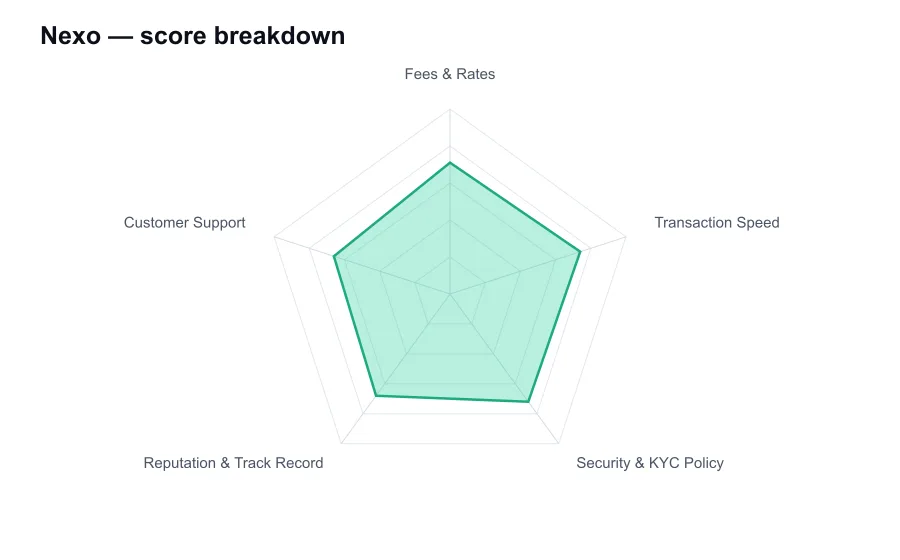
Nexo sits in a different part of the crypto market from a plain swap desk. It built its name as a lender and interest platform, then expanded into exchange trading, card spending, and private-client services. That breadth is attractive to people who want their coins, borrowing, and occasional trading under one login. It also means users need to understand counterparty risk, not just compare a quoted exchange rate.
The platform's exchange offers market, limit, and trigger orders, plus a smart-routing feature called Nexo Pro for more active traders. Nexo's basic exchange is designed for convenience rather than deep professional liquidity. It works well for converting a few assets inside an existing account. For serious spot trading, Binance, Kraken Pro, Coinbase Advanced, and dedicated regional exchanges generally offer a fuller order book and more transparent market depth.
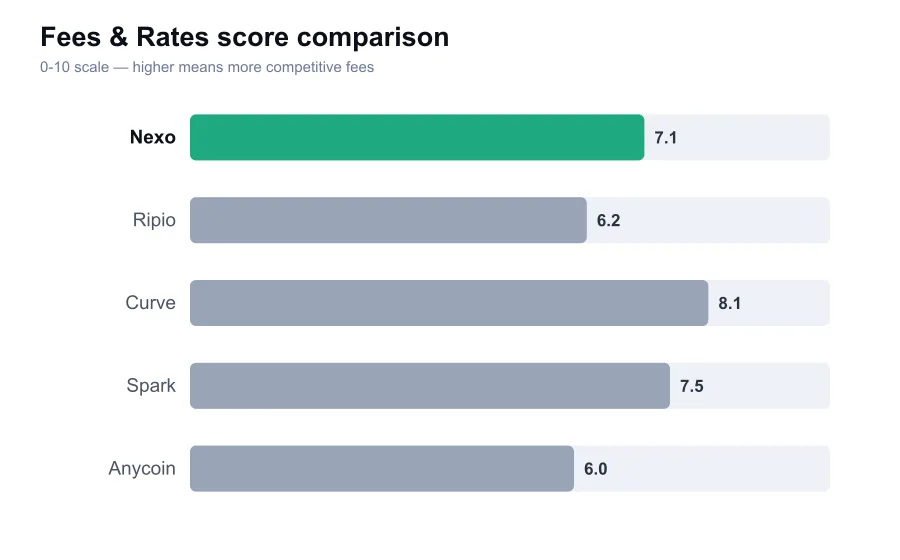
Fees are reasonable but not the central reason to choose Nexo. On Nexo Pro, the published spot fee schedule has started at 0.20% maker and 0.30% taker for lower-volume users, with lower rates at higher tiers. That is competitive with retail broker apps, though it is not especially cheap beside large exchange venues. Users of the regular in-app swap interface should pay particular attention to the final quote because the effective cost includes the spread.
That spread is where casual users can overpay without realizing it. A clean percentage fee is easy to compare. A quoted conversion rate that is slightly worse than the reference market price is not. Nexo's interface is polished enough that it can make a quick swap feel frictionless, but frictionless isn't synonymous with inexpensive. Check the quote against a liquid external market before converting a meaningful amount, especially on smaller altcoins or during sharp moves.
Nexo does have a useful loyalty structure. Holding NEXO tokens can unlock better borrowing rates, higher yield tiers, and benefits tied to the platform's loyalty program. That can work for committed users who already accept exposure to the token. I would not buy a platform token solely to save a modest amount on transaction costs. The supposed discount can disappear quickly if the token's price falls harder than the fees saved.
Transfer speed is usually good once a transaction is actually released. Internal movements between Nexo accounts are effectively immediate, and crypto withdrawals follow the relevant blockchain's normal confirmation cycle. Bitcoin can take longer during congestion, while stablecoins on lower-cost networks can arrive much faster. The bigger variable is Nexo's own compliance review and withdrawal processing, which can turn an expected quick transfer into a wait.
Fiat deposits and withdrawals are less predictable because they depend on currency, banking rail, cut-off times, and account verification. SEPA transfers are commonly processed on business-day schedules, while card purchases are immediate but expensive relative to a bank transfer. Nexo is a financial platform operating across multiple jurisdictions, not a local instant-payment app. Users who need guaranteed same-day access to cash should not assume every withdrawal will move as quickly as a stablecoin swap.
Security is one of Nexo's stronger areas on paper. The company has described cold-storage arrangements, multi-signature custody, 24-hour withdrawal address whitelisting, biometric access, two-factor authentication, and real-time monitoring. It has also promoted insurance coverage through custody partners. Those controls are useful, but insurance language deserves careful reading because it does not mean every customer loss, every market event, or every platform failure is automatically insured.
KYC is mandatory for meaningful use, and that is not negotiable. Nexo asks for identity verification and may request proof of address, source-of-funds documents, or additional information for compliance reasons. Privacy-first users won't like it. For a regulated-facing lending and payments business, though, this is more credible than pretending that a high-value financial platform can operate indefinitely with no customer checks at all.
The harder security question is not whether Nexo supports two-factor authentication. It is whether users are comfortable leaving assets with a lender whose business model involves lending, collateral management, and centralized discretion. Nexo says client assets are protected through its systems and partnerships, but customers do not control private keys. Its earned-yield products are not bank deposits, and headline rates should always be read alongside the risk of the issuer and the underlying asset.
Nexo's reputation has recovered some ground after a difficult period for centralized crypto lenders, but it remains complicated. The company was founded in 2018 and survived a brutal industry cycle that brought down Celsius, BlockFi, Voyager, and others. It settled with US regulators in 2023 over its Earn Interest Product and discontinued that product for US clients. That history is more reassuring than a collapse would have been, but it is still a serious mark against the old product model.
The firm has also faced regulatory scrutiny in Bulgaria, where authorities conducted searches in early 2023 before later closing aspects of the investigation. Nexo disputed allegations and has been vocal in its defense. Readers should resist both extremes here. It is wrong to treat every allegation as proof of wrongdoing, and equally wrong to dismiss regulatory history as irrelevant noise. Nexo has a real operating history, but it is not a risk-free household financial brand.
Customer support is available through in-app chat and ticket channels, with higher-tier clients receiving more direct service. The support experience is usually adequate for routine questions, but compliance cases can be frustrating. That is common across centralized exchanges, though it does not make it pleasant. If an account is under review, a chatbot and standard replies can feel painfully insufficient, especially when funds are needed urgently.
Nexo makes the most sense for a verified user who wants a consolidated crypto finance account and understands the custody trade-off. Its exchange is convenient, its app is mature, and its security tooling is better than that of many small swap sites. I would use it for limited conversions and carefully sized lending or collateral activity, not as the sole home for a long-term portfolio. Keep self-custodied reserves elsewhere, read the product terms, and treat the attractive yield as payment for risk rather than free income.