Trocador is not just another instant exchange. It is an aggregator, which changes the value proposition considerably. Instead of asking you to trust one conversion desk's price, it compares offers from a range of exchange partners and lets you choose a route. That makes it one of the more useful tools in the privacy-oriented swap market. The service still cannot remove every risk tied to its partners, but it gives users more visibility than a single-provider checkout page.
The basic flow is familiar. Choose the coin and network you are sending, select the asset you want to receive, review offers, provide a destination address, and fund the generated deposit address. Trocador does not operate like an order-book exchange or a wallet where you park funds. It routes a transaction to a selected provider. In practical terms, you are relying on both Trocador's interface and the underlying exchange selected for the swap.
That extra layer is not merely cosmetic. Price differences between instant exchangers can be substantial, particularly on less liquid assets or during volatile periods. One provider may have a better liquidity source for Monero, another for a stablecoin route, and another for a fixed-rate Bitcoin trade. Trocador exposes that competition. This is why I would often check Trocador before using Godex or ChangeHero directly, even if I have had a good experience with either service in the past.
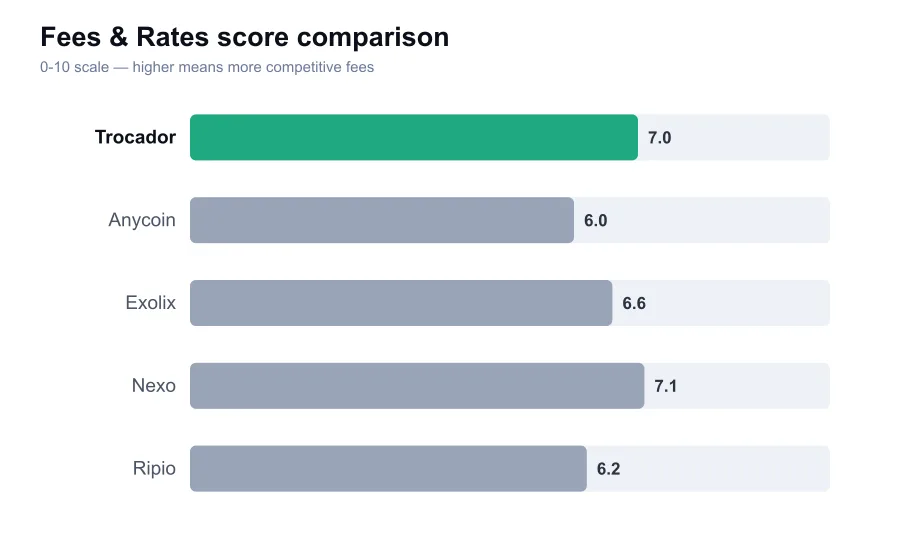
Its fees need to be understood in two pieces. The selected exchange partner has its own spread or service cost inside its rate. Trocador also discloses a platform fee that has commonly been around 0.5 percent, with some referral or affiliate arrangements able to reduce it. The exact displayed terms at the time of a swap are what matter. A 0.5 percent visible fee does not automatically make the deal worse, because a partner's gross quote can still be better than another service's supposedly fee-free quote.
That pricing honesty is a strength. Many instant exchange sites market "no fees" while giving users little way to inspect the spread. Trocador makes comparison part of the product. It does not turn crypto conversion into a free service, and it should not pretend otherwise. For small transactions, the difference may be trivial. For a large conversion, compare the final payout carefully, and consider whether a regular exchange with lower trading fees and a withdrawal fee would still be cheaper.
Trocador offers floating and fixed-rate options where its partners support them. Fixed routes are preferable if you need certainty and the quoted premium is acceptable. Floating routes can be attractive in a rising market, but they can also leave you with less than the estimate if the price moves before execution. The screen may say one thing at the quote stage and another at the end of a floating trade. That is not necessarily a defect. It is the contract type you selected.
Speed is usually good for an aggregator, but it cannot outrun the provider in the final leg. A fast route on Tron or Litecoin may settle soon after the deposit appears. Bitcoin and Ethereum can be slower due to confirmation requirements and network conditions. Some partner exchanges need additional time to source liquidity or process a larger order. Trocador gives more route information than many rivals, yet no routing dashboard can create a guaranteed settlement time on a public blockchain.
One distinctive feature is its attention to privacy-minded users. Trocador has promoted privacy tools and has historically included options such as a Privacy Mode, depending on current availability and the selected route. The company also has a public identity within the crypto privacy community that is stronger than a generic swap site with no visible philosophy. That does not mean users should assume every partner follows the same policy. Underlying providers have their own compliance rules, which can differ sharply.
KYC is therefore route-specific, not a simple yes or no answer. Trocador itself has aimed to minimize routine account requirements, but a selected exchange partner may request verification if its monitoring system flags a transaction. Trocador's comparison interface can help users see provider information and risk warnings, but it cannot guarantee that a partner will never pause funds. This is one reason to avoid treating an instant swap as the right place for money with a complicated transaction history.
Security is better than the average opaque swap site in one important sense: Trocador does not demand a standing custodial account, and its aggregation model reduces dependence on one house rate. But it remains a service-mediated transfer. You must trust that you are on the real domain, that you have chosen the right route, and that the partner executes. Save the order ID and transaction hash. For a high-value trade, verify the selected provider's terms before you click through.
Trocador has also built a stronger public reputation than most small instant exchange brands. It has been discussed for years in privacy and self-custody circles, and it has a visible relationship with a broad ecosystem of exchange partners. Still, an aggregator inherits some reputational risk from those partners. A good interface cannot fix a bad experience at a provider that is slow, has weak liquidity, or triggers a prolonged review. Choosing solely on the lowest number can be shortsighted.
Support is one of Trocador's better points, particularly because an aggregator has an incentive to mediate when a partner transaction goes wrong. The team can help trace an order and communicate with the provider, though that does not mean it can instantly compel a payout. The most useful support request includes the order ID, transaction hash, timestamps, screenshots, and a precise description of the issue. Vague messages such as "my swap is missing" slow down the process for everyone.
The service is not ideal for every user. Beginners may find multiple rate types, provider names, network options, and warnings overwhelming. A person buying their first crypto with dollars will not find what they need here. Frequent traders may prefer an order book and lower execution costs. Yet for someone already comfortable with self-custody, that complexity is a feature. It gives the user choices rather than hiding them behind one supposedly magic rate.
Trocador is my preferred first stop for comparing instant swaps, particularly for users who care about price transparency and do not want to maintain accounts at many exchanges. Its explicit platform charge is easier to respect than a vague claim of zero fees, because you can see the final equation. The partner model is its main limitation, not a fatal flaw. Use reliable routes, read the provider details, and do not choose a route just because it is a fraction of a percent cheaper.
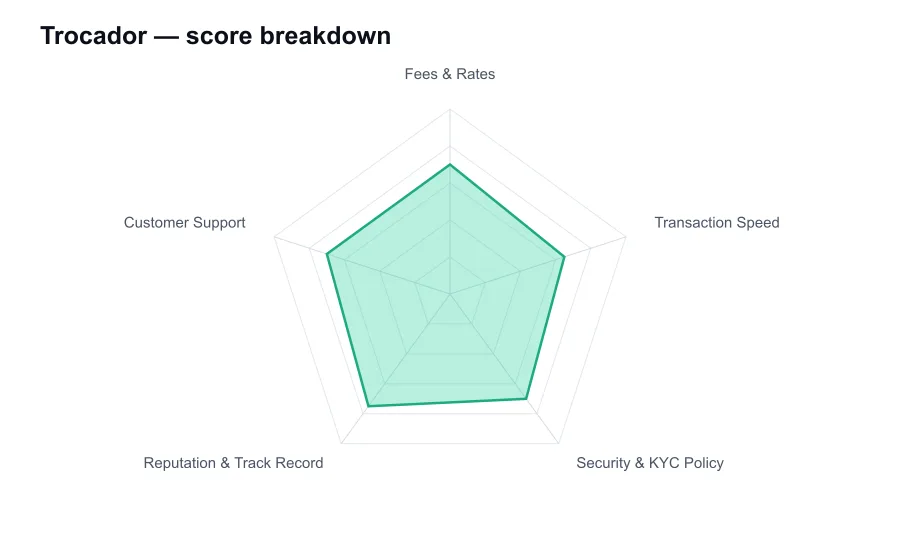
My final view is favorable. Trocador earns a higher score than most instant exchange services because it gives users meaningful choice, better rate visibility, and a more established reputation in the self-custody community. It cannot promise immunity from KYC reviews or partner delays, and it does add a fee layer. Even so, those drawbacks are outweighed by the ability to compare the market instead of blindly accepting one provider's quote. It is a tool for informed users, and it rewards informed use.