Spark sits in an awkward category for an exchange comparison because it is not really an exchange in the conventional sense. It is a DeFi platform built around the Sky ecosystem, formerly MakerDAO, and its core appeal is access to stablecoin borrowing and yield products rather than a broad spot market. Anyone arriving expecting a Binance, Kraken, or 1inch style venue for swapping dozens of assets will find that assumption wrong quickly. Spark is closer to an onchain money market with a deliberately narrow focus.
That narrowness is not a weakness by accident. Spark was designed to make the Sky ecosystem's stablecoin infrastructure easier to use. Its main products have included SparkLend, which lets users supply and borrow crypto assets, and savings-oriented vaults connected to USDS and DAI. The platform's pitch is straightforward: earn protocol-linked stablecoin yield, borrow against accepted collateral, and avoid handing assets to a centralized operator.
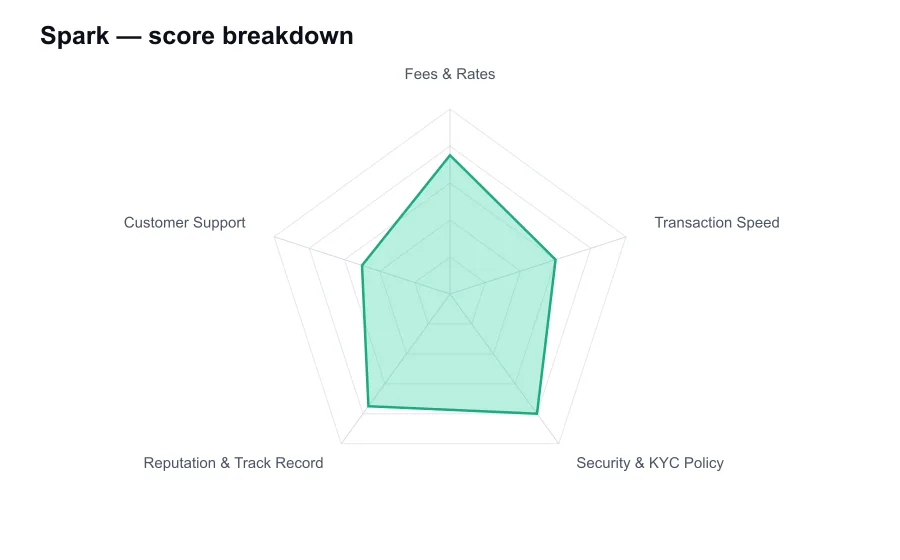
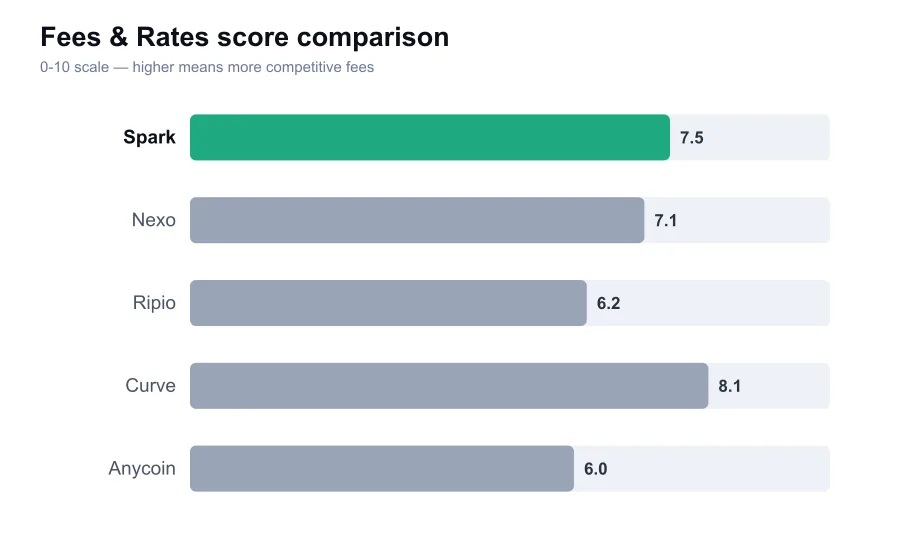
Fees need to be understood as lending costs, not a single trading commission. Depositing into a savings product may carry no platform entry fee, but users still pay Ethereum network gas. Borrowing has variable interest rates set by market and governance conditions, while borrowers may also face liquidation penalties if their collateral ratio falls below the required threshold. Those costs can be modest in quiet markets, but Ethereum gas alone can make small deposits uneconomic.
Spark's rates have often looked attractive beside ordinary bank-style savings products and some competing DeFi lending pools. That is the point. However, a headline savings rate is not a permanent contract. Rates can change with Sky governance, protocol revenue, and the incentives available to a particular vault. Anyone treating a displayed annual yield as guaranteed income is misunderstanding both DeFi and the product itself.
Transaction speed is largely Ethereum speed. A supply, withdrawal, borrow, or repayment settles after the relevant network confirmations, generally within minutes under normal conditions, not instantly in the way a centralized exchange updates a balance. During congestion, a user may wait longer or pay a high priority fee. Spark's interface can feel uncomplicated, but it cannot make mainnet settlement cheap or fast simply by hiding the plumbing.
That dependence matters most on exits. Depositing USDS or DAI into a savings product may be easy, yet moving funds back to a bank account requires several additional steps through outside services. There is no built-in fiat ramp and no native card withdrawal. For a crypto-native user with a wallet and a stablecoin strategy, that is perfectly normal. For a newcomer who just wants to buy crypto with dollars, Spark is the wrong tool.
On security, the strongest argument for Spark is its relationship with the mature MakerDAO, now Sky, stack. The underlying systems have been exposed to years of significant value, public governance scrutiny, and security review. Smart contracts and governance are visible onchain, which is a much better starting point than trusting a small exchange's private wallet claims. Still, public code and a recognizable ecosystem do not eliminate risk.
Smart contract risk is real here. A protocol can be audited and still contain an undiscovered vulnerability, an oracle issue, a governance failure, or an economic design flaw. Users who borrow also have market risk, because collateral can fall rapidly while debt remains fixed in dollar terms. That is not a rare theoretical scenario. The liquidation mechanics that protect lenders can be brutal for borrowers who run their positions too close to the limit.
Spark does not generally impose a conventional customer KYC process because users interact through self-custody wallets. That provides privacy and avoids the account approval friction associated with centralized exchanges. It also means there is no support agent who can reverse an erroneous onchain transaction, recover a compromised wallet, or restore funds sent to the wrong address. Self-custody gives control, but it transfers operational responsibility to the user.
The platform's reputation is better than its relatively young Spark branding suggests. Its credibility is tied substantially to the long history of MakerDAO and DAI, one of DeFi's most tested stablecoin systems. Yet Spark itself is newer, its product set can change with governance decisions, and the Sky rebrand has added a layer of complexity for users who already found Maker terminology confusing. This is established infrastructure, not a finished consumer product.
The interface is clean enough for users who know what a wallet, gas fee, and collateral ratio are. It is less forgiving than it first appears. A simple savings deposit is manageable, but borrowing introduces variables that casual users often ignore, including variable rates, liquidation thresholds, and transaction timing. Spark does not do a particularly good job of making those tradeoffs emotionally obvious before a user takes leverage.
Support is one of the weaker parts of the experience. Spark has documentation, community channels, and ecosystem resources, but it does not operate like a regulated brokerage with phone support and a case manager. Help tends to be informational rather than interventionist. If a transaction is pending, failed, or sent from the wrong wallet, the likely answer is a technical explanation rather than a rescue.
Compared with Aave, Spark feels more focused and more tightly aligned with one stablecoin ecosystem. Aave offers a broader asset menu and multi-chain reach, while Spark is a cleaner choice for someone specifically using USDS, DAI, ETH, or other supported collateral within the Sky orbit. That focus keeps the product coherent. It also limits the reasons to use it if you want varied trading pairs, altcoins, or cross-chain flexibility.
My view is that Spark is a strong specialist product masquerading in some directories as a crypto exchange. It deserves serious consideration for experienced stablecoin holders who understand DeFi lending and want onchain access to Sky-linked yield or borrowing. It should not be a beginner's first crypto platform, and it is not a substitute for a full exchange. Use it for a specific stablecoin strategy, not because the word exchange appears beside its name.