1inch is one of the most recognizable decentralized exchange aggregators in crypto, and it occupies a very different place from a centralized exchange such as Coinbase or Kraken. It does not normally hold customer balances or run a conventional order book for retail users. Instead, it searches decentralized liquidity sources and routes a swap through one or more protocols in an effort to find an efficient execution path. That design is useful, but it demands more from the user.
The basic appeal is strong. Rather than manually comparing Uniswap, Curve, Balancer, Sushi, and other sources of liquidity, a user can connect a self-custody wallet and let 1inch construct a route. A trade may be split across several pools if that improves the final output. For large or illiquid onchain swaps, this routing can be materially better than simply using the most familiar DEX.
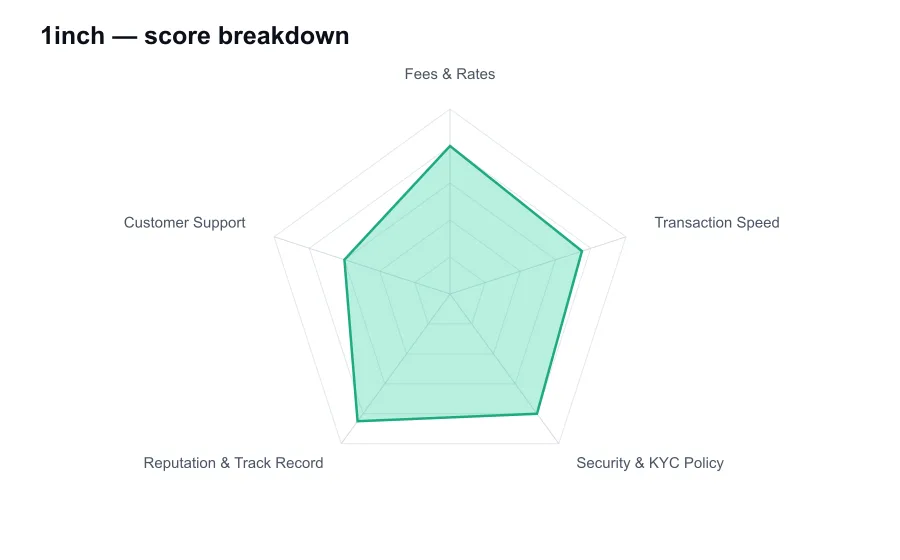
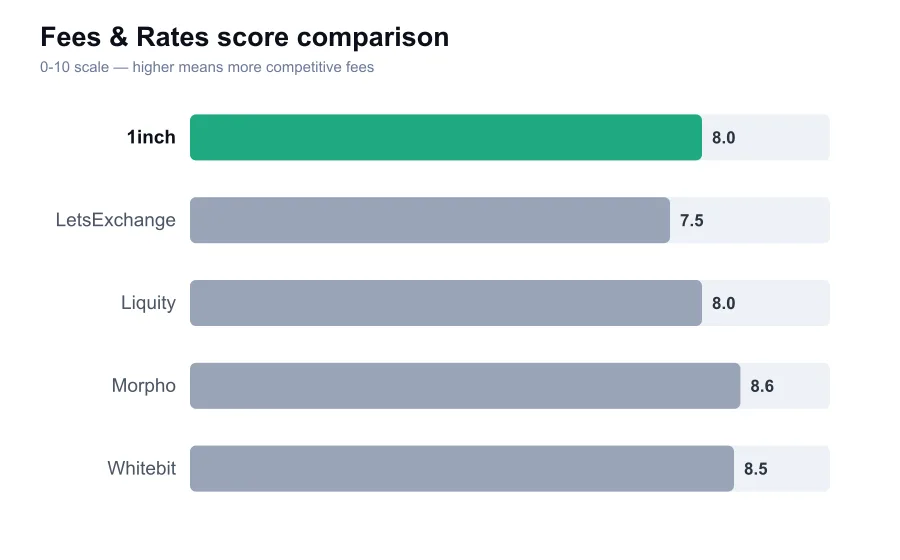
Fees are more nuanced than the common claim that 1inch is free. The aggregator generally does not charge a standard platform fee for ordinary swaps, but users still pay the underlying liquidity-provider fees and network gas. On Ethereum mainnet, gas can dominate the economics of a smaller trade. A trade with no visible 1inch commission can still be expensive after liquidity fees, price impact, wallet approval costs, and gas are included.
The right comparison is the final amount received, not the fee label. 1inch is especially valuable because it can compare routes and expose price impact before execution. Users should still check the quoted output against a direct swap on a major DEX, particularly for common pairs with deep liquidity. Aggregation is powerful, but a more complex route can occasionally cost more gas than the price improvement is worth.
For active users, the Fusion system is one of 1inch's more interesting ideas. Fusion uses resolvers to fill orders and can let users avoid paying network gas directly in the usual way, with execution mechanics and pricing handled through the protocol's design. It can be convenient, especially for users who dislike failed swaps and gas uncertainty. It is not magic. Execution may not be immediate, and users should understand the order terms rather than treating it as a guaranteed best-price button.
Speed depends on the network and route. On fast chains, a swap can complete in seconds or a few minutes. On Ethereum, confirmation depends on current gas conditions, and complex routes may require more computation. 1inch can optimize execution, but it cannot bypass block production, wallet signature steps, or chain congestion. If you need a fixed deadline for a payment, a DEX transaction is less dependable than an internal transfer on a centralized platform.
The platform's self-custody architecture is a major security advantage over leaving funds with an exchange. Users retain control of their private keys and approve transactions from their own wallet. There is no central 1inch balance for a hacker to raid in the usual exchange sense. That does not mean the system is safe by default. The greatest risk is often the user approving a malicious token, signing a phishing transaction, or granting an unnecessarily broad token allowance.
1inch has a meaningful security track record in the DeFi sector, with open protocol components, audits, bug bounty activity, and years of high-volume use. Its 2023 disclosure involving a vulnerability in an obsolete Fusion smart contract is a useful reminder that even experienced teams find flaws. The issue was handled publicly and did not become a broad user-fund catastrophe, but it reinforces the sensible rule: audited contracts reduce risk, they do not remove it.
KYC is generally not required to connect a wallet and use the core decentralized swapping tools. That is a genuine advantage for users who value privacy and global access. It also means 1inch is not a simple fiat gateway. You cannot normally deposit dollars from a bank account and start trading in the same seamless way as at a centralized exchange. Fiat features, if accessed through third parties, have their own location and verification requirements.
The interface is more polished than most DeFi tools, but it is still not beginner-proof. A new user must understand networks, token addresses, slippage settings, approvals, and the possibility of receiving a scam token that merely shares a familiar ticker. 1inch provides useful transaction previews, but no interface can protect a user who connects a compromised wallet or signs prompts without reading them. The learning curve is real and should not be minimized.
Reputation is one of 1inch's clearest strengths. It has been active since 2019, has become a major DeFi brand, and has remained relevant through several market cycles rather than disappearing after one incentive campaign. Its routing technology and developer-facing products have broad industry recognition. The 1INCH token's market performance is not a measure of whether the swap product works, and users should avoid confusing governance-token speculation with the utility of the aggregator.
Support is decent for a decentralized service but will disappoint anyone expecting a broker to fix a bad trade. 1inch offers a help center, documentation, community channels, and warnings around common scams. Support can explain how the protocol works or help investigate a transaction reference. It cannot reverse an executed swap, retrieve assets sent on the wrong chain, or restore a wallet whose seed phrase was exposed. That is the hard boundary of self-custody.
Compared with Uniswap, 1inch often wins on route discovery and price comparison, while Uniswap can be simpler for a direct, liquid pair. Compared with MetaMask Swap, 1inch gives users more direct visibility into routing and settings. Compared with a centralized exchange, it offers more control and less account friction but no conventional custody protection, fiat convenience, or dedicated account service. The best option depends heavily on trade size, chain, and user competence.
I rate 1inch highly as a tool, not as a place to park money or learn crypto from zero. It is excellent for users who already hold assets in a self-custody wallet and want competitive onchain execution across supported networks. The fee story is good only when gas and price impact are sensible, so users should never click through blindly. For a capable DeFi user, 1inch is one of the first tools I would check. For a novice buying their first $50 of crypto, it is more complexity than value.