WhiteBIT is a centralized crypto exchange headquartered in Europe and aimed at traders who want a broad spot market, fiat access, and a familiar exchange interface without paying the premium attached to the largest global brands. It has grown particularly visible in Eastern Europe, where its sports partnerships and local payment options have given it a stronger public profile than many readers in the US or UK might expect. This is a real exchange with meaningful liquidity, not a thinly branded instant-swap front end.
The product range is wider than its clean homepage initially suggests. WhiteBIT offers spot markets, margin trading in some jurisdictions, futures, staking products, launchpad-style token sales, crypto lending features, and a separate WhiteBIT Nova card offering in eligible European markets. That breadth is useful, though it also means the platform is no longer as simple as a beginner-only exchange. New users can buy crypto with a card, but active traders will spend most of their time in the order-book terminal.
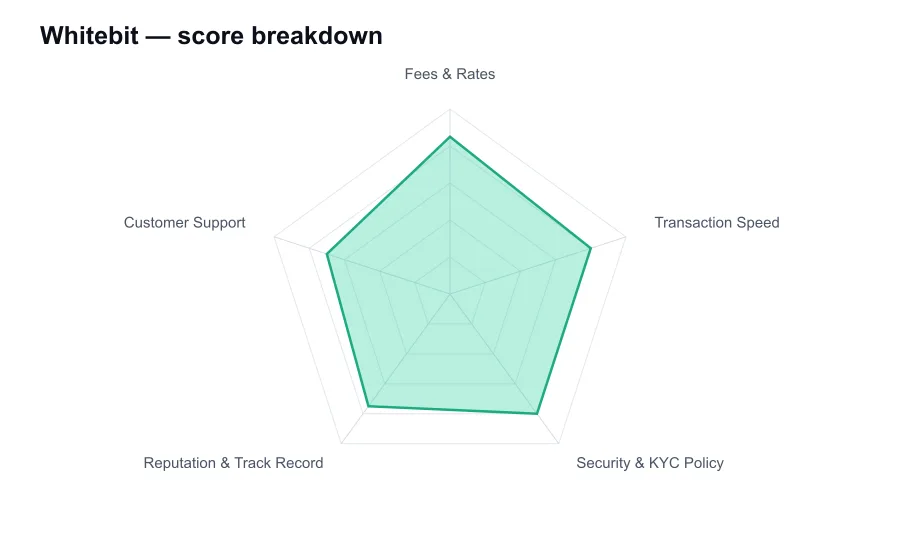
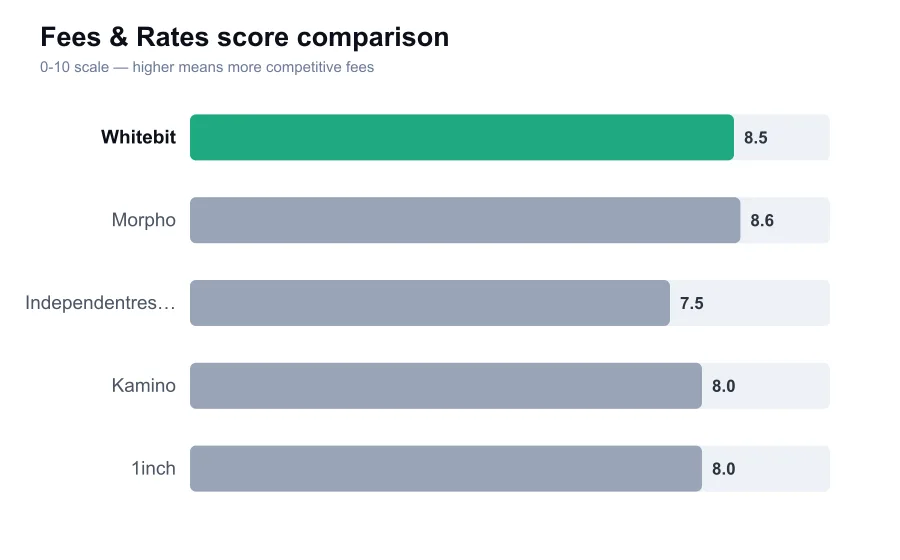
Its standard spot trading fee is one of the strongest reasons to consider it. WhiteBIT commonly charges up to 0.1% for maker and taker spot orders, below the basic rates at Coinbase and Kraken. Some pairs receive lower promotional pricing, and fee reductions are available through trading volume or holdings of the exchange's WBT token. The fee schedule is easy enough to find, which already puts it ahead of several smaller exchanges that hide the real cost behind a vague quote.
A 0.1% trading fee is genuinely competitive, but it is not the entire bill. Card purchases can be much more expensive because the payment processor and card issuer add their own costs. Fiat withdrawal fees vary with the rail and currency. Crypto withdrawals are where WhiteBIT can look less attractive, especially during periods of high network fees or on smaller assets where the exchange's fixed withdrawal charge is noticeable. Check the withdrawal page before depositing a token just because its trading fee looks cheap.
Liquidity is respectable on major pairs such as BTC, ETH, USDT, and several European fiat markets. For a normal retail trade, orders tend to fill cleanly and the spread is usually reasonable. That does not make WhiteBIT interchangeable with Binance, Coinbase Exchange, or OKX. Depth falls away faster on long-tail altcoins, and the displayed price can look better than the final execution once a larger market order starts eating through the book.
The matching engine feels responsive in routine trading. Spot fills are generally immediate after an order reaches the book, while deposits and withdrawals depend on the blockchain and the exchange's confirmation rules. A popular network transfer can arrive quickly, but it can still sit in review or wait for confirmations. WhiteBIT is not a magic shortcut around on-chain settlement. It is fast where an exchange can control the process, and merely normal where it cannot.
The platform offers both a straightforward conversion tool and a proper advanced interface. That distinction matters. The converter is convenient for small purchases, but traders who care about price should use limit orders on the exchange screen. A market order is transparent about its fill, while the conversion route can build the spread into the quote. WhiteBIT does not appear unusually abusive here, but convenience has a price on every centralized platform.
Security is one of WhiteBIT's better areas. The exchange promotes cold storage for most client funds, two-factor authentication, anti-phishing tools, address whitelisting, session management, and regular security monitoring. It has also publicized proof-of-reserves reporting and participation in security programs. Those are good signs, but proof of reserves is not the same as a complete audited balance sheet, proof of liabilities, or a guarantee that every operational risk has disappeared.
WhiteBIT requires identity verification for meaningful use of fiat services and for full account functionality. That policy will frustrate users who want a no-KYC venue, but it is more honest than platforms that advertise anonymity and then freeze a withdrawal for documents. Expect standard personal information, identity documents, and potentially source-of-funds questions if activity triggers compliance checks. US residents and users in restricted jurisdictions should not assume access, because availability changes by location.
Its track record is solid enough to take seriously, though not beyond criticism. WhiteBIT was founded in 2018 and has survived several ugly market cycles that eliminated plenty of smaller exchanges. It has pursued a regulated, partnership-heavy image and obtained registrations or authorizations in a number of markets. Still, it does not have the decades-long operating history of traditional finance, and its reputation is strongest in its home regions rather than universally established worldwide.
The company has attracted attention through partnerships with football clubs and public campaigns, which helps brand recognition but says little about custody quality. What matters more is that WhiteBIT has continued operating through volatility, maintained an active market, and not developed the sort of catastrophic public failure associated with collapsed offshore exchanges. I would treat that as a positive data point, not as permission to leave a life-changing balance on any exchange.
Customer support is available around the clock through live chat and ticket channels, and the help center covers basic verification, deposits, security, and trading questions fairly well. Straightforward problems are often handled quickly. The less flattering reports tend to involve KYC reviews, payment disputes, or frozen withdrawals, where support can feel procedural and slow. That pattern is common across centralized exchanges, but it is especially frustrating if you moved funds before understanding the compliance rules.
WhiteBIT is best used with a little discipline. Secure the account with app-based two-factor authentication, enable withdrawal whitelist protection, keep records of deposits, and test a small withdrawal before moving a large balance. Use the exchange for trading and fiat access, then consider self-custody for longer-term holdings. The platform provides the controls, but it cannot protect someone who ignores them.
My view is that WhiteBIT is a good value exchange for an active European retail trader who wants low spot fees and a more conventional regulated-service experience than the anonymous swap sites offer. It is less compelling for deep institutional execution, for users who refuse KYC, or for people whose only criterion is the absolute lowest withdrawal charge. The product is credible, polished, and competitively priced, but it should be treated as an exchange account, not a permanent vault.