LetsExchange is one of the more substantial instant-swap platforms, positioned as a liquidity aggregator rather than a conventional trading venue. It lets users convert cryptocurrencies from their own wallets without maintaining a custodial account, and it has built a large asset catalog around that model. For people who want access to many chains without learning several exchange interfaces, it is a credible and established option.
The company launched in 2020 and has expanded beyond a simple website into partner and API integrations. That matters because an instant exchange becomes more useful when it appears inside wallets, payment services, or crypto applications rather than requiring users to visit a separate site every time. LetsExchange has made a serious effort to occupy that infrastructure layer, which gives it more weight than a basic clone-style swap page.
The selection is extensive, with thousands of coins and tokens and a very large number of available exchange directions. Major assets are covered, but the real appeal is the long tail: users can often swap assets across different networks without manually selling into a central stablecoin pair first. Availability can change, particularly for low-liquidity tokens, but the catalog is among the stronger points of the service.
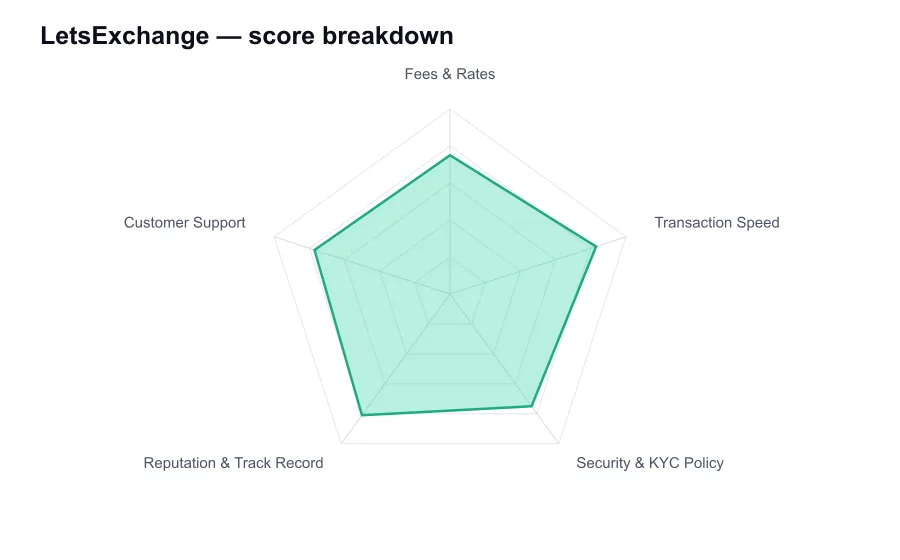
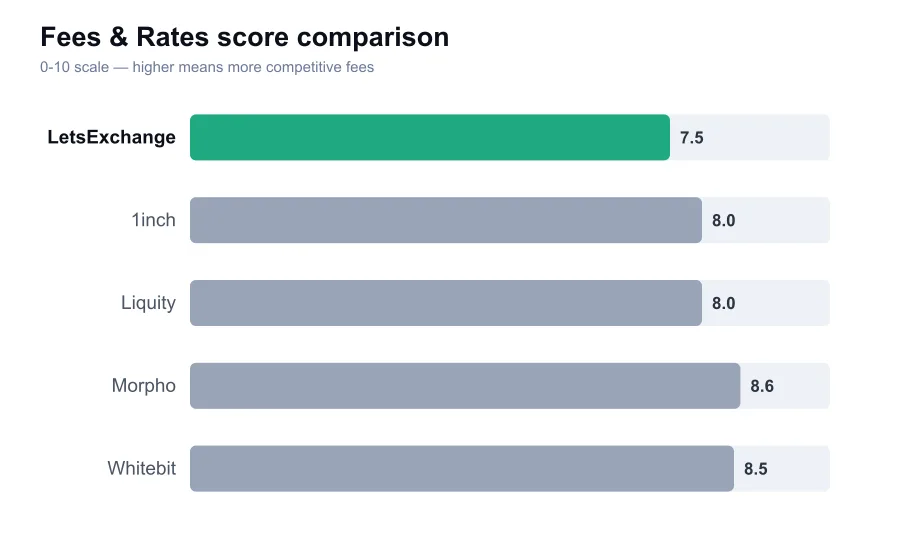
Pricing is based on a quote rather than a posted maker-taker schedule. LetsExchange draws from multiple liquidity sources, then presents the amount expected at the destination address. Its rate contains the market price, liquidity-provider economics, network costs, and the platform's own margin. This is the correct model for convenience swaps, though it means claims of low fees should always be tested against the actual output.
The platform offers floating-rate and fixed-rate exchanges. A floating transaction follows market conditions while it is processed. A fixed transaction locks the expected output for a stated window and typically reflects a premium for that certainty. This choice is not cosmetic. In a rapidly moving market, fixed execution may save more than it costs. In a stable market for a small amount, a floating quote may be the better value.
LetsExchange is usually competitive on liquid routes, but it is not automatically the winner. It often competes well with SimpleSwap and ChangeNOW, while a user with verified access to Kraken, Coinbase Advanced, or Binance may still obtain tighter execution through an order book. That comparison is not entirely fair because those exchanges demand an account and more trading steps. Convenience has value, but it is still a cost.
The most honest fee assessment is that LetsExchange is transparent about the quote, not necessarily transparent about every component behind it. Users are shown what they are expected to receive before sending, which is good. They are not usually given an itemized invoice separating spread, provider fee, and service margin. For most users, the net result is enough. For large transactions, lack of itemization is a reason to compare several providers.
Transaction speed is generally strong. On fast chains and liquid pairs, swaps can be completed in a matter of minutes after the deposit reaches the required confirmation threshold. Bitcoin and Ethereum activity can extend that timeline, while a cross-chain conversion may involve more than one network's operating conditions. LetsExchange processes its part quickly in normal conditions, but it cannot remove blockchain settlement delays.
The platform's status tools and order information make the workflow easier to audit than a bare-bones exchanger. That is valuable if a transaction is delayed, because users can identify whether the deposit has arrived, whether the exchange is processing, or whether the payout is pending. Still, no tracker replaces careful preparation. Use the correct network, meet the deposit minimum, and do not attempt to send tokens to an address format the receiving wallet cannot support.
LetsExchange is commonly used without account registration. That is a practical privacy and security benefit, since there is no persistent exchange balance or routine password account to protect. It does not mean every transaction is beyond compliance controls. The service states that it may request KYC or supporting information where its anti-money-laundering process identifies risk. This is a standard conditional model, and users should plan around that reality.
The platform's non-custodial language also needs a precise reading. LetsExchange does not operate like a deposit-taking exchange where a customer stores a portfolio indefinitely. Funds are nevertheless sent into a transaction process, and the user depends on LetsExchange and its partners to deliver the outgoing asset. It reduces long-term custodial exposure. It does not eliminate counterparty risk during the swap itself.
Reputation is one of LetsExchange's better categories. It has been visible for years, supports a substantial partner network, and has gathered a meaningful volume of public user feedback. That does not mean every review is glowing. Complaints about delayed orders, rate changes on floating swaps, or compliance reviews appear across the entire sector, including here. The difference is that LetsExchange has more operational history against which those complaints can be judged.
The company also benefits from being known to wallet and crypto-service partners, although an integration should never be read as a guarantee of every individual transaction. It is simply a stronger signal than a site with no external footprint. For a user deciding between several unfamiliar instant exchangers, that history and distribution give LetsExchange a real advantage. I would still test a route before moving a significant amount.
Customer support is available through live chat, email, and an extensive help center. In straightforward cases, the team has a reasonable reputation for responding with transaction-specific guidance. Difficult cases can take time, especially when a partner exchange, a blocked deposit, or a recovery process is involved. Users should approach support with evidence rather than anger: the order ID, transaction hash, addresses, amount, time, and screenshots of the quote.
LetsExchange's API and widget options deserve mention because they explain why it appears in more places than some competitors. Businesses and wallet developers can use the service's exchange infrastructure rather than build their own liquidity-routing system. That does not directly improve a retail quote every time, but it indicates a platform thinking beyond one-off website traffic. It is a meaningful sign of maturity in a category full of interchangeable interfaces.
For the typical self-custody user, LetsExchange is a strong convenience choice. It has broad coverage, sensible quote options, decent operational transparency, and a better-established record than many newer aggregators. The downside is familiar: you pay for simplicity through variable spreads, and a compliance review can still interrupt the account-free experience. Neither issue is fatal, but both should affect the size and urgency of a transaction.
My take is that LetsExchange belongs near the top of the instant-exchange shortlist, especially for users who need unusual pairs or cross-chain routing. It is not where I would go for professional trading execution, deep reporting, or maximum legal certainty. It is where I would go to move assets efficiently from one self-custody wallet position to another after checking the final quote. That is a narrower endorsement than marketing language suggests, but it is a solid one.